

First time since 1992 at the Fed
A Washington governor just voted for a hike →
October 29, 2026
·
11 Min Read



The briefing serious investors read first.
Free analysis before markets open. Start thinking in decades, not days.
Join 45,000+ readers · No spam · Unsubscribe anytime · No card needed
Before we begin: this report is for education, not financial advice. Nothing here is a recommendation to buy or sell any stock, company, or asset, and we make no price predictions. Investing carries risk, including loss. Please read the full disclaimer at the end.
Today’s Big Picture
The Fed changed one word yesterday.
In September, its statement said the economy was growing at a “solid” pace. Yesterday, it said “strong.”
Then it held rates at 3.75% to 4% anyway, and stocks barely noticed. The S&P 500 rose 0.28%.
Bonds did care, on the other hand. The 10-year Treasury yield closed back above 5%, its biggest one-day rise in a month, while the 2-year yield, the one that tracks the Fed most closely, barely moved.
When the Fed holds still in an economy it calls strong, the bond market does the tightening.
This morning, two reports tested that word. The economy grew at a 3.4% annual pace last quarter, faster than the 3.2% economists expected. September’s PCE inflation came in at 3.6%, right on forecast.
It’s a full day after that. The European Central Bank decided at 9:15 a.m., a day after Christine Lagarde said she’ll step down early, in February. Amazon reports after the close.
Below, Tan Gera on why the move he cared about yesterday happened in bonds.

The 10-Year Just Closed Above 5%. Washington Can’t Afford for It to Stay There.
America owes more than $40 trillion, and the interest alone already runs past $1 trillion a year. Every time the 10-year yield climbs, as it did yesterday, new borrowing gets more expensive.
At this scale, cutting, taxing or inflating its way out won’t close the gap. That leaves growth, and Washington is betting on AI to deliver it.
Tan Gera, DM’s co-founder and a CFA charterholder, walks through what that means for your money in a free online briefing. You’ll see the AI-linked asset class sitting in the path of all that spending, why the debt makes the bet so hard to walk back, and the 3-phase ABN system he uses to position for it.
It’s built for people who’ve never invested outside a 401(k). Stay to the end and the ABN Wealth System Guide is yours, free.
Watch Tan’s free briefing here…
Signal vs. Noise
Two Dissents. One Came From Washington.
- The noise: the Fed held, as about 9 in 10 traders expected.
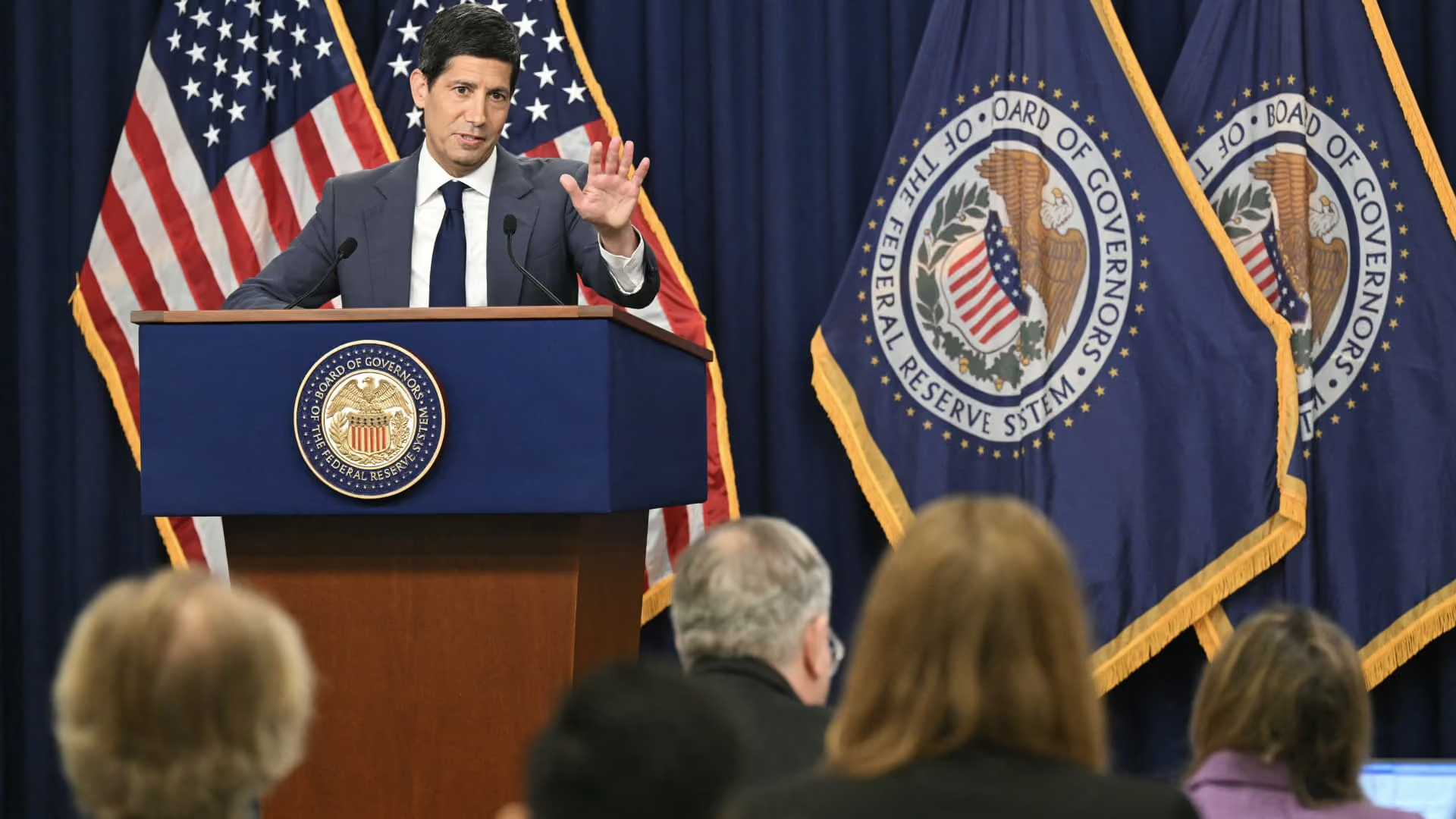
- The signal: who voted against it. Cleveland’s Beth Hammack dissented for a hike, as expected. Lorie Logan and Neel Kashkari, who both dissented in July, voted to hold.
The second dissent came from Lisa Cook, one of the governors on the Fed’s board in Washington. According to Fortune, it’s the first time since 1992 that a governor and a regional Fed president dissented together.
Futures still put a December hike at roughly 4 in 5, about where they were before the meeting.
For beginners: governors vote at every meeting, while only some regional presidents vote each year. A governor dissenting means the case for a hike now has a vote at the center of the Fed.
Read the Line Under the GDP Headline
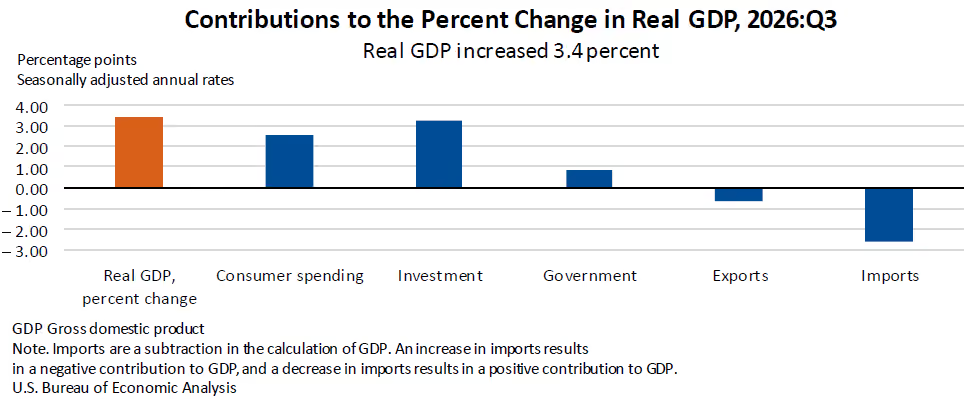
- The noise: the headline GDP number. The economy grew at a 3.4% annual pace last quarter, up from 2.2% in the spring.
- The signal: a line further down called final sales to private domestic purchasers. It leaves out trade, inventories and government, and counts what American households and businesses bought. That grew at 4.9%, even faster than the headline.
Why the gap? Much of the AI build-out runs on imported chips, and the GDP math subtracts imports, even when those chips end up in American data centers. Last quarter, imports rose while exports fell.
For beginners: when the headline and the line under it disagree, the line under it tells you more about demand. That’s the line the Fed is reading.
Same Night, Opposite Verdicts
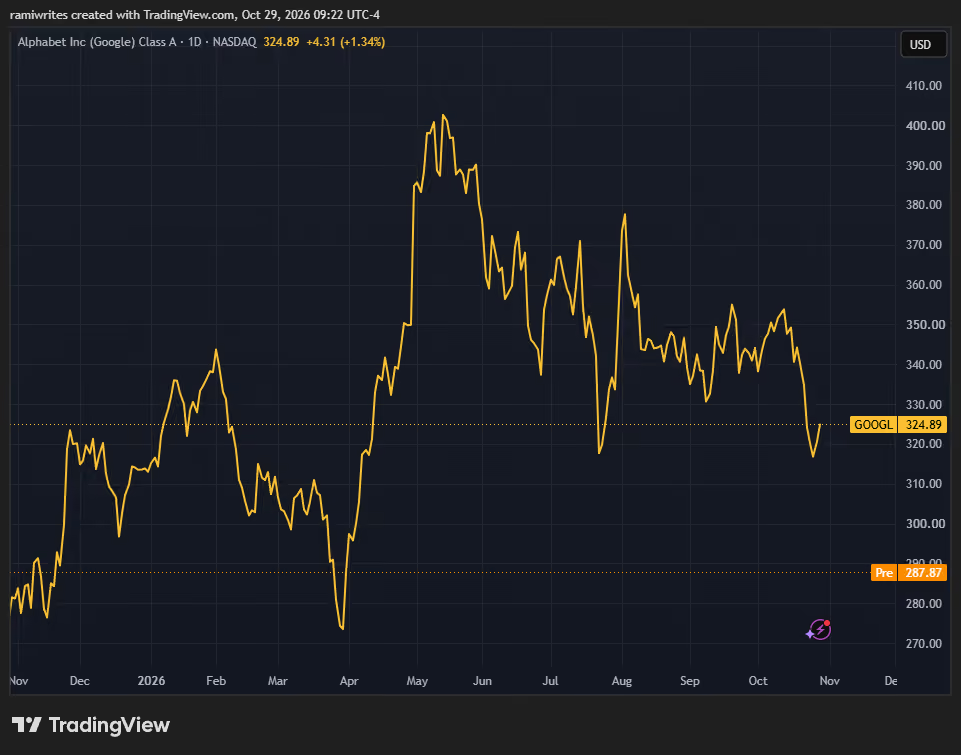
- The noise: Microsoft beat earnings estimates and Alphabet missed.
- The signal: cash. Microsoft brought in $18.6 billion of free cash flow and rose about 3.5% before the open.
Alphabet spent $51.4 billion on its build-out in a single quarter, more than twice as much as a year ago. Its free cash flow turned negative at −$9.1 billion. It raised $28.7 billion in bonds and $12.4 billion in new shares, paused its buybacks and fell about 10% before the open.
Meta’s free cash flow turned negative last week too. Amazon reports tonight.
For beginners: free cash flow is what’s left after a company pays its bills and its build-out. Right now, investors reward AI spending that pays for itself and mark down spending that needs borrowed money.

Featured Contributor
Today’s guest is Tan Gera, co-founder of Decentralized Masters and a CFA charterholder. He writes The Macro Letter, where he publishes his own buy and sell levels before markets reach them. Everything below describes his own portfolio. Nothing in this section is a recommendation.
The Fed Held. The Bond Market Didn’t.
Yesterday at 2 p.m., the Fed did exactly what the market expected. It held its range at 3.75% to 4%.
Stocks barely budged. The S&P 500 finished up 0.28%, its third straight gain.
If you only watched stocks, you’d think nothing happened. I watched one more number.
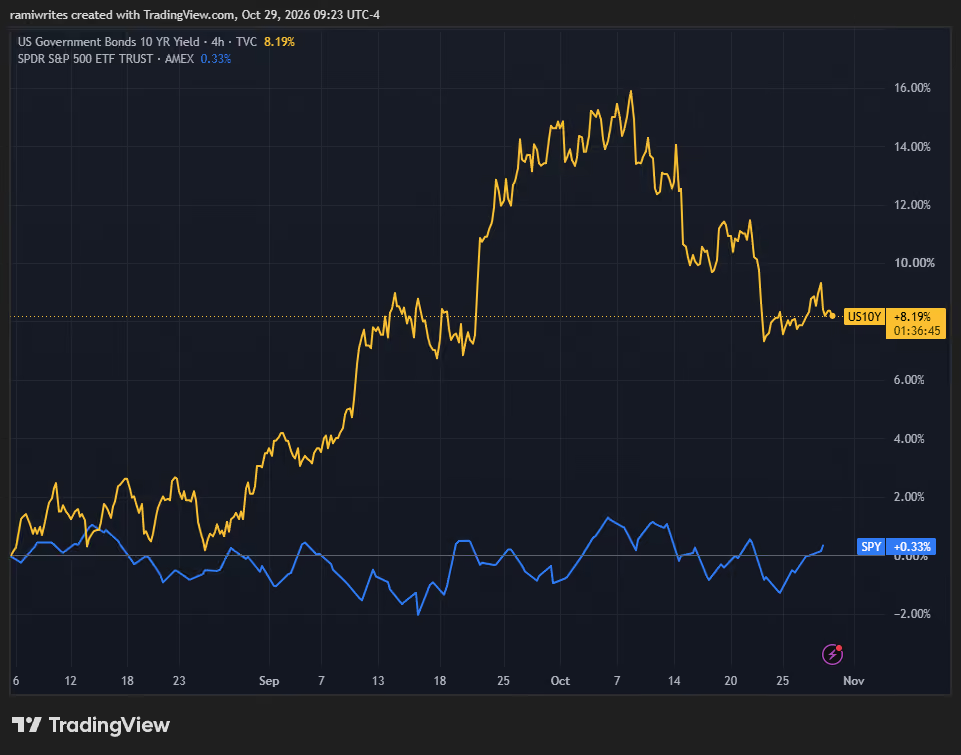
The 10-year Treasury yield rose about five-hundredths of a percentage point and closed above 5%. The 2-year, which tracks the Fed most closely, barely moved.
That gap tells the whole story of the day.
Two rates, two bosses
The Fed controls short-term rates. The market sets long-term ones, and those are what you pay on a mortgage and what a company pays on its bonds.
Yesterday, the short end said the Fed is on hold for now. The long end said this economy is running hot, and lenders want more to tie up their money for 10 years.
Rate-sensitive stocks heard it. Utilities fell 0.8% and real estate fell 0.7% while tech rose.
The Fed held still yesterday, and the bond market tightened for it.
One word told you why
In September, the Fed’s statement said the economy was growing at a “solid” pace. Yesterday, it said “strong.”
Kevin Warsh, who runs the Fed, added his own read. The third quarter, he said, “appears to have brought an even more rapid advance, led by healthy consumer spending likely running above 3% growth.”
The statement also dropped the line saying September’s hike would “support a timelier return” to 2% inflation. In its place: the Fed will let “the accumulation of more information” decide.
In plain English: we’re watching, and we’re promising nothing. I listened for the word “December” all afternoon. Warsh never said it, and told reporters he doesn’t believe in forward guidance outside a crisis.
Two votes for a hike, a stronger word for growth and no promises about what comes next. That’s a Fed holding still in a speeding economy, and the bond market priced it that way.
This morning’s test
At 8:30 this morning, two reports checked whether “strong” was the right word.
The first was third-quarter GDP. The economy grew at a 3.4% annual pace, faster than the 3.2% economists expected and up from 2.2% in the second quarter.
I don’t stop at the headline. A lot of the AI build-out runs on imported chips, and imports get subtracted in the GDP math. So I go one line down, to what American households and businesses bought. That grew at 4.9%, up from 4.6% the quarter before.
The second was September’s PCE inflation, the Fed’s preferred gauge. It came in at 3.6% over the past year, with core at 3.1% and a monthly core gain of 0.3%. All three matched forecasts.
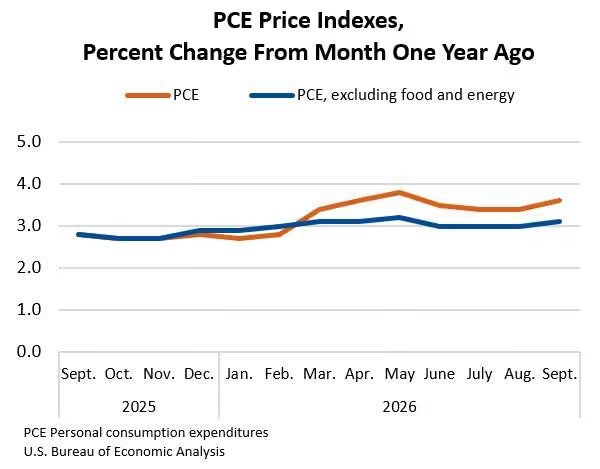
That monthly number is the awkward one. JPMorgan’s Michael Feroli pointed out that the Fed hiked in September after a two-tenths monthly core reading, and held yesterday with three-tenths on the way. This morning, three-tenths is what arrived.
There was one soft spot. After inflation, September spending was flat, and spending grew faster than income, so households saved just 3.8% of what they earned.
Still, a strong quarter plus a hot monthly reading is how December goes from likely toward certain.
What it means for my plan
The 10-year is the price of money for nearly everyone. When it stayed above 5% earlier this month, pending home sales fell to their lowest since records began.
It matters for stocks too. Last night, Alphabet told investors it raised $28.7 billion in bonds to help pay for its build-out. Every one of those dollars costs more with the 10-year above 5%.
None of my orders filled yesterday, and I didn’t touch any of them.
My next S&P 500 order is at 7,450, about 3.8% below Wednesday’s close, with more below it down to 6,400. On Bitcoin, it’s $72,000, roughly 10% below where it trades, and my weekly buy keeps running through Dec. 31. On gold, I bought at $4,000 last week, and my next sells sit at $4,720 and $5,000.
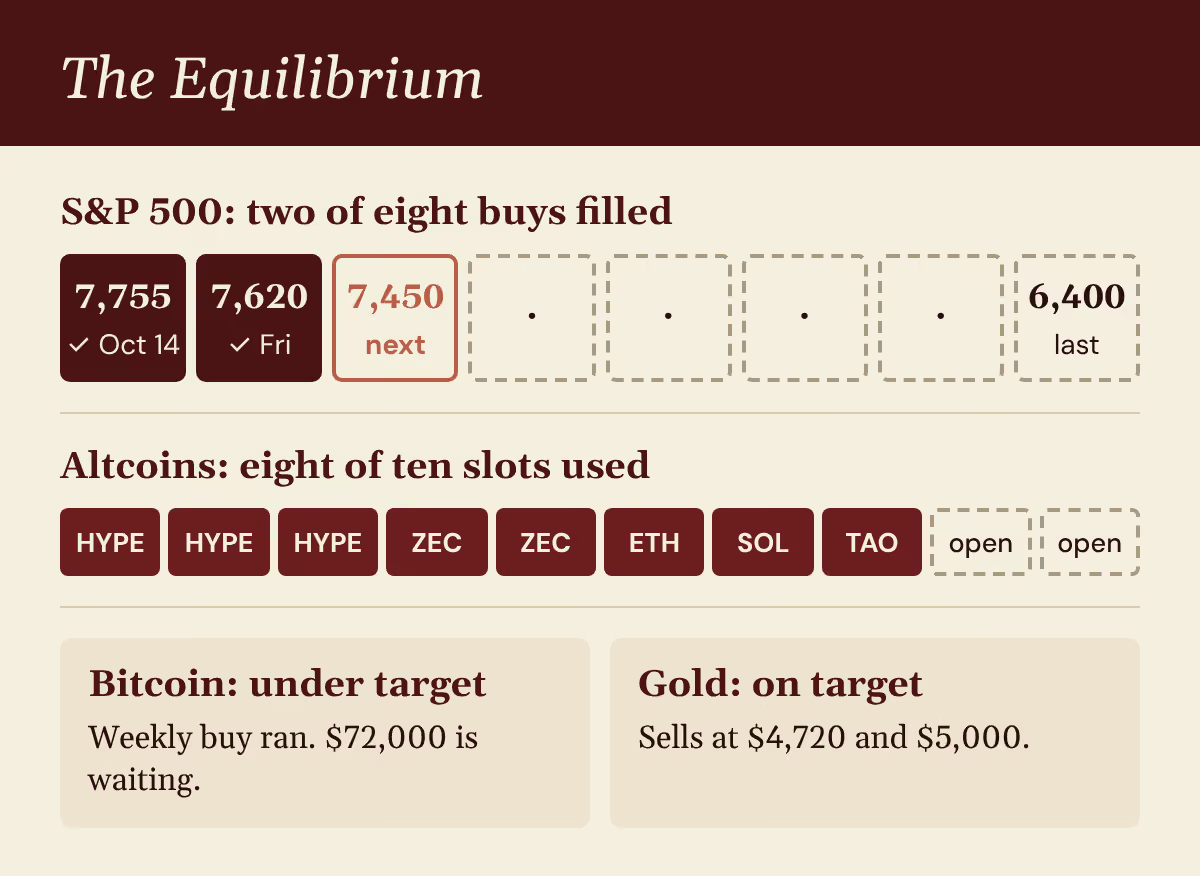
Higher long-term rates tend to weigh on stock valuations. If the 10-year keeps climbing while the Fed holds still, my S&P orders are where that pressure would show up. If yields ease after this morning, my weekly buy keeps going and I leave the rest alone.
Three things I’m watching
- Whether the 10-year stays above 5% after this morning’s reports
- Nov. 4: Treasury lays out its borrowing plans, and the bigger bond buybacks it started in September are scheduled to end
- Dec. 9: the Fed’s next decision, with new projections
Every level above is in The Macro Letter, written down before the market got there, misses included. If any of them change after this morning, that’s where I’ll put it.
The Fed stood still yesterday. The price of money kept moving.
- Tan Gera
Co-founder, Decentralized Masters | The Macro Letter
Positions described are Tan’s own portfolio, shared for transparency, and are not a recommendation to buy or sell any asset. Past performance is not indicative of future results.
Tan Read the Bond Market Yesterday. Twice a Week, He Shows You What He Sees.

Yesterday, most investors watched the Fed and saw a quiet day. Tan watched the 10-year yield climb back above 5%, and you just read what that means for his plan.
He does that twice a week in The Macro Letter.
The Macro Letter is Tan’s own newsletter. He’s a co-founder of Decentralized Masters and a CFA charterholder. Each issue follows one story across rates, oil, stocks, gold and digital assets. It’s written in plain English, and every term is explained the first time it comes up.
Here’s what you get that most market commentary doesn’t give you:
- His own levels, in advance: the exact prices where he’d add to or trim his own portfolio, written down before the market gets there
- His calls, graded: past calls checked in the open, misses included
- One clear thread: the story that matters most that week, followed through to what it means for your money
Today’s piece is one of those threads in short form. The Macro Letter is where he keeps following it: through the Nov. 4 Treasury refunding, the Fed’s Dec. 9 decision and every level he’s watching along the way.
Positions described are Tan’s own portfolio, shared for transparency, and are not a recommendation to buy or sell any asset. Past performance is not indicative of future results.
Final Thought
Most people will remember yesterday as the day the Fed did nothing.
The S&P 500 barely moved, so it looked that way.
Meanwhile, two officials voted for a hike, the Fed upgraded its word for growth and the 10-year climbed back above 5%.
The quiet number on your screen isn’t always the important one.
Tonight brings Amazon. Next week is loud by design: America votes on Nov. 3, and Treasury sets out its borrowing plans on Nov. 4.
The best time to decide what you’ll do is before the noise starts.
See you tomorrow.
Editor in Chief | Future Finance
Everyone’s Chasing The AI Stocks. The Smarter Question Is What’s Underneath Them.
You just read what happened to Alphabet last night. It’s spending so much on AI that it borrowed and sold new shares to cover it, and its stock dropped about 10% before the open.
Here is the part most investors never step back far enough to see.
America is carrying more than $40 trillion in debt, and the interest bill alone now runs past $1 trillion a year. Growth is the only realistic way out. And the government is betting on AI to deliver it.
That bet has to run through one specific asset class before a single model gets smarter.
Institutions like Goldman Sachs and BlackRock are already pointing there, and our research team just put the whole case into one free presentation.
Watch the free AI presentation right here…
Disclaimer: This content is not financial advice, it is for informational purposes only. All investments involve inherent risk. Any financial decisions you make are solely your responsibility.
Latest



Editor's Picks

Become a sharper capital allocator in 5 minutes a day.
Institutional-grade research on where the smartest capital is positioning, across AI, energy, biotech, robotics, and digital assets. Distilled into a daily read you finish before your coffee does.
Join 45,000+ readers · No spam · Unsubscribe anytime · No card needed