

40% Will Fail. The Other 60% Capture The Profit. A Map of the AI Stack.
Who actually captures the value when software starts running itself
7 min read




The briefing serious investors read first.
Free analysis before markets open. Start thinking in decades, not days.
Join 45,000+ readers · No spam · Unsubscribe anytime · No card needed
Before we begin: this report is for education, not financial advice. Nothing here is a recommendation to buy or sell any stock, company, or asset, and we make no price predictions. Investing carries risk, including loss. Please read the full disclaimer at the end.
From chatbot to coworker
For a couple of years, most people met artificial intelligence as a clever assistant. You typed a question, it typed an answer, and there the interaction ended.
Useful, sometimes astonishing, but fundamentally passive. It waited for you.
Something more consequential is happening now.
AI is starting to act. Instead of just answering, the newest systems can be handed a goal, "book this trip," "reconcile these invoices," "research these suppliers and draft the report," and then take the steps to accomplish it, calling other software, making decisions, and adapting when something goes wrong.
The industry calls this agentic AI: AI that behaves less like a chatbot and more like a coworker who actually does the task.
This shift is genuinely large, and a great deal of money is moving to position for it. Which raises the question that matters for anyone trying to understand the opportunity.
But here's what everyone is missing in the headlines…
The headlines obsess over which AI is smartest.
The more useful question, the one serious investors actually ask, is "when all this works, who gets paid?"
In any technology gold rush, the company with the flashiest product is often not the one that captures the lasting profit. Understanding the layers of how agentic AI is built, and where money tends to pool versus where it tends to evaporate, is far more valuable than knowing which model topped a leaderboard this week.
This report gives you that map. None of it is a stock recommendation.
It is a way of seeing the whole field.
The gold rush principle
Start with a piece of history that explains the entire report.
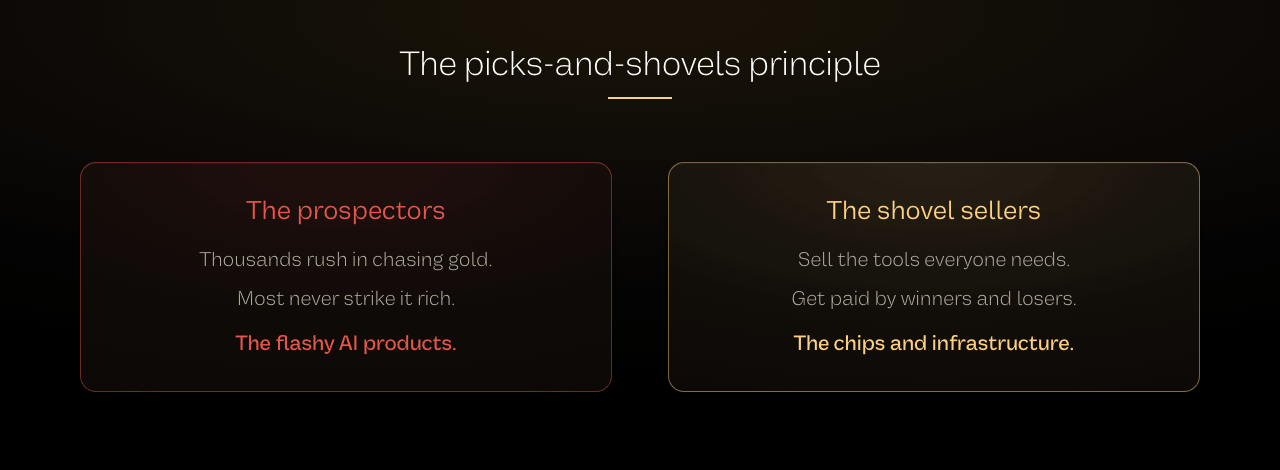
During the California Gold Rush, tens of thousands of prospectors rushed west to strike it rich.
Most of them never did.
The people who reliably made money were not the miners at all.
They were the merchants who sold the picks, shovels, boots, and supplies that every prospector needed, whether or not that prospector ever found gold.
This is the single most useful idea in technology investing, and it has a name: picks and shovels.
When everyone is rushing toward a new frontier, the most dependable profits often go not to the adventurers but to the people supplying the tools the adventurers cannot do without.
Agentic AI is a gold rush. Thousands of companies are racing to build AI products, and like the prospectors, most of them will not strike gold.
So the smart question becomes: in this particular gold rush, who is selling the picks and shovels, and who is panning hopefully in the river?
The same pattern repeated in the early internet. The first wave of flashy websites mostly went bust, while the companies selling the networking equipment, the routers and switches that every website needed regardless of whether it survived, made fortunes during the build-out.
The lesson is not that the exciting products never win. Some do, spectacularly.
It is that betting on the toolmakers is often the steadier way to gain exposure to a frenzy, because they get paid up front by everyone, winners and losers alike.
To apply that lesson to AI, you need to see the layers.
ABN System
You've just seen the map. Here's the system for navigating it.
Understanding the stack is the insight. Building a portfolio that captures the right layers, without overpaying for the ones with thin margins, is the discipline. Our free ABN System training walks through the three-part framework we use to do exactly that.
Watch the ABN System training →The stack, from the ground up
"The stack" is just the industry's word for the layers of technology piled on top of one another to make agentic AI work. Picture a building. Each floor rests on the one below it, and value is distributed unevenly between the floors.
Let us walk up from the basement.
The ground floor is the chips. At the very bottom are the specialized computer chips that do the immense calculations AI requires.
Every AI system, no matter whose, ultimately runs on this hardware.
These chips are the purest picks and shovels in the whole rush, because whoever wins the race to build the best AI, they all need to buy them.
The next floor is the cloud and infrastructure. Almost nobody buys those chips and runs them in their own basement.
Instead they rent computing power from a handful of giant providers who operate vast data centers full of the chips.
This floor also includes the physical necessities that turn out to matter enormously: the electricity and the cooling those data centers consume, a constraint so important we devote a separate report to it.
Above that sit the foundation models. These are the large, general-purpose AI brains, trained at staggering cost, that can understand language and reason about problems.
They are the engines everything else is built on. This floor produces the headline-grabbing names and the most dramatic competition.
Next is the orchestration and tools layer. A raw AI brain is not yet an agent.
To act in the world, it needs connective tissue: software that lets it remember things across steps, break a big goal into smaller tasks, safely reach out to other tools and databases, and coordinate with other agents when a job is too large for one.
This plumbing is what turns a clever model into something that can actually finish a multi-step task without a human nudging it along at every turn. It is unglamorous, and it is also where a lot of the practical difficulty, and therefore a lot of the real engineering value, currently lives.
At the top floor are the applications. This is where an ordinary person or business finally touches agentic AI: the specific product that books the travel, runs the customer service, or automates the accounting.
It is the finished experience built on top of every floor below.
Five floors: chips, cloud, models, orchestration, applications.
The insight that matters is that profit does not spread evenly across them, and where it pools is rarely where the excitement is.

Where the money tends to pool, and where it tends to evaporate
Here is the counterintuitive heart of the whole subject.
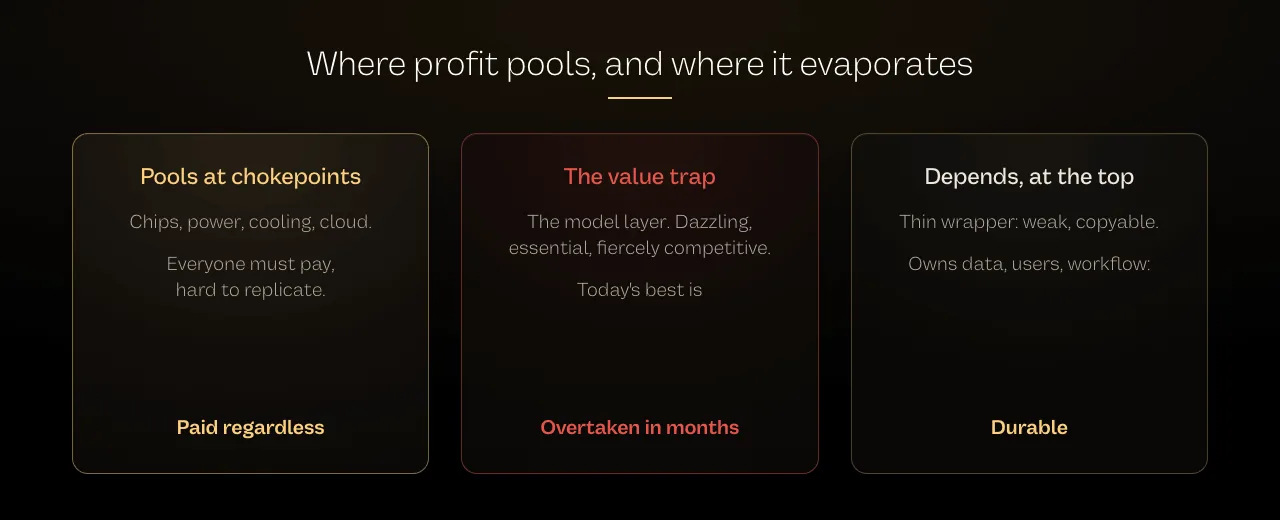
So far in this boom, an enormous share of the actual profit has accrued to the bottom of the stack, the picks and shovels, rather than the glamorous top.
The chip makers and the infrastructure providers have captured extraordinary margins, because every single competitor at every higher floor has to pay them, no matter who ultimately wins.
Hyperscale providers have committed hundreds of billions of dollars in spending, and a remarkable amount of it flows straight down to the hardware and infrastructure layers.
In a gold rush, the shovel sellers get paid first.
The foundation-model floor is more treacherous than it looks.
Building these AI brains is breathtakingly expensive, and they increasingly resemble one another in capability. When several competitors offer something similar, prices fall and margins get squeezed.
Analysts have started to describe parts of the model layer as a potential "value trap": dazzling, essential, and yet a difficult place to earn durable profit, because the competition is ferocious and today's best model is overtaken in months.
The application floor is where the long-term picture gets interesting.
A thin product that just wraps someone else's AI brain, adding little of its own, has a weak position; anyone can build the same thing, and the model underneath can simply absorb its function.
But an application that owns something genuinely hard to copy, deep access to a particular industry's data, a base of loyal users, a workflow customers are locked into, can build a durable, profitable business on top of all those floors.
Real users paying for real outcomes is, in the end, where a lot of value has to land.
The thread running through all of it: durable profit tends to migrate toward chokepoints, the spots that everyone must pass through and that are genuinely hard to replicate.
Today many of those chokepoints sit at the bottom of the stack, in chips and the power and cooling that feed them.
Over time, some of that margin may migrate upward as hardware becomes more abundant and competition shifts.
Watching where the chokepoints are is how you follow the money.
Gems Uncovered
You know the map. We track the names.
Knowing which layers of the AI stack capture the value is the framework. Finding the specific names positioned at those chokepoints, at prices that make sense, is the work. Gems Uncovered surfaces one high-conviction idea each week across the AI value chain, with the full reasoning and risks.
See how Gems Uncovered works →The honest counterweight: most of this will not work
A report that only sold you the excitement would be lying by omission.
So here is the sober half, and it is essential.
For all the genuine promise, a large share of agentic AI projects are going to fail.
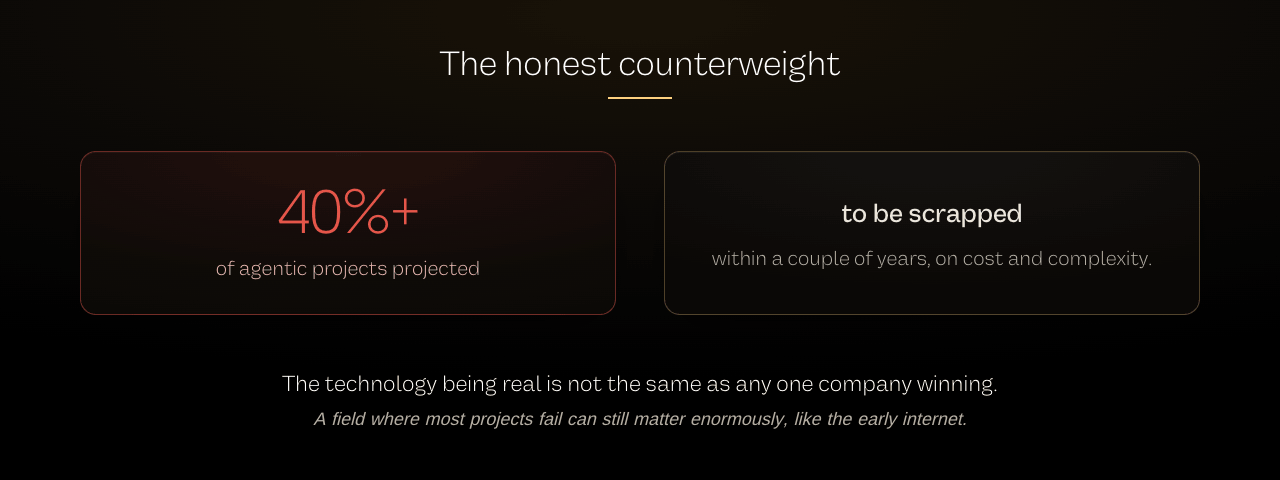
Industry analysts have projected that more than 40% of agentic AI initiatives will be scrapped within a couple of years, undone by costs that spiral, complexity that overwhelms, and the simple fact that letting software act autonomously introduces dangers that letting it merely answer questions did not.
Those dangers are real and specific.
An agent that takes actions can take wrong actions, at scale and speed, before a human notices. It can be manipulated into doing things it should not. It can confidently make a mistake and then build further steps on top of that mistake.
This is why an entire sub-industry is emerging just to supervise other AI agents, to check their behavior and catch them before they cause harm.
The need for that watchdog layer tells you how unsolved the risks still are.
For an investor, this is an indispensable caution.
A field where most individual projects fail can still be enormously important in aggregate, the early internet was exactly that, but it means the average bet is far more likely to disappoint than the breathless coverage suggests.
The technology being real does not make any particular company a winner. Many will be cautionary tales, and separating the two in advance is genuinely hard.
How to think about this for yourself, for free
This is the part you can act on the moment you finish reading. None of it requires buying anything, and the tools are free.
1. Always ask which floor you are looking at.
When you encounter an AI company or product, locate it on the stack. Is it selling picks and shovels at the bottom, building a fiercely contested model in the middle, or running an application at the top?
The floor shapes the economics more than the marketing does.
What to look for: whether the business sits at a chokepoint everyone must pay, or in a crowded layer where competition erodes profit.
2. Hunt for the chokepoint.
For any company, ask the picks-and-shovels question: does it get paid no matter who wins the layer above it? A chip maker gets paid whichever model wins. A power supplier gets paid whichever data center expands.
That "paid regardless" quality is a sign of a durable position.
What to look for: a genuine bottleneck that is hard to replicate, rather than a product a competitor could clone next quarter.
3. Be skeptical of thin wrappers.
The most crowded and fragile spot is a product that simply adds a thin layer over someone else's AI brain. Ask what a company truly owns that others cannot easily copy: proprietary data, locked-in customers, a real workflow.
If the answer is "nothing much," the position is weak however slick the demo.
What to look for: a defensible moat, not just a polished interface over a model anyone can rent.
4. Discount the hype by the failure rate.
Hold every exciting claim against the reality that a large share of these projects will fail. Treat dramatic projections as the optimistic end of a wide range, and assume the average outcome is far more modest.
What to look for: sober evidence of real adoption and real revenue, not promises and projections.
A note on expectations, so you use this well. This framework helps you understand where value is likely to accrue across the AI economy.
It does not tell you which specific company will win, what any stock will do, or when.
The map is for seeing the terrain clearly, not for predicting the weather on any given day.

The one thing to take with you
If you forget everything else, keep this.
When a technology gold rush is on, do not just watch the prospectors with the shiniest products.
Walk down the stack and ask who is selling the picks and shovels, where the chokepoints sit, and who gets paid no matter which adventurer strikes gold.
So far in the agentic AI boom, a great deal of the real profit has pooled at the bottom, in the chips and the infrastructure and the power that everyone above must pay for, while the glamorous middle has been a harder place to earn a lasting living.
And temper all of it with the knowledge that most individual projects in this field will not succeed. The technology is real and important.
That is a different statement from "any given company will win," and confusing the two is how people lose money in every boom.
You can study this map for free, long before risking a cent.
The people who understand the layers tend to see the opportunity, and the traps, far more clearly than those dazzled by whichever AI is smartest this month.
- Rami Al-Sabeq (Editor in Chief | Future Finance)
About Future Finance
Future Finance is written by Rami Al-Sabeq, Editor-in-Chief, and his research team. His macro-to-crypto work has been featured in Unchained and Cryptonary, and his independent essays appear at RamiWrites.Substack.com.
Behind every issue sits Head of Research Tyler Hubbard, whose track record across 590+ digital asset picks has produced an 85% directional accuracy rate and a 426% average peak return. That's as of the third-party audit measuring performance through April 30th, 2026. Follow him on TradingView here.
Free Strategy Call
How does this fit your portfolio?
The framework tells you where the value concentrates. Applying it to your specific situation, your goals, your timeline, your risk tolerance, is the personal work. On a free strategy call, we will walk through how the AI value chain fits your portfolio, with no hype, no obligation.
Book your free strategy call →Disclaimer: This report is for educational and informational purposes only and does not constitute financial, investment, legal, or tax advice. Future Finance is not a registered financial advisor or broker-dealer. Companies, sectors, and technologies described are illustrative examples used to explain a framework and are not recommendations to buy or sell any security. Nothing in this report is a price prediction. All investments carry risk, including the possible loss of the entire amount invested; technology investments in particular can be highly volatile, and a large share of emerging-technology ventures fail. Past performance and projections are not indicative of future results. The figures cited are approximate and accurate only as of mid-2026; they change constantly, so verify all current data independently. Markets can move against you, and you should never invest money you cannot afford to lose. Always conduct your own research and consult a qualified, licensed financial advisor who understands your personal circumstances before making any investment decision.
Latest




Editor's Picks


Become a sharper capital allocator in 5 minutes a day.
Institutional-grade research on where the smartest capital is positioning, across AI, energy, biotech, robotics, and digital assets. Distilled into a daily read you finish before your coffee does.
Join 45,000+ readers · No spam · Unsubscribe anytime · No card needed