

Meta’s cash flow just went negative…
Blame Elon Musk’s rocket company. →
October 22, 2026
·
5 Min Read



The briefing serious investors read first.
Free analysis before markets open. Start thinking in decades, not days.
Join 45,000+ readers · No spam · Unsubscribe anytime · No card needed
Today’s Big Picture
Meta brought in $64.6 billion in revenue last quarter, up 26%. It still spent $2.1 billion more cash than it took in.
A year ago, the same quarter produced $10.6 billion of spare cash. The difference is AI: data centers, chips and the power to run them.
Tesla, whose sales didn’t grow at all, went the other way. It generated $1.5 billion in free cash flow.
And AT&T, the kind of steady dividend stock people buy for safety, fell 6% on Wednesday after beating forecasts and raising its outlook. Its problem has a name: SpaceX.
The labels investors lean on, growth and safe, are moving under their feet.
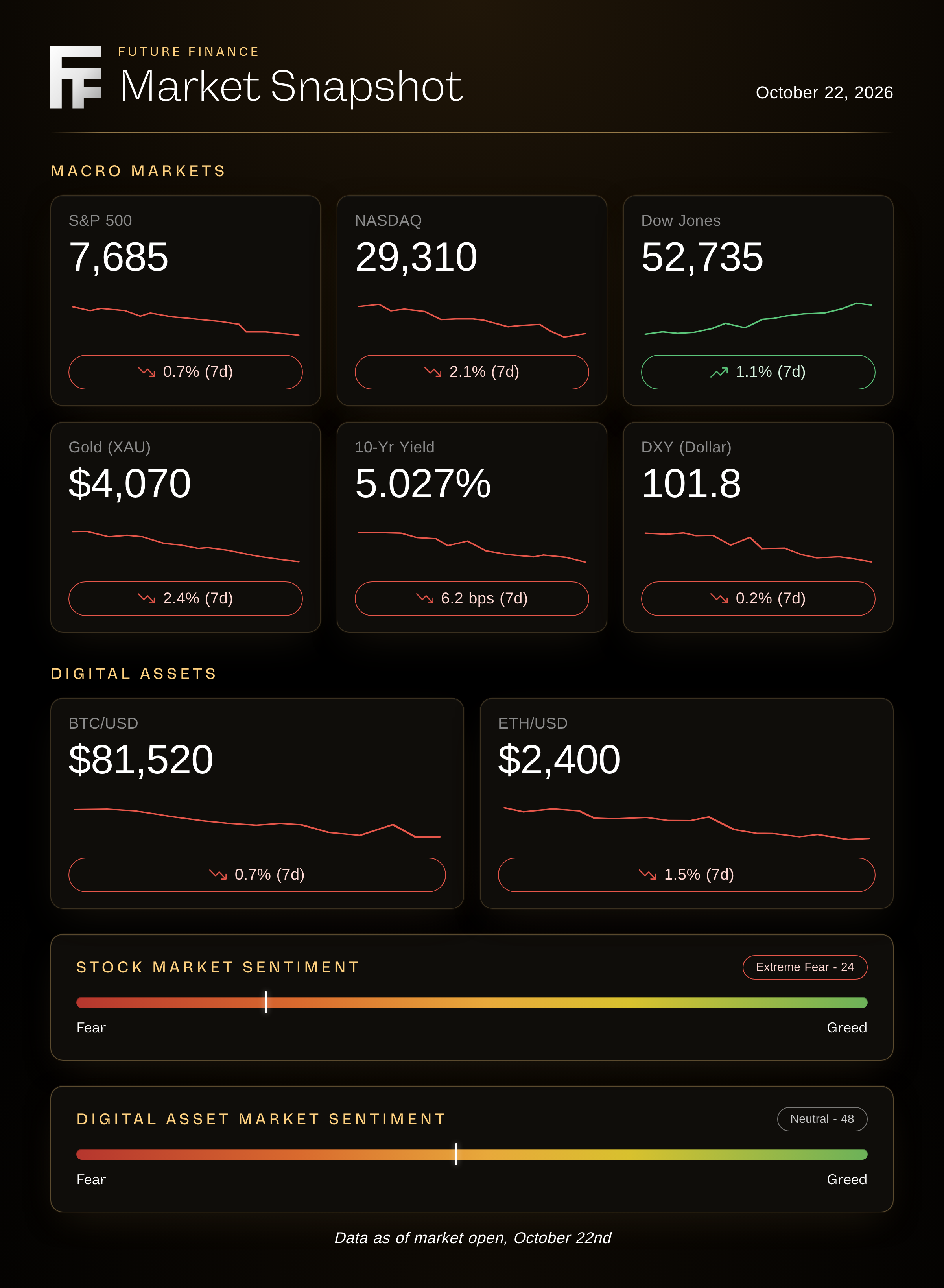
Below, Robert Rapier on why “the market” is several markets at once, and why that matters more than usual right now.
Paid Advertisement
The Next Crisis Won’t Destroy Wealth. It Will Simply Change Hands.
A severe financial crisis does not make the world’s real wealth disappear. The businesses, land, natural resources, commodities, and productive assets still exist. What changes is who owns them.
Doug Casey believes the United States is approaching upheaval unlike anything most investors have experienced. Government debt is approaching $40 trillion. Washington spends roughly $2 trillion more each year than it takes in.
The turmoil ahead could destroy years of savings for millions of Americans. For others, it could become the opportunity of a lifetime.
Casey and David Stockman, Reagan’s former budget director, have released an urgent briefing on how to position before the transfer.
Disclosure: International Man is a paid partner of Future Finance. The forecasts, track record and claims above are the views of Doug Casey, David Stockman and International Man, and do not represent the view of Future Finance. As always, do your own diligence.
Signal vs. Noise
Meta’s Ads No Longer Pay for All Its AI

- The noise: headlines calling Meta’s earnings a miss. Its profit included a one-time $9.9 billion legal charge. Without it, Meta earned $7.40 a share, and the stock rose after hours.
- The signal: the cash. Free cash flow, what’s left after paying for operations and investments, came in at negative $2.1 billion.
Meta now expects to spend $135 billion to $145 billion on capital projects this year. Wall Street was hoping for a 2027 number, with one tally at about $193 billion.
It didn’t get one. Meta said only that it expects “to continue investing aggressively.”
For beginners: revenue tells you a business is growing. Free cash flow tells you whether it can pay for its own growth. Right now, Meta is dipping into its $82 billion cash pile to do it.
AT&T Beat, Raised and Fell 6%
- The noise: AT&T’s strong quarter. It beat forecasts, raised this year’s profit outlook and added a record 769,000 internet customers.
- The signal: investors were looking at SpaceX. It is buying airwaves to beam service straight to phones, and its Starlink Mobile service already has 22 million monthly users.
On the call, CEO John Stankey told investors not to “over-rotate” on SpaceX, saying it would take years to match the big carriers’ networks. The stock still had the worst day in the S&P 500.
SpaceX, meanwhile, reported revenue up 161% to $14.6 billion and its first profit as a public company.
For beginners: a stock that pays a big dividend can still get hit when a new competitor shows up. Safe describes the payout, and the business underneath still has to hold its ground.
Oil and Rates Are Squeezing at the Same Time

- The noise: mixed signals on whether the U.S. and Iran are talking. President Trump said they were negotiating “a little bit,” then said they weren’t.
- The signal: Iranian state TV said seven tankers were hit in or near the Strait of Hormuz overnight. If confirmed, that would be the most in a single day since the war began in February. Brent crude jumped 2.1% to $111.11.
At the same time, the 10-year Treasury yield sits at 5.13%. Traders see about an 84% chance the Fed holds next Wednesday, and roughly 90% odds of a hike by December.
For beginners: expensive oil pushes prices up, and high rates make borrowing hurt. Getting both at once is the squeeze the Fed is trying to manage.
Featured Contributor

Today’s guest is Robert Rapier of Investing Daily who last wrote here about why diversification can feel like failure. Robert's work has appeared in Forbes, The Wall Street Journal, The Washington Post and the Christian Science Monitor. He has been a featured expert on 60 Minutes and The History Channel.
Nothing here is a recommendation.
When the Dow Rises and the Nasdaq Tumbles
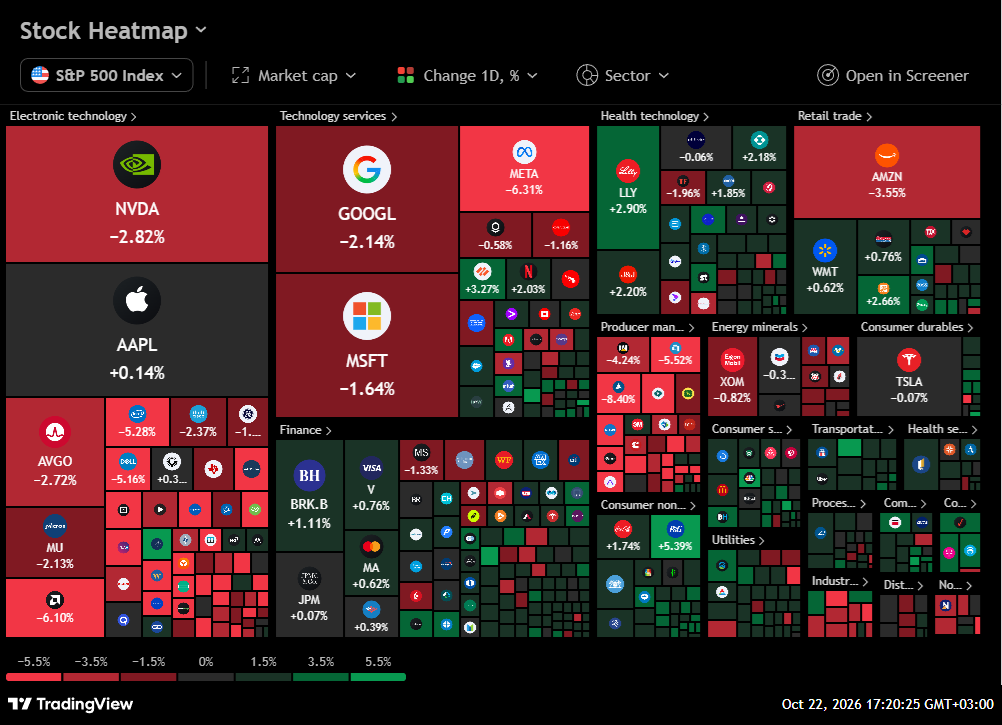
Most investors tend to think of “the market” as a single thing. Stocks are either going up or going down, and the major indexes usually seem to move in roughly the same direction. Last week was a useful reminder that this is not always the case.
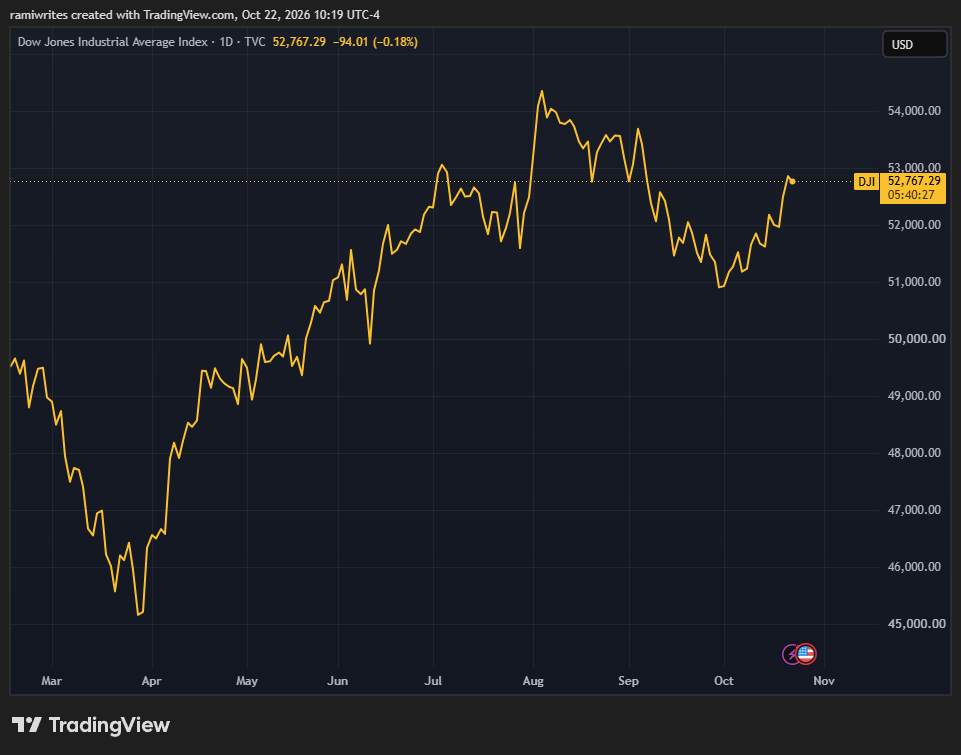
For the week ending October 16, the Nasdaq Composite fell 4.5%, while the S&P 500 declined 1.9% and the Russell 2000 dropped 3.0%. Yet the Dow Jones Industrial Average gained 0.7%.
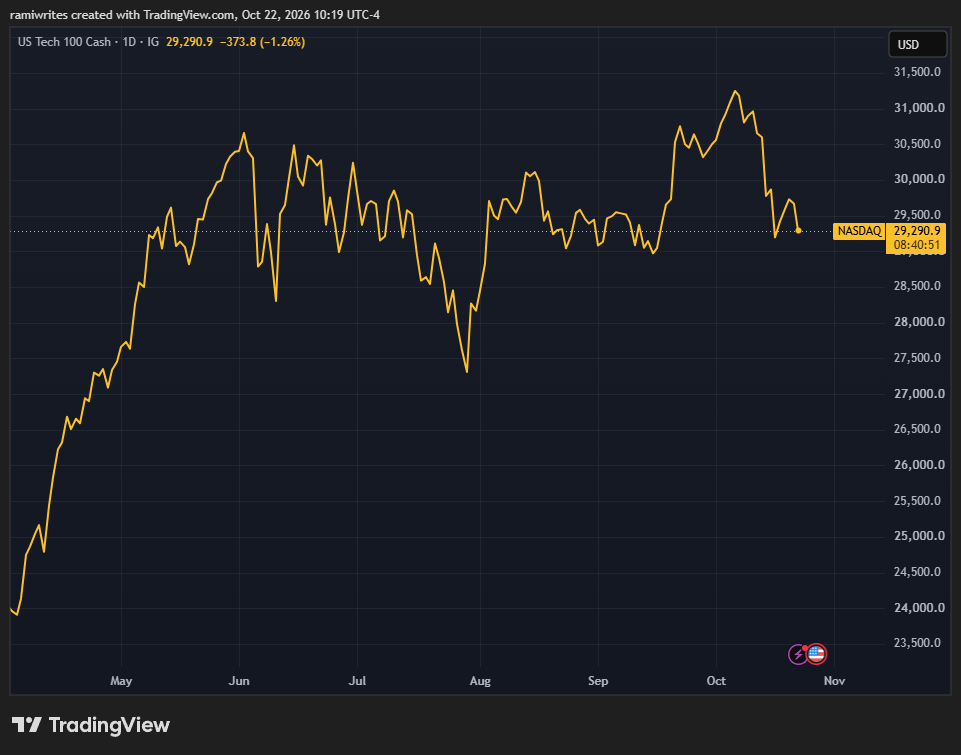
That is a striking divergence over such a short period. The major indexes are not interchangeable, because they are built differently and represent very different collections of companies.
The Indexes Are Built Differently
The Dow contains just 30 large companies and is price-weighted, meaning that stocks with higher share prices exert more influence on the index.
It includes major technology companies, but financials alone make up about 28% of the index, versus about 18% for technology, with big helpings of healthcare, industrials and consumer businesses.
The Nasdaq Composite, by contrast, contains about 3,400 companies, and technology makes up roughly two-thirds of its weight.
That concentration has been a major advantage when technology has led the market higher, especially during the AI-driven rally of recent years. But concentration works in both directions. When sentiment turns against the dominant group, the Nasdaq can fall much more sharply than indexes with broader sector exposure.
That is essentially what happened last week. Technology stocks sold off as investors became more skeptical about valuations and the enormous sums being committed to AI infrastructure, while money rotated toward more defensive areas of the market.
AI Is Facing a Higher Bar
Artificial intelligence remains one of the most important investment themes in the market, and a sharp weekly selloff does not mean that story is over.
What has changed is the level of scrutiny investors are applying to companies making large AI-related investments, as spending on data centers, chips, power infrastructure and cloud capacity continues to climb.
For much of the AI boom, companies were rewarded simply for announcing aggressive investment plans. Now investors want to know how quickly that spending will pay off, and how much of it will be financed with debt.
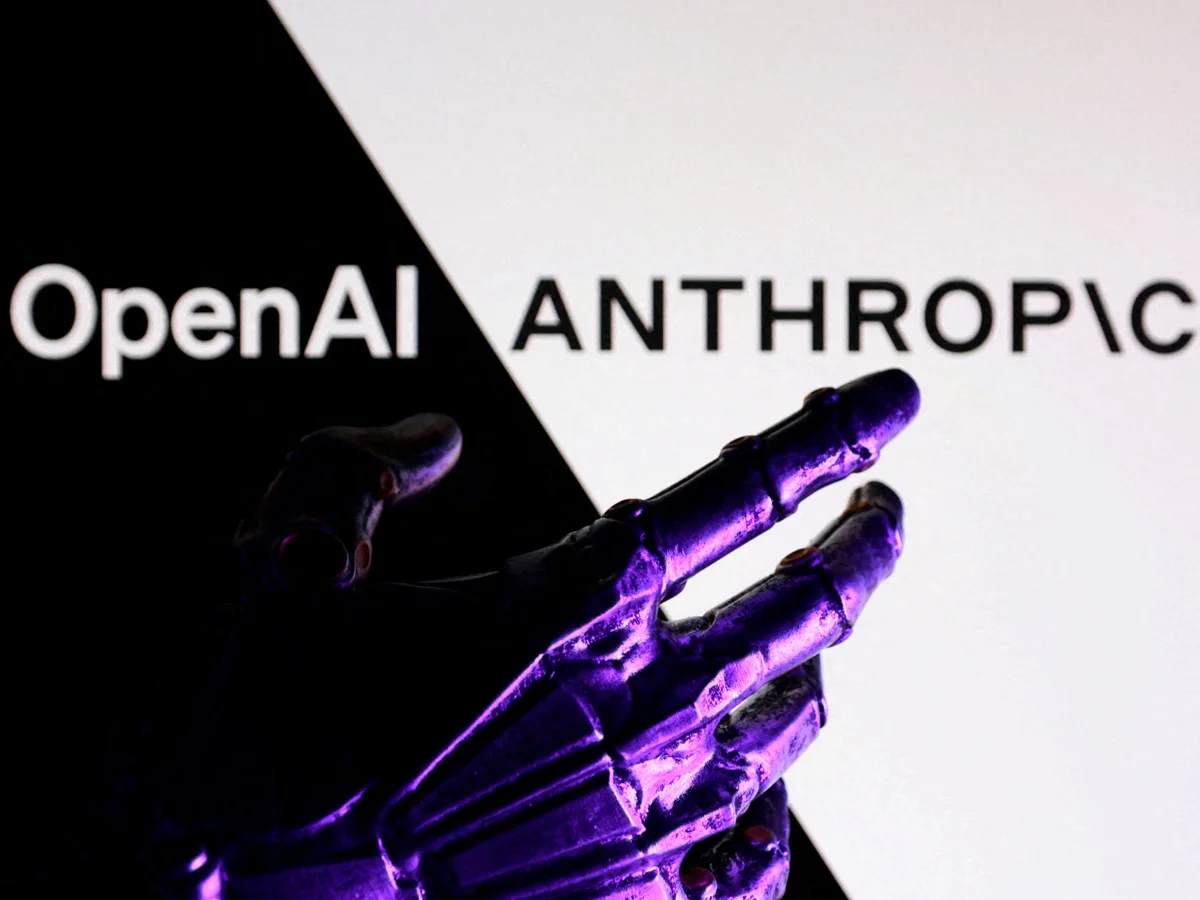
The market is not necessarily rejecting the technology itself; it is becoming less willing to assume that every dollar spent on AI will automatically produce attractive returns. At some point, spending has to translate into earnings, cash flow and a return on invested capital that justifies the enormous sums being committed.
Leadership Can Change Quickly
Technology and AI-related companies have been responsible for an outsized share of the market’s gains in recent years, at times making diversification seem unnecessarily cautious. But the same concentration that magnifies gains also magnifies losses when leadership changes.
A falling Nasdaq does not necessarily mean investors are abandoning stocks altogether, just as a rising Dow does not mean the entire market is healthy.
Sometimes the more useful question is not whether money is leaving the market, but where it is going instead.
Paid Advertisement
What Investors Should Take Away
The lesson from last week is not that investors should abandon technology or rush into defensive stocks. It is that there is no single thing called “the market.” Those differences can stay hidden when most stocks move in the same direction, and they become obvious when leadership changes.
That is also why diversification remains important even when it seems to be holding a portfolio back. During a narrow bull market, owning anything outside the leading group can feel like a mistake.
But the purpose of diversification is not to maximize exposure to whatever is working best today. It is to reduce the risk that your long-term results depend entirely on one sector, one investment theme, or one group of companies continuing to dominate indefinitely.
Last week’s split between the Dow and the Nasdaq is a big part of why I built my Utility Forecaster portfolios the way I did. Investors are usually told to pick two of three: safety, income, or growth.
My Income Portfolio, a model portfolio, returned 10.7% in 2025 with a 4.8% yield. It’s built for a smoother ride, not protection from losses, and that kind of ride matters when leadership changes quickly. See the portfolios and this month’s Best Buys list here.
- Robert Rapier
Investing Daily
Disclosure: Investing Daily is a paid partner of Future Finance. Portfolio returns are Investing Daily’s own model-portfolio figures. Past performance does not guarantee future results. As always, do your own diligence.
Everyone’s Chasing The AI Stocks. The Smarter Question Is What’s Underneath Them.
You just read how quickly the AI trade can flip from leader to laggard, and back again.
Here is the part most investors never step back far enough to see.
America is carrying more than $40 trillion in debt, and the interest bill alone now runs past $1 trillion a year. Growth is the only realistic way out. And the government is betting on AI to deliver it.
That bet has to run through one specific asset class before a single model gets smarter.
Institutions like Goldman Sachs and BlackRock are already pointing there, and our research team just put the whole case into one free presentation.
Watch the free AI presentation right here…
Final Thought
This morning, Procter & Gamble, about as defensive as a stock gets, beat forecasts because people bought more of its products. Volume rose 2.4%.
In the same 24 hours, AT&T, another “safe” name, had the worst day in the S&P 500. And Meta, the growth darling, had to dip into savings to pay for its plans.
Owning a “growth” bucket and a “safe” bucket only works if the labels stay put. This week, they didn’t.
The more useful test is what each company does with its cash. Is the business paying its own way, or is it living off its savings?
That question works for a telecom, a soap maker or an AI giant. It’s also the one Rapier says the market has started asking.
See you tomorrow.
Editor in Chief | Future Finance
One Subscription. The Entire Gems Uncovered Research Library.
You just read why the surface of the news rarely tells the whole story.
Gems Uncovered is built on that same principle. It’s our weekly research briefing on early-stage assets and native market access, the opportunities that build real wealth before they ever reach a mainstream exchange.
One level beneath the headlines is where the edge lives.
Disclaimer: This content is not financial advice, it is for informational purposes only. All investments involve inherent risk. Any financial decisions you make are solely your responsibility.
Latest




Editor's Picks

Become a sharper capital allocator in 5 minutes a day.
Institutional-grade research on where the smartest capital is positioning, across AI, energy, biotech, robotics, and digital assets. Distilled into a daily read you finish before your coffee does.
Join 45,000+ readers · No spam · Unsubscribe anytime · No card needed