

The Fed decides at 2 p.m. Listen for one word.
Hint: it isn’t the rate decision →
October 28, 2026
·
12 Min Read



The briefing serious investors read first.
Free analysis before markets open. Start thinking in decades, not days.
Join 45,000+ readers · No spam · Unsubscribe anytime · No card needed
Before we begin: this report is for education, not financial advice. Nothing here is a recommendation to buy or sell any stock, company, or asset, and we make no price predictions. Investing carries risk, including loss. Please read the full disclaimer at the end.
Today’s Big Picture
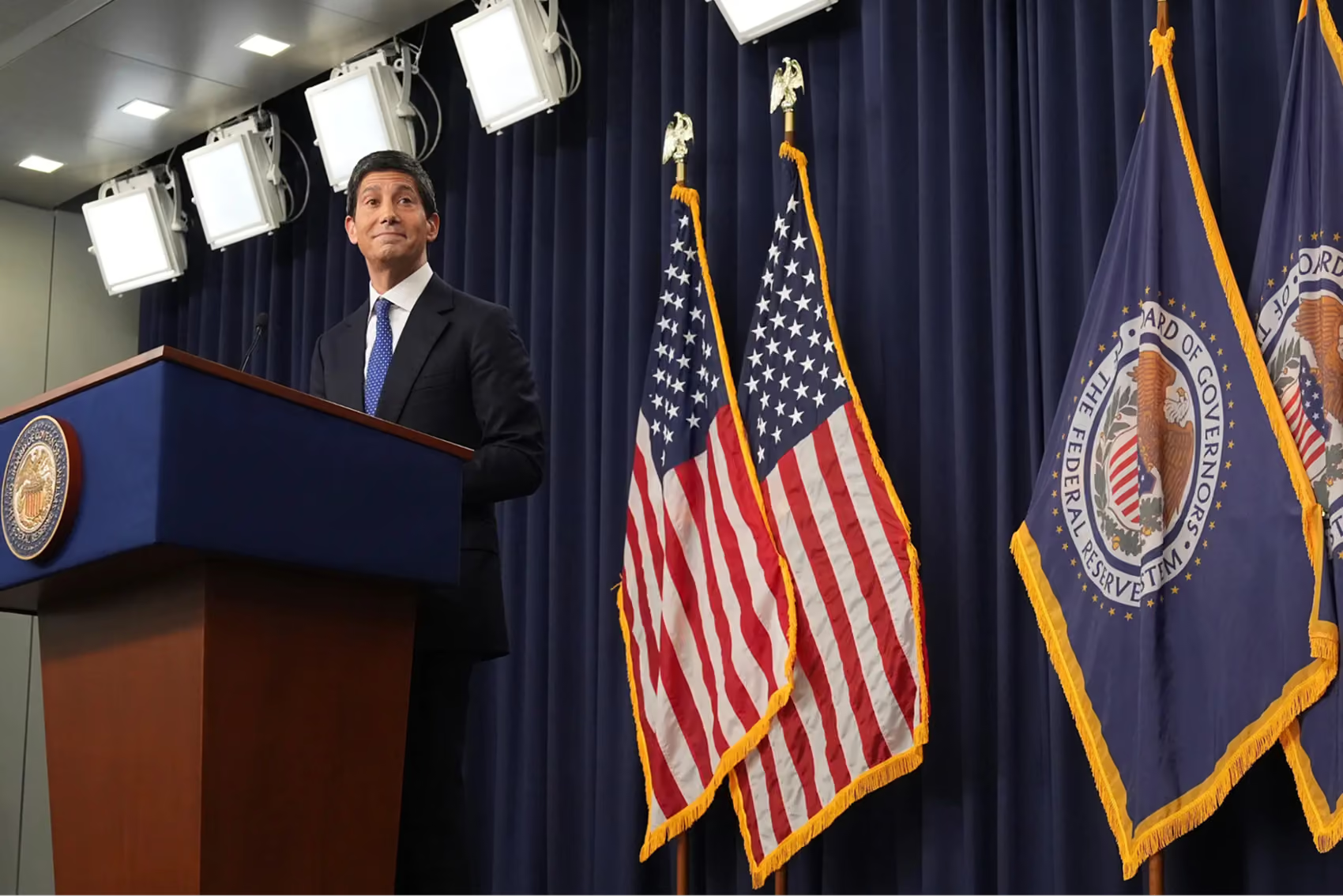
Kevin Warsh, who runs the Fed, has made a point of not telling markets what he’ll do next.
At 2:30 p.m. ET today, traders around the world will listen to him not tell them.
Think of a poker table where the dealer never shows a card. Everyone reads the tells instead: who votes against him, which sentence is missing, and whether he says the word “December.”
Last time, the tell came mid-answer. Stocks were up after the 2 p.m. statement on Sept. 16. By the close, the Dow was down 631 points.
Today’s decision is close to priced, with a hold at about 90%. The S&P 500 closed Tuesday at 7,722.60, about 1.2% under its record, and the 10-year yield is sitting right at 5%.
It’s a full day. Canada’s central bank goes first at 9:45 a.m., with a hike priced at roughly 3 in 4, and Microsoft and Alphabet report after the close.
When the decision is already priced, the tells are the news.
Below, Tan Gera on why he’ll spend this afternoon listening instead of trading.

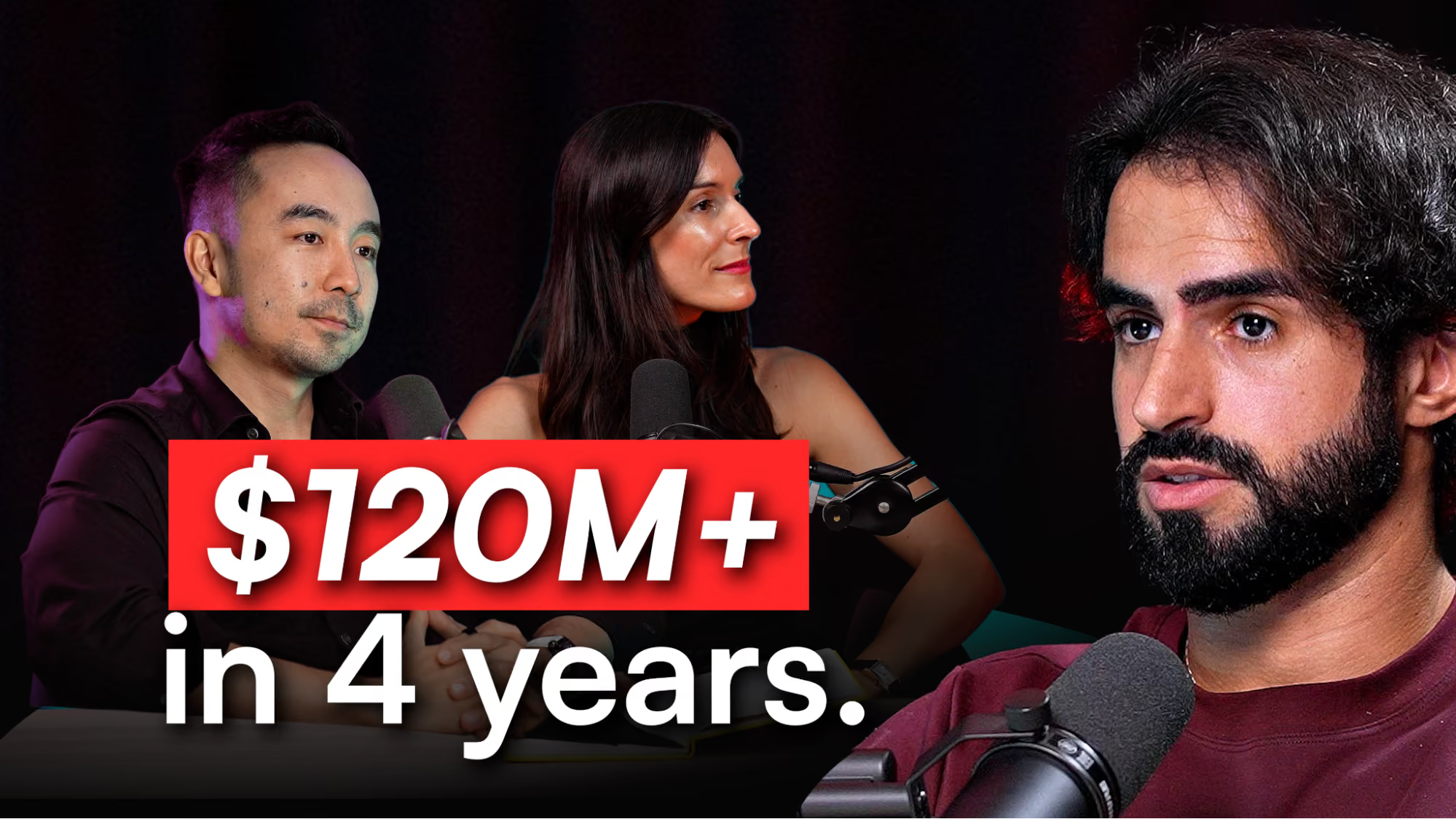
He Took $1,000 a Month Over an Engineer’s Salary. Then Came $120M+ in Sales.
At 2 p.m. today, markets will wait on one man’s words. Salim Elhila built his career on the things he could control.
Salim co-founded Decentralized Masters, the team behind this newsletter, with Tan Gera. Early on, he chose $1,000 a month over a steady engineering paycheck. Since then, the business has done more than $120 million in sales.
In a new podcast episode, he walks through:
- How they kept selling after payment processors and ad platforms cut them off
- The daily, weekly and monthly routine he uses to stay focused
- Why identity can beat willpower when the pressure is on
The same habits hold for anyone building wealth on their own: a plan you keep when the headlines get loud.
Signal vs. Noise
The Vote Is the Decision
- The noise: hold or hike.
- The signal: the vote count. In July, three Fed officials dissented in favor of a hike. In September, the vote to hike was 12–0.
Rabobank expects all three to dissent again if the Fed holds today. Continuum Economics expects two of them, Beth Hammack and Lorie Logan, and calls Neel Kashkari a closer call.
Three dissents for a hike would read like a bloc, and December would start to look close to locked. A unanimous hold would leave Warsh more room.
For beginners: when the outcome is nearly certain, disagreement inside the room is the news. You’ll find the vote at the bottom of the statement at 2 p.m.
Consumers Feel Better. They Expect Worse.
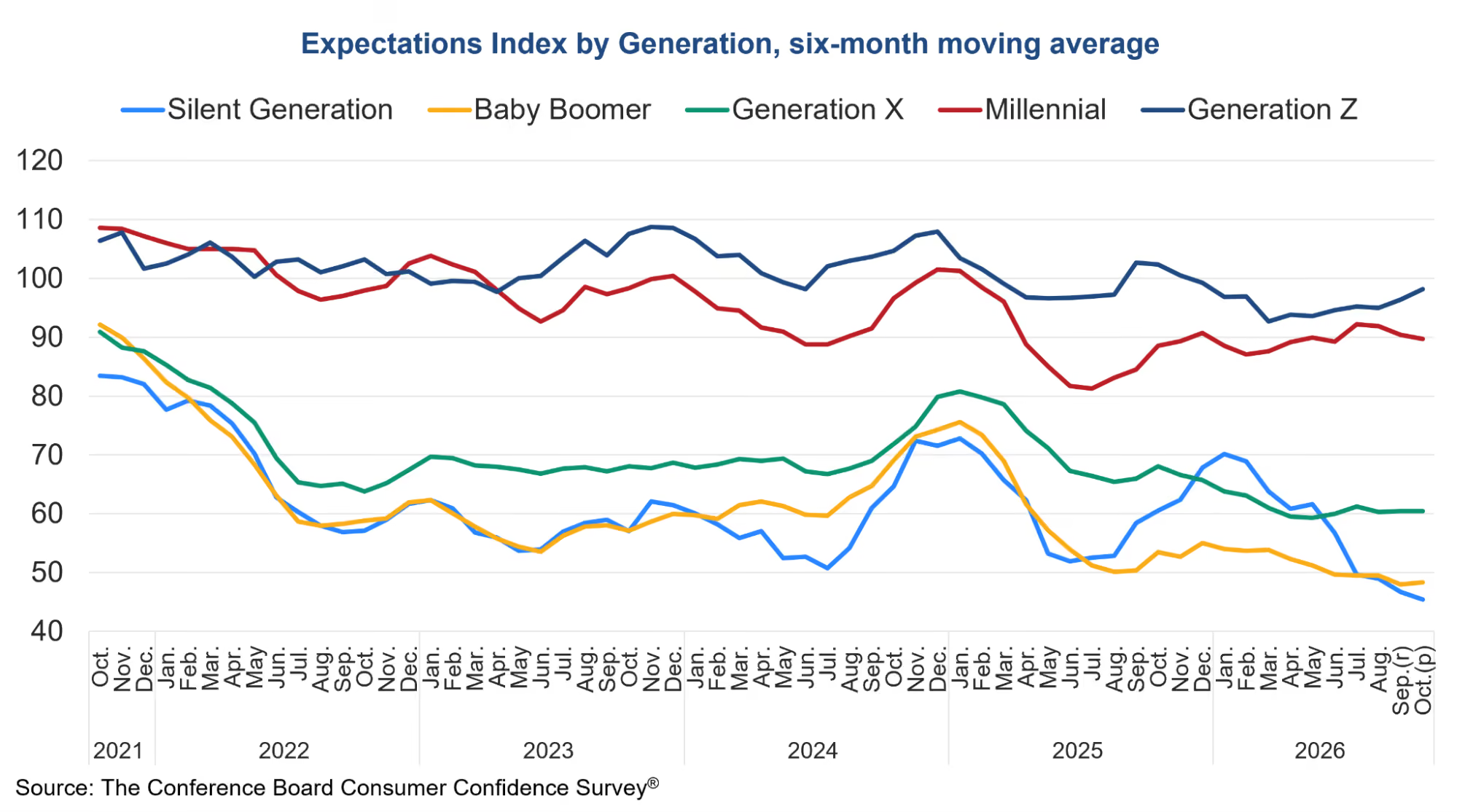
- The noise: consumer confidence jumped to 91.7 in October, far above the 81 economists expected.
- The signal: in the same survey, people expect prices to rise 5.8% over the next year. The University of Michigan’s longer-run gauge sits at 3.5%, its highest since May.
Those expectations matter to the Fed because they can turn into wage demands and price increases. They’re exactly the kind of thing Warsh will be asked about at 2:30.
For beginners: the Fed watches what people expect inflation to be, as well as what it is. Rising expectations make another hike easier to justify.
Three Hours After Warsh, Big Tech Sends Its Bill
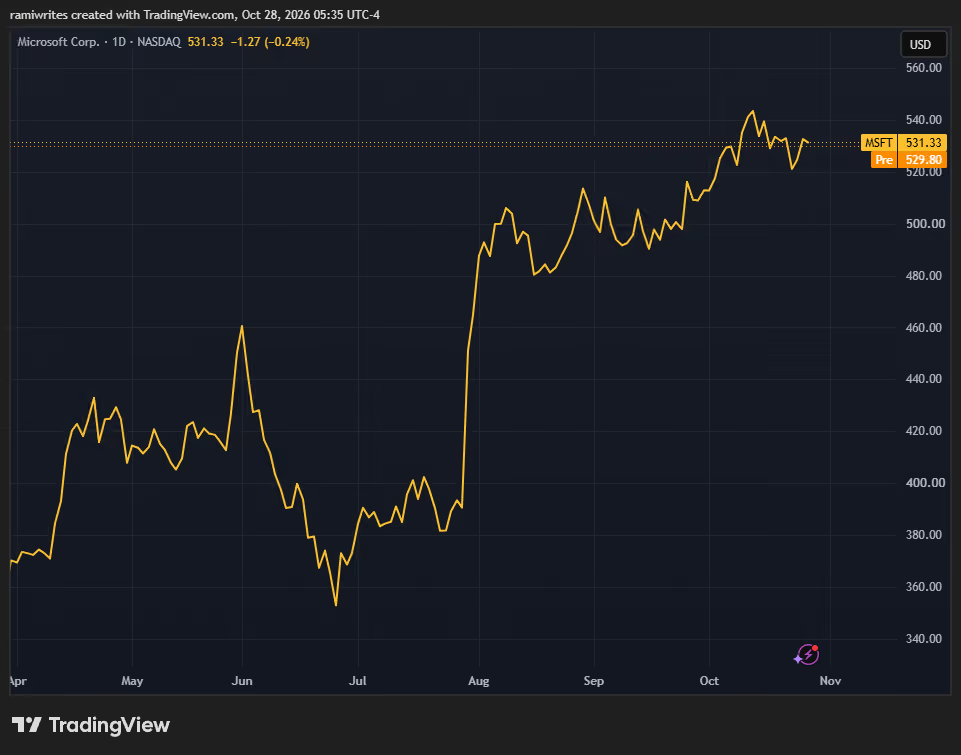
- The noise: Big Tech beats earnings estimates, again.
- The signal: the spending plans. Microsoft’s capital spending for the quarter is expected somewhere around $47 billion to $50 billion, and Alphabet has guided to $195 billion to $205 billion for all of 2026.
Last week, Meta’s free cash flow turned negative, and its stock fell about 7% the next day. The market now treats bigger spending as bigger risk.
The two events are connected. Higher rates make every dollar of that build-out more expensive to finance.
Microsoft and Alphabet also rent computing power to AI labs like Anthropic, which filed to go public this week. Their spending plans show how much of that build-out is still being paid for.
For beginners: capital spending is money a company puts into buildings, chips and equipment. When it grows faster than the cash coming in, the company is betting on demand that hasn’t shown up yet.

Featured Contributor
Today’s guest is Tan Gera, co-founder of Decentralized Masters and a CFA charterholder. He writes The Macro Letter, where he publishes his own buy and sell levels before markets reach them. Everything below describes his own portfolio. Nothing in this section is a recommendation.
I’m Not Trading the Fed Today. I Already Did.
At 2 p.m. today, the Fed tells us whether it’s raising rates again.
At 2:30, Kevin Warsh starts answering questions.
And somewhere between those two times, a lot of people will make a decision they regret by Friday.
I won’t be one of them, and it has nothing to do with nerve. I made my decisions weeks ago, in daylight, and my orders are already sitting where I put them.
What’s already priced
The market puts the odds of a hold today at about 90%, which would keep the Fed’s range at 3.75% to 4%.
So the decision itself probably isn’t the news. December is.
Futures put a hike at the December 8–9 meeting at roughly 4 in 5. In a Reuters poll, all 100 economists expect one.
No new projections are expected today, so there’s no dot plot to pick apart. That leaves two moments to watch.
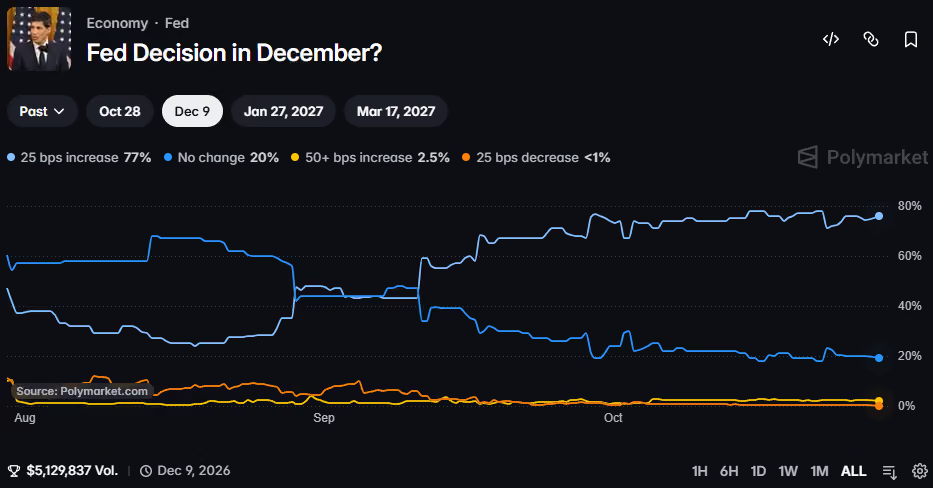
2:00 p.m.: read the vote before the words
In July, three Fed officials voted against holding, because they wanted a hike. In September, the vote was unanimous.
If the Fed holds today and those three dissent again, that’s a bloc, and December starts to look locked.
Then check one sentence. September’s statement said the hike would “support a timelier return” to 2% inflation, and stopped there. Warsh doesn’t like promising future moves. If a new line about further hikes shows up, he’s saying something without saying it.
2:30 p.m.: listen for one word
Warsh has told us how he works. “I’m not a data-point-dependent guy,” he said in September. He’s committed, in his words, “to a discipline, not to a decision.” And he’s called October and December the two big decision points of the year.
So give him two minutes and listen for one word: December. If he says it, the market will hear a hike. If he dodges it, the market will try to read the dodge.
I’ve seen this before. In December 2018, the Fed raised rates exactly as expected. The Dow was up about 380 points that afternoon. Then Jerome Powell, who ran the Fed, started talking, and it closed down about 350.
That year, the Fed hiked in September, held at the meeting right after the midterms and hiked again in December. The S&P 500 fell about 20% from its September high to Christmas Eve.
This year rhymes: a hike in September, a likely hold today, and December priced at roughly 4 in 5. I’m not betting on a repeat. Between now and the end of the year, I’m expecting a lot of volatility, in both directions.
What my orders already did
Here’s why I can listen calmly.
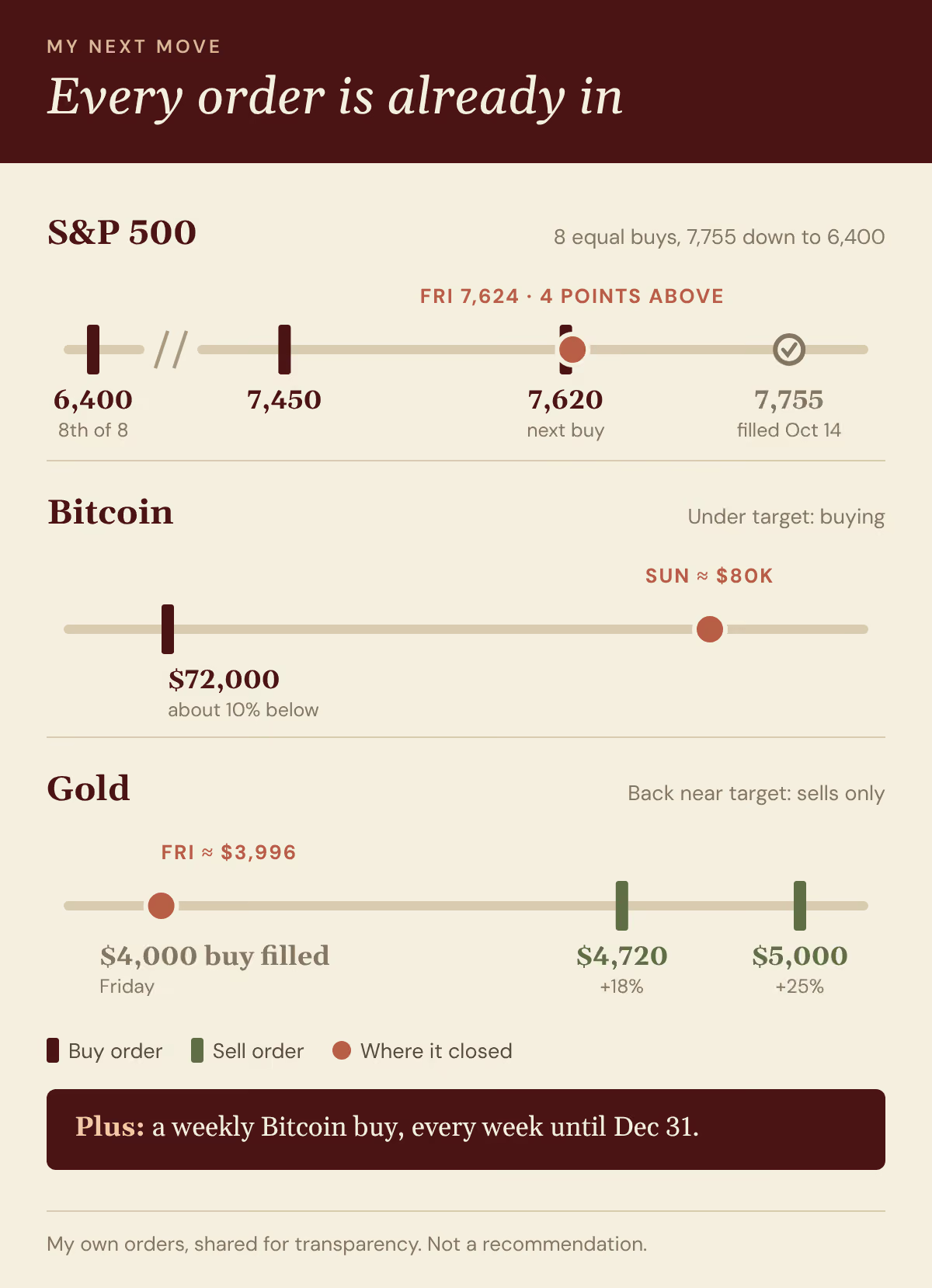
Two weeks ago, my S&P 500 order at 7,755 filled. On Friday, the index dipped to 7,612 during the day, just under my next order at 7,620.
Gold fell below $4,000 the same day, and my buy there filled too.
I didn’t make a single decision on Friday. I’d made them all weeks earlier.
What would change my plan, and what wouldn’t
Here’s what won’t: a hawkish tone, a dovish tone, a dissent, or a 600-point swing in the Dow by 4 p.m.
I won’t sell before the vote because I’m nervous. I won’t chase a big green day after it. And I won’t move a single price because of a headline.
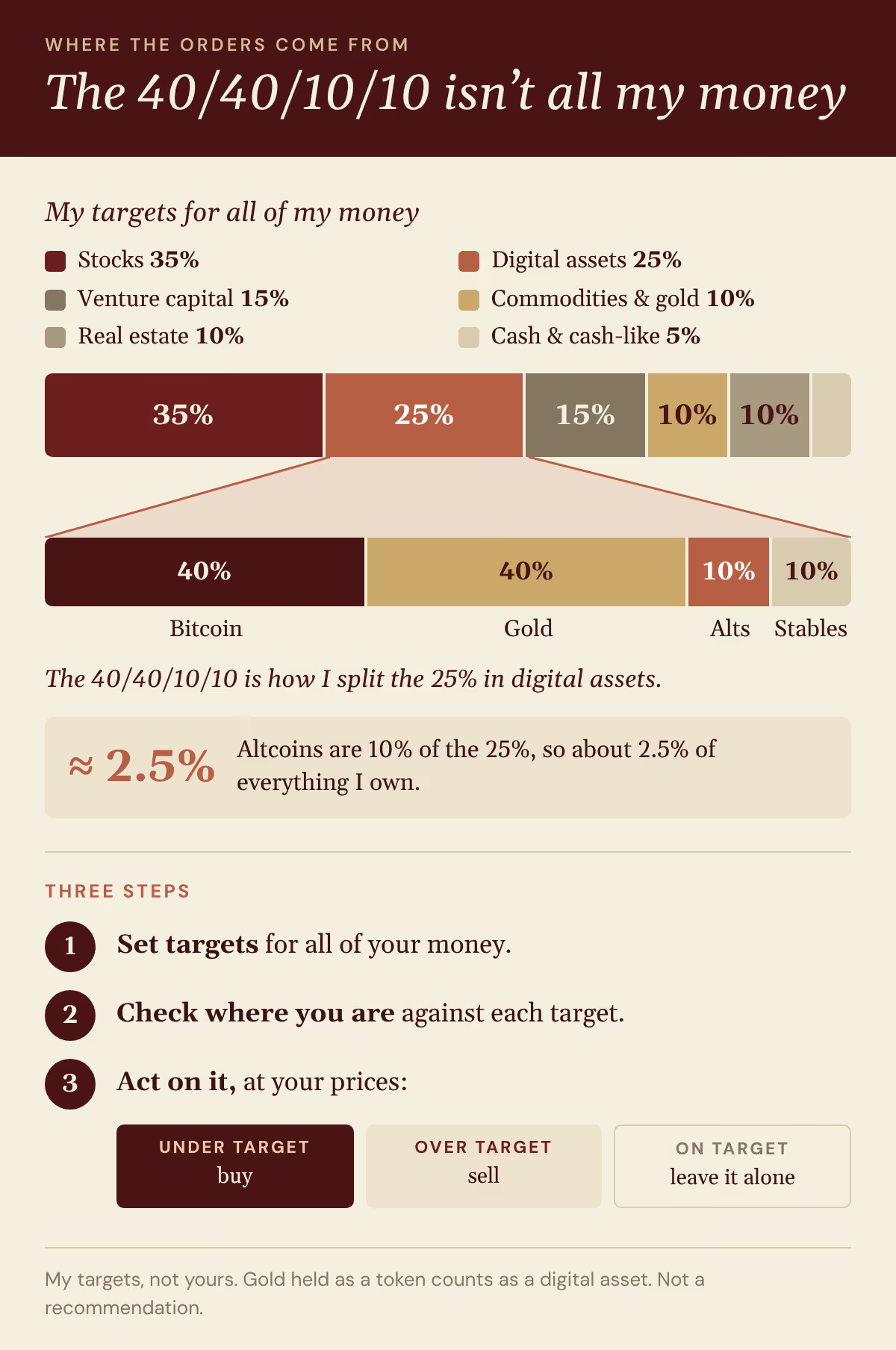
What would: one of my buckets moving off its target. My rule is simple. Under target, I buy at my prices. Over target, I sell at my prices. On target, I leave it alone.
My next S&P 500 order is at 7,450, about 3.5% below Tuesday’s close, with more below it down to 6,400. On Bitcoin, my next order is at $72,000, about 11% below where it trades, and my weekly buy keeps running through Dec. 31. On gold, my next sells are at $4,720 and $5,000.
If none of them fill today, my weekly buy keeps building, and I sleep fine.
The number that matters more
If I could watch only one number this week, it wouldn’t come out today.
It comes out Thursday at 8:30 a.m., when September’s PCE inflation lands. Economists expect 3.6%, with core at 3.1%. That’s the number that tells Warsh whether December is easy or hard.
Every level above is in The Macro Letter, written down before the market got there, misses included. If anything in my plan changes after today, that’s where I’ll put it.
The Fed gets two minutes of my attention today. My plan already has the rest.
- Tan Gera
Co-founder, Decentralized Masters | The Macro Letter
Positions described are Tan’s own portfolio, shared for transparency, and are not a recommendation to buy or sell any asset. Past performance is not indicative of future results.
Every Order Tan Just Mentioned Was Written Down Weeks Ago
None of the levels in Tan’s piece were made up on the spot. Each one ran first in The Macro Letter, before the market got there.
Bitcoin at $81,000 filled on Oct. 8. The S&P 500 at 7,755 filled on Oct. 14. Gold at $4,000 filled on Oct. 23.
The Macro Letter is Tan’s newsletter, published twice a week. Each issue covers what he’s watching across rates, oil, stocks and digital assets, the exact levels where he’d add or trim in his own portfolio, and how his past calls played out, misses included.
Today’s piece is the short version. The Macro Letter is where Tan lays out the full plan: every bucket, every level, and anything he changes after the Fed speaks.
If you’d rather see the plan before the market tests it, that’s where to find it.
Positions described are Tan’s own portfolio, shared for transparency, and are not a recommendation to buy or sell any asset. Past performance is not indicative of future results.
Final Thought
By tonight, you’ll know three things.
- What the Fed decided.
- How Warsh talked about December.
- What Microsoft and Alphabet plan to spend next.
None of them should change a plan you wrote down while things were quiet.
The same goes for next week, when America votes on Nov. 3 and Treasury sets out its borrowing plans on Nov. 4.
Tomorrow morning brings the inflation number that tells you whether December will be an easy call for the Fed or a hard one. We’ll walk through it.
See you tomorrow.
Editor in Chief | Future Finance
The Institutions Are In. The Edge Is In What They Buy Next.
By the time a pension fund files a disclosure, the easy money has already been made.
The real edge is spotting where serious capital is heading before the paperwork catches up to it.
That’s the whole job of Gems Uncovered, our research on early, asymmetric plays before they reach the mainstream.
Follow the smart money early, not after it’s on the front page.
Disclaimer: This content is not financial advice, it is for informational purposes only. All investments involve inherent risk. Any financial decisions you make are solely your responsibility.
Latest


Editor's Picks

Become a sharper capital allocator in 5 minutes a day.
Institutional-grade research on where the smartest capital is positioning, across AI, energy, biotech, robotics, and digital assets. Distilled into a daily read you finish before your coffee does.
Join 45,000+ readers · No spam · Unsubscribe anytime · No card needed