

41 stocks make up half the S&P 500…
And a record pile of borrowed money bought them. →
October 23, 2026
·
5 Min Read



The briefing serious investors read first.
Free analysis before markets open. Start thinking in decades, not days.
Join 45,000+ readers · No spam · Unsubscribe anytime · No card needed
Before we begin: this report is for education, not financial advice. Nothing here is a recommendation to buy or sell any stock, company, or asset, and we make no price predictions. Investing carries risk, including loss. Please read the full disclaimer at the end.
Today’s Big Picture
On Thursday, the company that makes Tide and Crest had its best day since March 2020. Procter & Gamble jumped 5.6%.
On the same day, the Nasdaq had its worst day since June, down 2.6%. Meta fell 7%, and chip stocks dropped more than 6%.
The S&P 500 lost 1.2%, its worst day since July, even though the Dow finished slightly higher.
Here’s why one bad day for AI hits so many portfolios.
By one count, 41 AI-linked companies now make up about half of the S&P 500’s total value.
If you own an index fund, roughly half of it rides on one idea.
Below, Dylan Jovine on the other half of the story: how much of that bet was made with borrowed money.

Everyone’s Chasing The AI Stocks. The Smarter Question Is What’s Underneath Them.
You just read how quickly the AI trade can flip from leader to laggard, and back again.
Here is the part most investors never step back far enough to see.
America is carrying more than $40 trillion in debt, and the interest bill alone now runs past $1 trillion a year. Growth is the only realistic way out. And the government is betting on AI to deliver it.
That bet has to run through one specific asset class before a single model gets smarter.
Institutions like Goldman Sachs and BlackRock are already pointing there, and our research team just put the whole case into one free presentation.
Watch the free AI presentation right here…
Disclosure: Educational content only. This briefing is not financial, investment, legal, or tax advice, and nothing in it is a recommendation to buy or sell any asset. Forecasts are the presenter’s opinions, not guarantees. All investing carries risk, including possible loss of principal. Do your own research.
Signal vs. Noise
Oil Spiked. Bonds Rallied Anyway.
- The noise: Brent crude jumped 4% to $113 a barrel on new tanker attacks around the Strait of Hormuz.
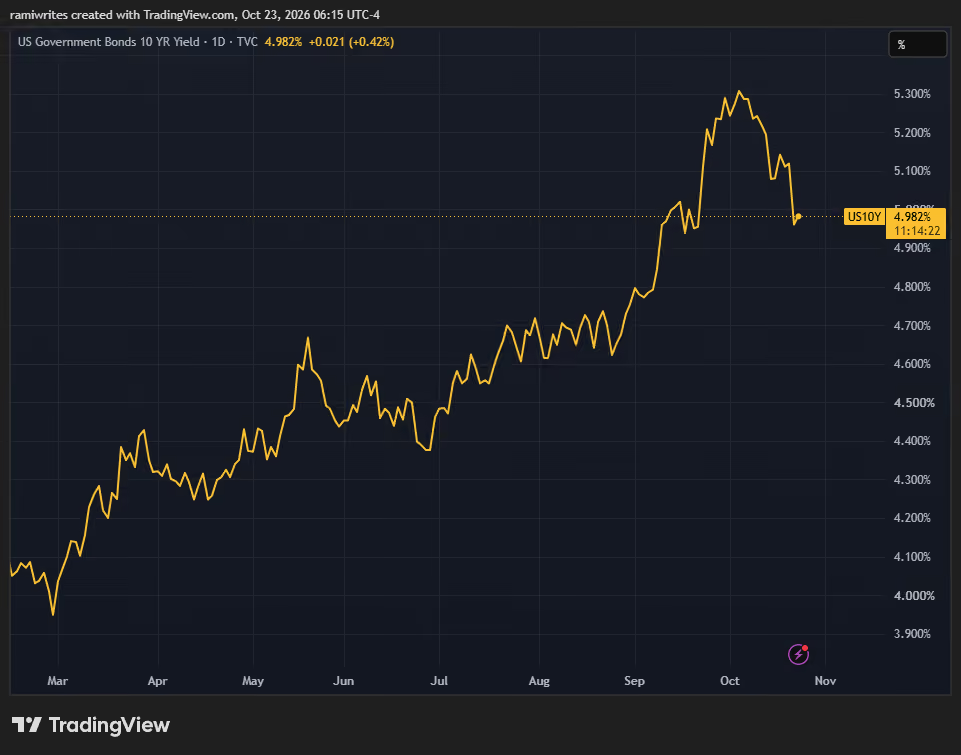
- The signal: the bond market didn’t care. The 10-year Treasury yield fell to 4.95%, its biggest one-day drop in more than a year and its first close below 5% since September.
Expensive oil usually pushes yields up, because it feeds inflation. This time, traders were more worried about growth as the AI trade wobbled.
The job market isn’t the worry. First-time jobless claims fell to 194,000 last week, a three-month low.
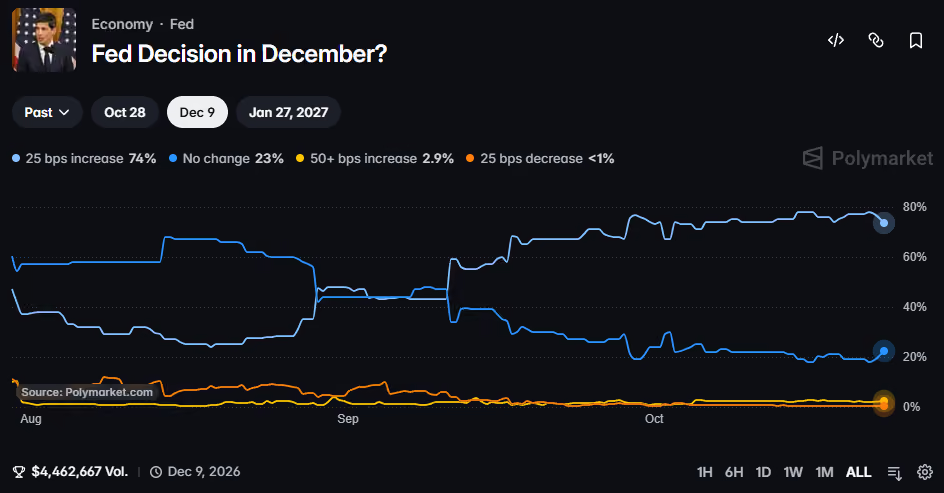
Fed bets moved too. Traders see about a 93% chance the Fed holds on Wednesday, and the odds of a hike by December slipped to about 80%, from above 90% a week ago.
For beginners: when the 10-year falls, mortgage rates tend to follow. Homebuilder stocks rallied Thursday for exactly that reason.
Good News, Sold Anyway
- The noise: Western Digital crushed its forecasts. Revenue jumped 55%, and its outlook for next quarter came in above Wall Street’s.
- The signal: the stock fell 6% to 8% after hours anyway, on worries about costs and spending. Investors are punishing AI-linked companies for anything less than perfect.
Meta’s after-hours bounce didn’t last either. It closed Thursday down 7% as investors digested its spending plans.
Meanwhile, the money went somewhere. Lockheed Martin rose about 5% on a record order backlog, and Blackstone jumped 8%. For the week, the Dow is up 1.7% and small caps 2.3%, while the Nasdaq is down 0.5%.
For beginners: when good results get sold, it usually means expectations were already sky-high. The bar for AI stocks just went up.
Bitcoin Funds Flipped $1.2 Billion in Two Days
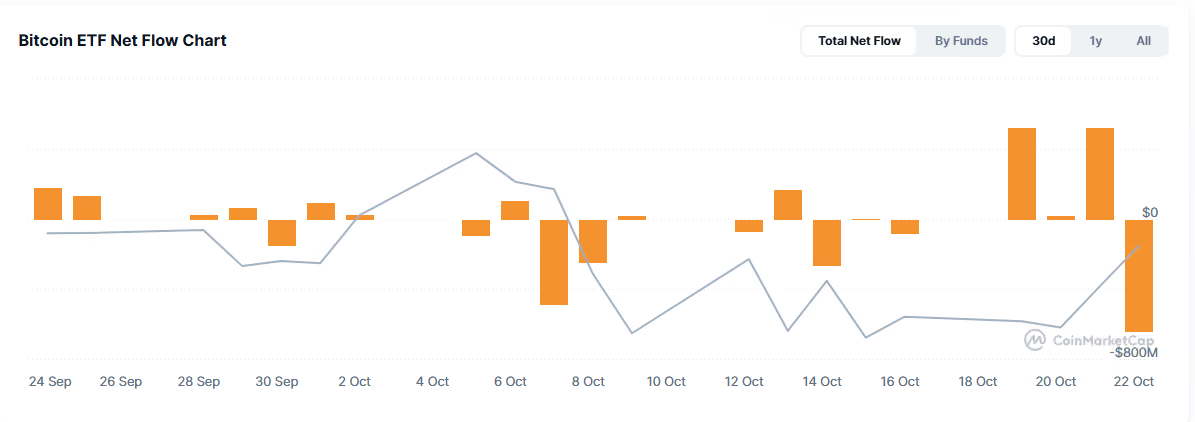
- The noise: Bitcoin slipped back toward $81,000 Thursday.
- The signal: how fast the money turned. Spot Bitcoin funds took in $524.8 million on Wednesday, then lost $635.6 million on Thursday, per Farside.
Leveraged traders got squeezed too. About $418 million of bets on rising prices were liquidated in a day, per CoinGlass. That’s the forced-selling chain The DeFi Doctor walked through earlier this month.
For beginners: digital assets are trading in step with the Nasdaq right now. When the AI trade stumbles, the most leveraged corners feel it first.

Featured Contributor
Today’s guest is Dylan Jovine of Behind the Markets, who argued here earlier this month that the AI boom had become a credit bet. Over nearly three decades on Wall Street he founded the brokerage and investment bank Lexington Capital Partners at 24, then built his research firm Tycoon Publishing to more than 500,000 readers across 28 countries before selling it to Agora in 2011.
His piece first ran Thursday; we’ve checked it against FINRA data, CME FedWatch and reporting by Seeking Alpha.
Nothing here is a recommendation.
41 AI Stocks Are Now Half the S&P 500. Wall Street Bought Them With Borrowed Money.
Two numbers crossed my desk this week. Each one is startling on its own. Together they tell you exactly what kind of market you’re standing in.
Number one. A basket of 41 AI-linked companies, drawn from JPMorgan strategist Michael Cembalest’s research, now makes up 49% of the S&P 500’s market value, per Seeking Alpha. Jim Bianco of Bianco Research ran the same list and got 48.68%.
Half the index. One theme.
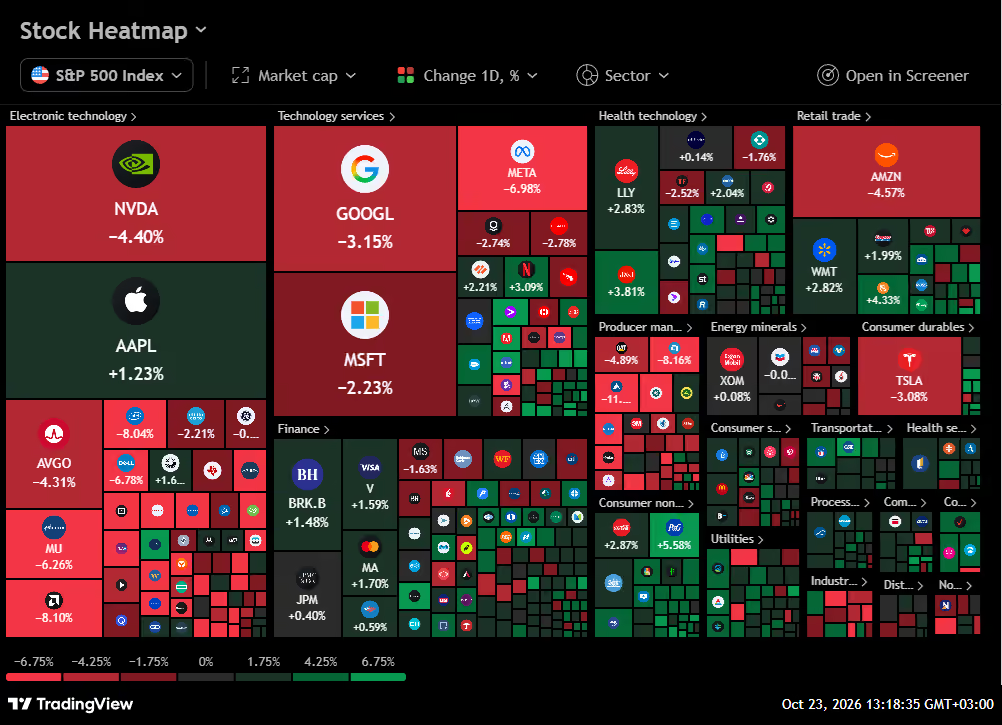
The last time a single theme was that big a share of the market was the railroads in the 19th century, per Bianco. Not even the dot-com mania got there. Tech peaked at about a third of the index in 2000. We blew past that this year.
Number two. Margin debt, the money investors borrow from their brokers to buy stocks, hit a record $1.5 trillion in June, per FINRA data. September’s reading was $1.48 trillion, up 31% in a year.
Measure it against the economy and it gets louder. Margin debt now equals about 4.6% of GDP, per The Trading Tools’ analysis of FINRA data. At the March 2000 top it was 3%. At the 2021 peak it was 3.8%.
Half the market is one trade. And a record pile of borrowed money is sitting underneath it.
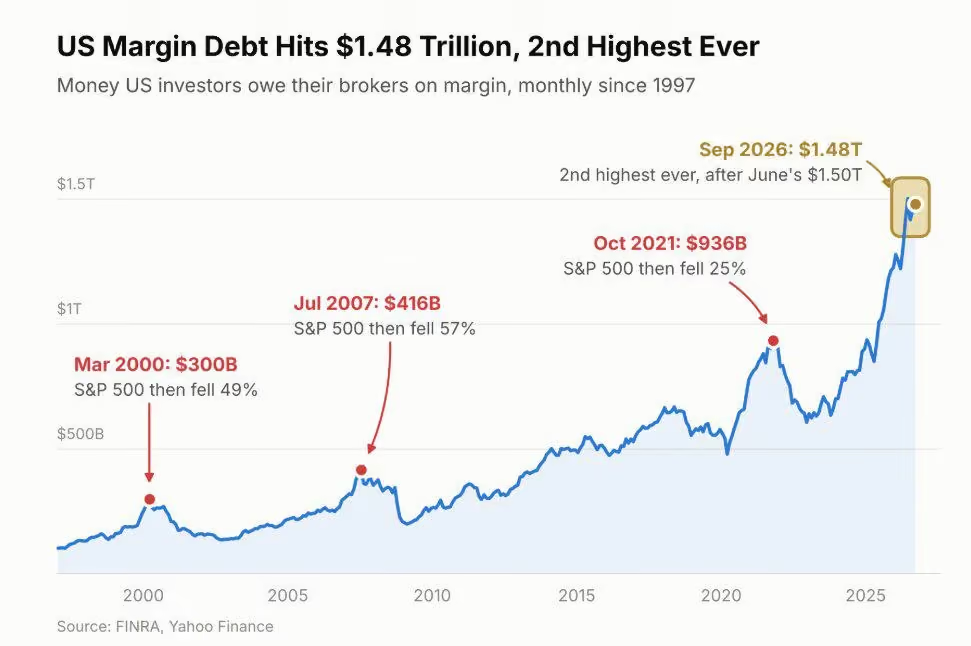
That pile already flinched once. In July, margin debt fell $85 billion in a single month, per FINRA data. In dollars, that’s a bigger one-month drop than October 2008 or January 2022.
In percentage terms it was much smaller: 5.6%, against nearly 20% in October 2008. Then investors turned around and borrowed most of it back by September.
Meanwhile the Fed hiked a quarter point in September, its first increase in three years, and traders put about 80% odds on another hike by December, per CME Group’s FedWatch tool.
The 10-year Treasury yield touched 5.36% this month, its highest since 2002, before falling back below 5% on Thursday. The Nasdaq just posted its worst week since June.
Borrowed money has one rule. When prices fall, you don’t decide when to sell. Your broker decides for you.
That’s why leveraged markets never correct gently. The first dip triggers the margin calls. The margin calls trigger the selling. The selling triggers more margin calls.
I’m not predicting a crash. Nobody can time one, and margin debt has climbed for stretches of years before mattering.
But I am telling you what I’m doing. I’m making my shopping list now, while it feels unnecessary. Great companies at crazy prices become great companies at fair prices when somebody else gets the margin call.
The investors who borrowed $1.5 trillion will be forced to sell someday.
I’d rather be the guy they sell to.
Here’s one name near the top of my shopping list. It’s tied to the power every one of those AI data centers needs, and it isn’t trading on borrowed enthusiasm yet.
Google, the Pentagon and Berkshire Hathaway have all put money into this corner of energy. I call it the Last Energy Revolution, and the key date is Nov. 17. See what’s on my list before Nov. 17 here.
- Dylan Jovine
Behind the Markets
The Part of the AI Boom Nobody Brags About
Every investor can name the big AI companies. Far fewer are looking at what makes them run.
The largest gains in a build-out like this often come from the layer underneath the story, the power and the infrastructure most people ignore.
Finding those overlooked plays before the crowd is the whole job of Gems Uncovered.
The crowd buys the headline. The edge is in what powers it.
Final Thought
If you own an S&P 500 index fund, you own those 41 AI stocks too. About half of every dollar.
That’s been great for most of this year. Thursday showed the other side.
Nobody needs to panic over it. But it’s worth knowing what’s inside the funds you own, and whether anything in your portfolio moves differently from them.
The Fed decides on Wednesday. A hold is all but priced in. What Kevin Warsh says about December is the part that matters, especially for anyone carrying a loan, or a stock bought with one.
Tomorrow, The Closing Bell rounds up the week. Have a great weekend.
Editor in Chief | Future Finance
By The Time Something IPOs, The Early Money’s Already Made.
The public gets its invitation last, right as the insiders line up to sell.
The whole game is getting in before the crowd, in the markets where access doesn’t wait for Wall Street’s permission.
That’s exactly what this Native Markets training walks you through, step by step.
Disclaimer: This content is not financial advice, it is for informational purposes only. All investments involve inherent risk. Any financial decisions you make are solely your responsibility.
Latest




Editor's Picks
Become a sharper capital allocator in 5 minutes a day.
Institutional-grade research on where the smartest capital is positioning, across AI, energy, biotech, robotics, and digital assets. Distilled into a daily read you finish before your coffee does.
Join 45,000+ readers · No spam · Unsubscribe anytime · No card needed