

Diesel just hit $6.28 a gallon…
The real squeeze is in the refineries. →
October 26, 2026
·
8 Min Read



The briefing serious investors read first.
Free analysis before markets open. Start thinking in decades, not days.
Join 45,000+ readers · No spam · Unsubscribe anytime · No card needed
Today’s Big Picture
Fill up a diesel truck this week and you’ll pay about $6.28 a gallon, roughly 70% more than a year ago.
Brent crude closed Friday at $116.72, its highest since April, after a 6% weekly jump.
And yet, counting every route out, the Persian Gulf is shipping more oil than it did before the war started in February.
The crude is getting out. What’s missing is the capacity to turn it into the fuel trucks and planes burn.
The squeeze is in refined fuel, and diesel is where it bites.
That matters on Wednesday, when the Fed meets. Diesel feeds into the price of almost everything that moves by truck, which makes it the kind of inflation the Fed can’t easily look past.
Below, Jim Rickards on the refinery war between Ukraine and Russia, and the deals Washington is weighing to end it.

The Treasury Announcement Set for the Morning After the Midterms
Most investors will spend Nov. 4 reading election results. Tan Gera, CFA, will be watching Treasury.
That morning, Treasury announces how much it plans to borrow next quarter, with the 10-year yield already sitting at 5%.
Tan has a name for the risk he sees building around that announcement: the “November 4th Freeze.” On a free live briefing this Wednesday, he’ll break it down step by step and show what he’s doing with his own savings before Nov. 4.
Disclosure: Educational content only. This briefing is not financial, investment, legal, or tax advice, and nothing in it is a recommendation to buy or sell any asset. Forecasts are the presenter’s opinions, not guarantees. All investing carries risk, including possible loss of principal. Do your own research.
Signal vs. Noise
Oil Hit a Six-Month High. The Barrels Are Flowing.
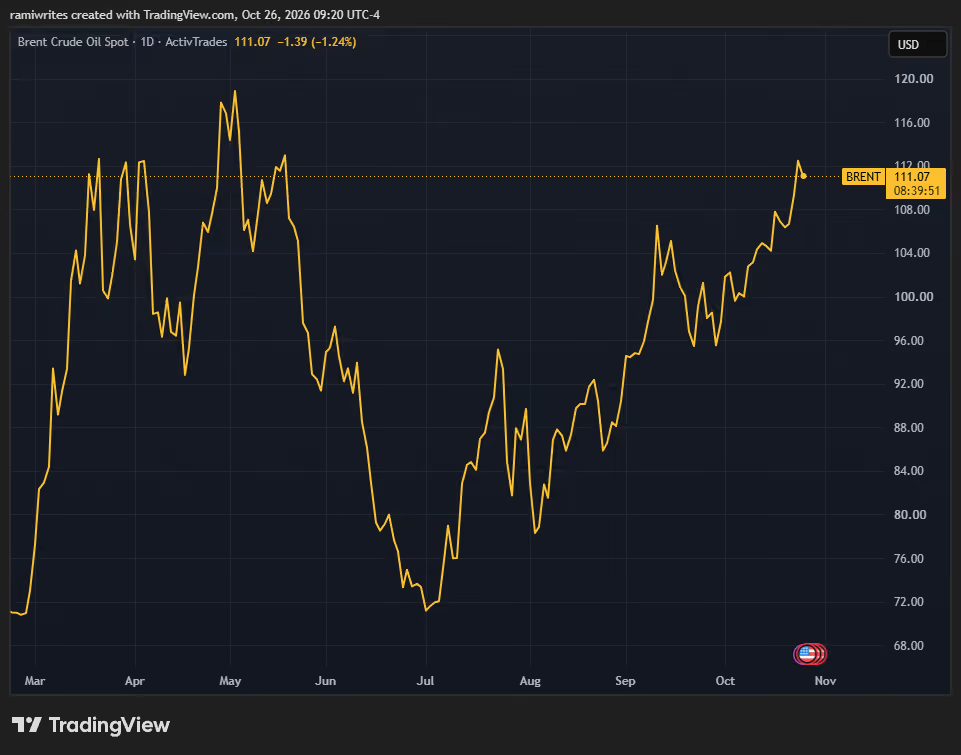
- The noise: Brent’s jump to $116.72 Friday, its third straight weekly gain.
- The signal: the oil is moving. Middle East exports topped 24 million barrels a day in the week to Oct. 18, counting pipelines and other routes, above the pre-war level of 23.3 million, per Kpler data reported by the Wall Street Journal.
What’s gone up is the cost of moving it. Brokers told the Financial Times that war-risk insurance now runs 6% to 10% of a tanker’s value per trip, against about 0.25% before the war.
President Trump said over the weekend it’s “getting to be decision time” on Iran. Brent eased to about $115 Sunday night.
For beginners: a price can rise even when supply is fine, if buyers are paying up for the risk that it won’t be. That premium can vanish quickly on good news, or jump on bad.
The Fed Holds Wednesday. December Is the Real Meeting.
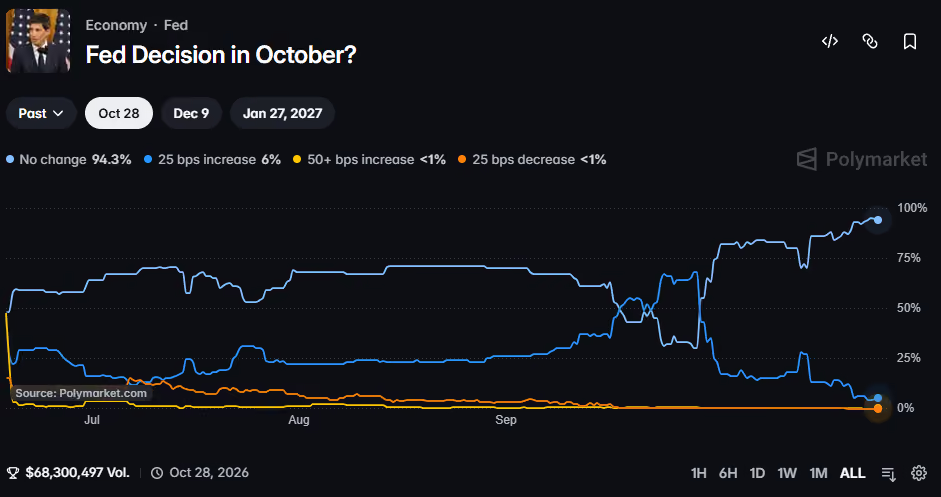
- The noise: Wednesday’s decision. Traders see about a 91% chance the Fed leaves rates alone, per CME FedWatch.
- The signal: the data the Fed walks in with. A key survey of businesses showed new orders at a four-and-a-half-year high on Friday, and consumers’ long-run inflation expectations rose to 3.5%, the highest since May.
That keeps December alive. The odds of a hike then sit near 80%, and the 10-year yield is back at 5%.
The line to watch is whether Kevin Warsh says energy prices are seeping into those expectations. If he does, a December hike becomes the base case.
For beginners: the Fed can look past a one-time spike in gas prices. It gets worried when people start expecting higher prices to stick, because that’s when they change how they spend and what they ask for in pay.
Big Tech’s Biggest Week Starts Wednesday
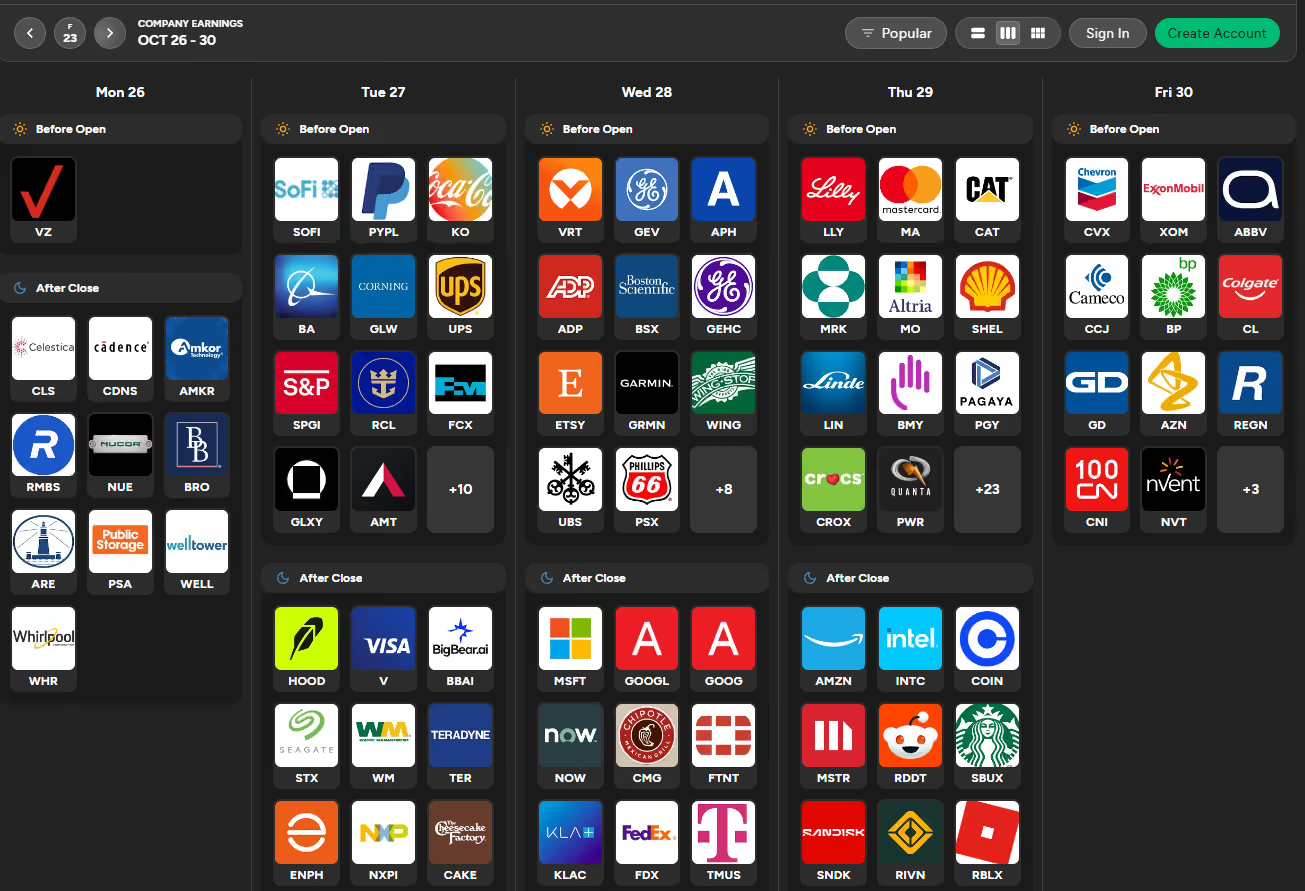
- The noise: the Nasdaq’s second straight weekly loss, down 0.7%, while the Dow rose for a third week and small caps gained 2%.
- The signal: the spending numbers coming this week. Microsoft and Alphabet report Wednesday after the close, hours after the Fed, and Amazon follows Thursday.
Analysts expect Microsoft’s quarterly capital spending at about $46.6 billion, more than double a year ago. Meta’s spending plans sank its stock 7% last week.
Thursday morning also brings third-quarter GDP and September’s PCE inflation, the Fed’s preferred gauge.
For beginners: this is the busiest stretch of the earnings season. Rate news, inflation data and the biggest AI spenders all land within about 24 hours.

Featured Contributor
Today’s guest is Jim Rickards of The Daily Reckoning, on the energy deals behind the Russian diesel sanctions waiver we first flagged. Rickards has contributed as an advisor on capital markets to the U.S. intelligence community and at the Office of the Secretary of Defense in the Pentagon. He’s the author of four NYT Bestsellers. Nothing here is a recommendation.
Trump’s Russia Play, and China’s Fear
There has been a flurry of activity between U.S. and Russian negotiators recently involving global energy markets and the role of Russia in the war in Ukraine.
So many deals are being discussed, with some already announced, that it’s a challenge to keep abreast of the news. All of these deals have implications beyond the four corners of each.
Despite the blockage in the Strait of Hormuz, the world is not running out of oil. There’s plenty of U.S., Russian and Venezuelan oil around, and substantial amounts are making it out of the Persian Gulf, albeit at higher prices that reflect insurance, freight and attack risk.
But we don’t put oil in our cars and trucks. We use gasoline and diesel. Planes use jet fuel. Those are all refined products. The real bottleneck is in the refineries.

The Refinery War
Ukraine has been blowing up Russian refineries using swarms of drones that are relatively easy to manufacture. By the end of August, about half of Russia’s refining capacity had been knocked offline, according to S&P Global Energy.
Russia is a major exporter of refined products, as are the Persian Gulf countries. Damage to Russian refineries, combined with limited exports of Gulf refined products, is reducing the world supply of diesel and keeping the price high.
In turn, higher diesel prices get passed along to consumers, because trucks move much of the nation’s goods. Energy, gasoline directly and diesel through freight, is driving the recent pickup in U.S. inflation. That’s a political problem for whichever party holds power heading into the midterms.
Trump wants Ukraine to stop attacking Russian refineries. That’s ironic, because Ukraine’s strikes reportedly rely on satellite and targeting intelligence from the U.S. and its allies.
Trump’s envoys reportedly warned Kyiv this month that intelligence sharing could be cut if the strikes continued, according to Axios and CNN, and Zelensky confirmed the warning. Trump says the U.S. is still sharing.

The Deals on the Table
The U.S. is finally moving on the diplomatic front with Russia. One deal under discussion would allow U.S. investors to buy Lukoil’s international assets, including a retail gasoline and diesel network.
Nothing has been signed. Treasury’s license to negotiate runs to Nov. 21, and any sale would have to cut the business off from its Russian parent.
Another deal under discussion would allow U.S. investors to invest in the Nord Stream natural gas pipelines, which run from Russia to Germany.
That relatively cheap gas was critical to Germany’s success as a manufacturing and export powerhouse, especially as it phased out nuclear power and cut back on coal.
The pipelines were blown up in September 2022. German prosecutors are now trying a Ukrainian man over the attack, which Kyiv denies; journalist Seymour Hersh has alleged U.S. involvement, which Washington denies.
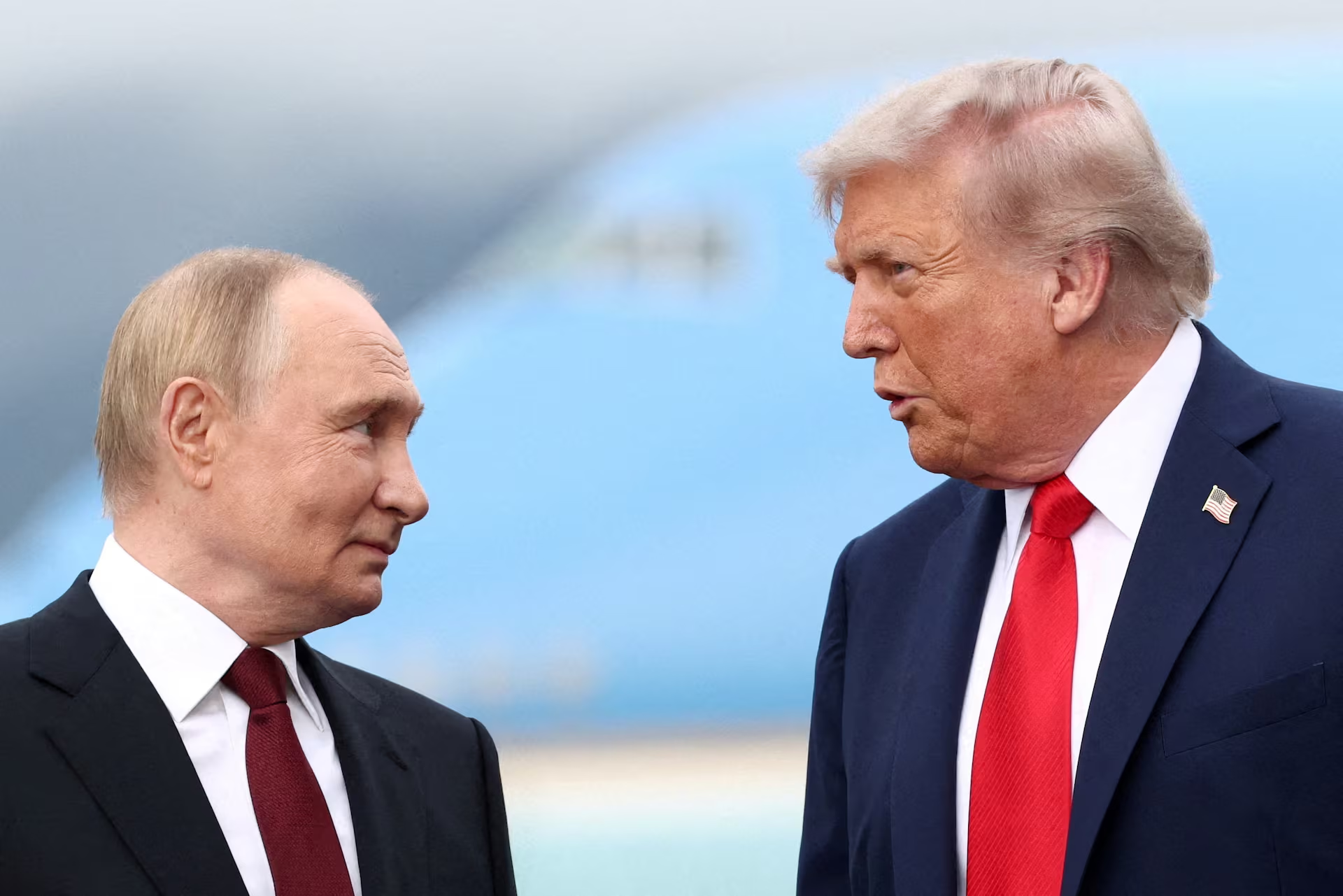
Russia found other buyers for some of its gas. Germany’s energy-intensive industries suffered: their output in 2025 was about 18% below 2021, according to Germany’s statistics office.
U.S. investment could lead to repairs and get Russian gas flowing to Europe again, in exchange for U.S. sanctions relief. It would still run into EU sanctions, and Germany says a restart is not wanted.
The net effect would be more diesel and natural gas on world markets, and lower prices. Ukraine would be a big loser. Some kind of détente between Russia and the U.S. could help end the war sooner, and Putin has also offered to mediate between the U.S. and Iran, according to Axios.
Energy, money, sanctions, Ukraine, Iran, Russia and the U.S. are all connected in one deal-making web.
Chokepoints
Another big loser would be China, if the U.S. and Russia worked together to isolate it. One big obstacle to this kind of multi-part deal is Western Europe and the UK, which remain firmly opposed.
Investors know chokepoints in the geographic sense: the Strait of Hormuz, the Strait of Malacca, the Suez Canal, the Bab el-Mandeb at the mouth of the Red Sea, the Panama Canal and several others.

Arctic shipping lanes, including Russia’s Northern Sea Route, are an emerging one. But some chokepoints aren’t strictly geographic. The Nord Stream pipeline is one. Diesel refineries are another.
Russia plays a critical role in Arctic shipping, the Nord Stream system and global refining. China imports roughly three-quarters of the oil it uses, which leaves it exposed at nearly every chokepoint on that list.
The U.S. already has influence over many of these chokepoints and could extend it in cooperation with Russia. That would leave China facing the combined power of both.
Let’s give this time. These energy and geostrategic plays won’t solve inflation or lift growth overnight. But I see them as important steps in the right direction, and in my view, Trump and Putin both know exactly what they’re doing.
One last thing. Energy isn’t the only market where I think the next few months matter.
I’ve recorded a short video on gold. In it, I walk through why I think gold could reach $10,000 an ounce within a year, and why I’m watching a small $2 gold miner ahead of a decision I expect from Washington on Dec. 30.
If you own gold or are thinking about buying it, I’d watch this first.
Watch Jim’s gold briefing here →
- Jim Rickards
The Daily Reckoning
Disclosure: Paradigm Press, publisher of The Daily Reckoning, is a paid partner of Future Finance. The views above are Jim Rickards’s and do not represent the view of Future Finance.
Silicon Valley Bank Failed in 48 Hours. Here’s What Tan Gera Is Watching Now.
In March 2023, Silicon Valley Bank went from open to seized in about 48 hours.
The problem had been sitting on its books for months: bonds bought when rates were low, worth far less once rates rose.
Rates are higher today than they were then. Last quarter, JPMorgan and Wells Fargo both reported that losses on their bond holdings trimmed their capital.
On his free live briefing this Wednesday, Tan Gera, CFA, connects that to Nov. 4. He’ll cover:
- Why a Treasury announcement the morning after the midterms has his attention
- The 52-year-old arrangement that has helped fund Washington since 1974, and the cracks he sees in it
- The 3-step approach some investors are using to hold part of their wealth outside a bank or broker
Stay to the end and you’ll get The Freeze-Proof Report, with the three assets Tan holds in his own portfolio ahead of Nov. 4.
Disclosure: Educational content only. This briefing is not financial, investment, legal, or tax advice, and nothing in it is a recommendation to buy or sell any asset. Forecasts are the presenter’s opinions, not guarantees. All investing carries risk, including possible loss of principal. Do your own research.
Final Thought
For most of this year, the oil story has been about how much crude could get out of the Gulf.
This week it’s about something more ordinary: how many refineries are working, and what that does to the price of a gallon of diesel, a truckload of groceries and, eventually, the Fed’s next move.
Put one more date on your calendar while you’re at it. On Nov. 4, the day after the midterms, Treasury announces how much it plans to borrow next quarter, and its expanded bond buybacks are set to expire.
With the 10-year yield sitting at 5%, that announcement matters more than it usually does.
See you tomorrow.
Editor in Chief | Future Finance
P.S. New on the Future Finance podcast: He Chose $1,000 a Month Over an Engineer’s Salary. Now: $120M+ in Sales.
Salim Elhila, who co-founded Decentralized Masters with Tan Gera, on how they kept selling after payment processors and ad platforms cut them off, the daily, weekly and monthly routine he uses to stay focused, and why identity can beat willpower.

Their Research Team Flagged Derive at 14 Cents. It’s 35 Cents Today.
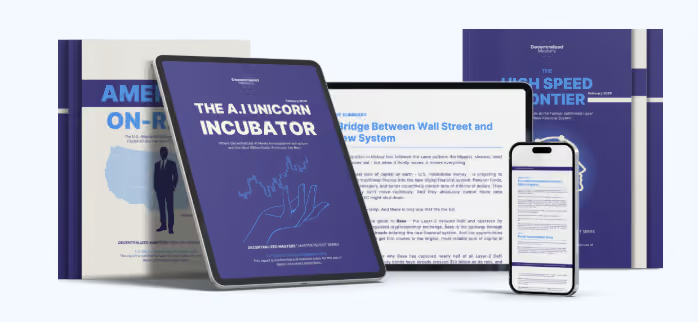
Gems Uncovered is the weekly research newsletter from Decentralized Masters. Every week, our research team picks the digital assets it thinks the market is underpricing and sends subscribers the full case for each one.
Subscribers get that research on the day coverage starts. They read the case for Derive (DRV) on July 17, when it traded near 14 cents. It’s up 159% since.
A few more picks since Gems covered them:
- Magma Finance (MAGMA): up 126% since March 27
- Pump.fun (PUMP): up 79% since Aug. 7
- Venice (VVV): up 68% since Aug. 21
- NEAR Protocol (NEAR): up 45% since Sept. 18
Here’s what a subscription includes:
- New picks every week, each with the research behind it
- Market commentary on what’s moving digital assets and why
- Updates on past picks, plus monthly performance reports that show every pick, winners and losers
- The full research library of past coverage
Not every pick works out, and the reports show those too.
See what Gems is covering now →
Returns run from each asset’s price on the day Gems Uncovered covered it to CoinGecko prices on Oct. 26, 2026, before fees and taxes. These are selected results: of the 86 assets Gems covered from January through September 2026, 19 were above their coverage price on Oct. 26. Past performance doesn’t guarantee future results. Nothing here is a recommendation.
Disclaimer: This content is not financial advice, it is for informational purposes only. All investments involve inherent risk. Any financial decisions you make are solely your responsibility.
Latest



Editor's Picks

Become a sharper capital allocator in 5 minutes a day.
Institutional-grade research on where the smartest capital is positioning, across AI, energy, biotech, robotics, and digital assets. Distilled into a daily read you finish before your coffee does.
Join 45,000+ readers · No spam · Unsubscribe anytime · No card needed