

You Pay for Inflation Twice This Black Friday
Inflation hits at the register, then again on any card balance after the Fed's expected Dec. 9 hike. Plus Robert Rapier on three stocks he's watching after the sell-off.
November 27, 2026
·
9 Min Read




The briefing serious investors read first.
Free analysis before markets open. Start thinking in decades, not days.
Join 45,000+ readers · No spam · Unsubscribe anytime · No card needed
Disclaimer: This content is not financial advice, it is for informational purposes only. All investments involve inherent risk. Any financial decisions you make are solely your responsibility.
Today's Big Picture
Before anyone carved a turkey this year, Americans had already spent $82.5 billion online for the holidays.
That covers Nov. 1 through Nov. 22, and it's up 9.1% from a year earlier, according to Adobe. Every one of those days topped $3 billion.
Adobe expects another $12.9 billion today alone.
Some of that is people buying more. A lot of it is the same things costing more: across the season, Mastercard and the National Retail Federation both expect about half of sales growth to come from higher prices.
On Wednesday, the government's October inflation report showed prices speeding up, with the Fed's favorite core measure at its highest since November 2023.
Traders now price a Fed rate hike on Dec. 9 as close to certain, and a hike reaches the rate on most credit cards within a billing cycle or two.
That's how inflation can cost you twice this Black Friday: once at the register, and again on any balance you carry after the Fed responds.
Below: what Wednesday's report changed, and Robert Rapier on three stocks he's watching after the sell-off, including the payment network behind many of today's card swipes.

Paid Advertisement
The $248 Trillion "White Swan" Chaikin Sees by Dec. 5
Marc Chaikin has been on Wall Street for 60 years. His clients have included billionaires like Steve Cohen and George Soros, and his Chaikin Money Flow indicator is built into every Bloomberg terminal.
Now he's calling his newest prediction the most important of his career.
His case: a small AI company has launched "micro clusters," computing power he says uses 99% less electricity, water and space than today's data centers. If he's right, the giant data centers going up across America could be outdated before they're finished.
Chaikin expects the company to present its latest findings at a major tech conference in Europe on or before December 5. He's giving away the name and ticker free.
Get Chaikin's free AI pick here →
Disclosure: MarketWise is a paid partner of Future Finance. The forecasts, track record and claims above are those of Marc Chaikin, Chaikin Analytics and MarketWise, not Future Finance research or advice. As always, do your own diligence.
Signal vs. Noise
3.3%: The Number That All but Locked In December's Hike
- The noise: Wednesday's 3% round trip in stocks.
- The signal: prices are speeding up while the economy grows fast, and that keeps borrowing expensive into 2027.
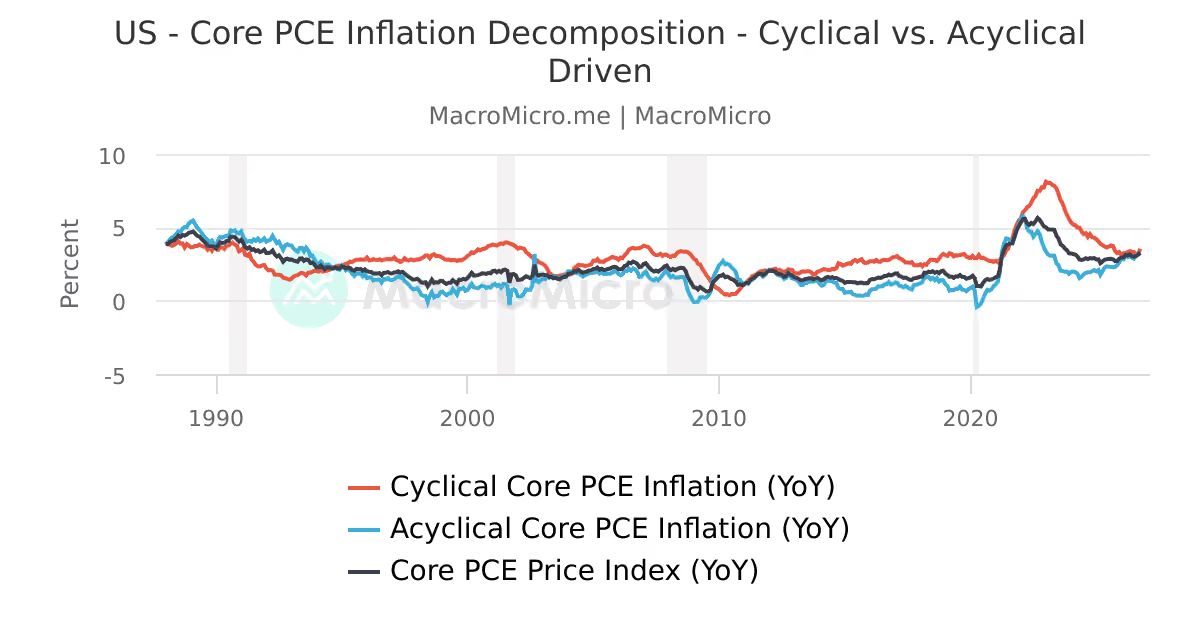
On Wednesday morning, we told you the one line to check first in the October inflation report: the one-month change in core PCE.
PCE tracks the prices of what households buy, and it's the inflation gauge the Fed watches most closely. "Core" leaves out food and energy, which swing the most from month to month.
It rose 0.3%, as forecast. On its own, that points to a quarter-point hike on Dec. 9 rather than a half.
The yearly number is the one that changed the picture. Core prices rose 3.3% from a year earlier, up from 3.1% in September and above the 3.2% forecasters expected.
That's the highest since November 2023, and the Fed's target is 2%. Over the past three months, core prices rose at a 3.6% annual pace, up from 3.0% in September, according to Capital Economics.
The same 8:30 release showed the economy grew at a 4.3% annual rate in the third quarter, revised up from 3.4%. Fewer people filed for unemployment than forecasters expected: 189,000, against 200,000.
Fast growth with prices speeding up gives the Fed little reason to wait. After the report, traders put the odds of a quarter-point hike on Dec. 9 at 94% or higher, according to CME FedWatch.
They put the odds of another hike in January at about 60%.
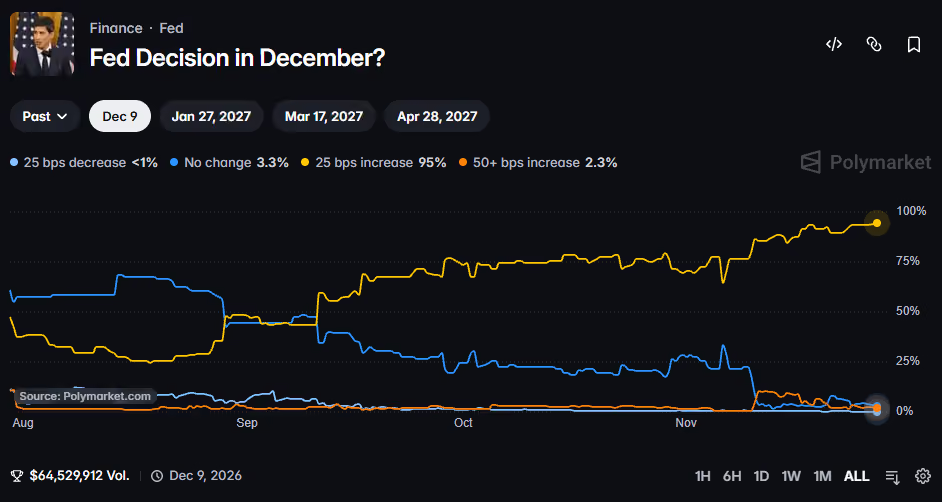
On Sept. 30, we gave about an 85% chance that the Fed raises rates at least once more before the year is out. That call gets graded on Dec. 9 at 2 p.m. Eastern.
For your wallet, a hike shows up on the card first. The prime rate, 7.00% today, would go to 7.25% after a quarter point, and card rates tied to it follow.
A single quarter point is small: less than $4 a year on a $1,500 holiday balance. The bigger cost is the rate that balance already carries, and Wednesday's report gave the Fed a reason to keep raising it.
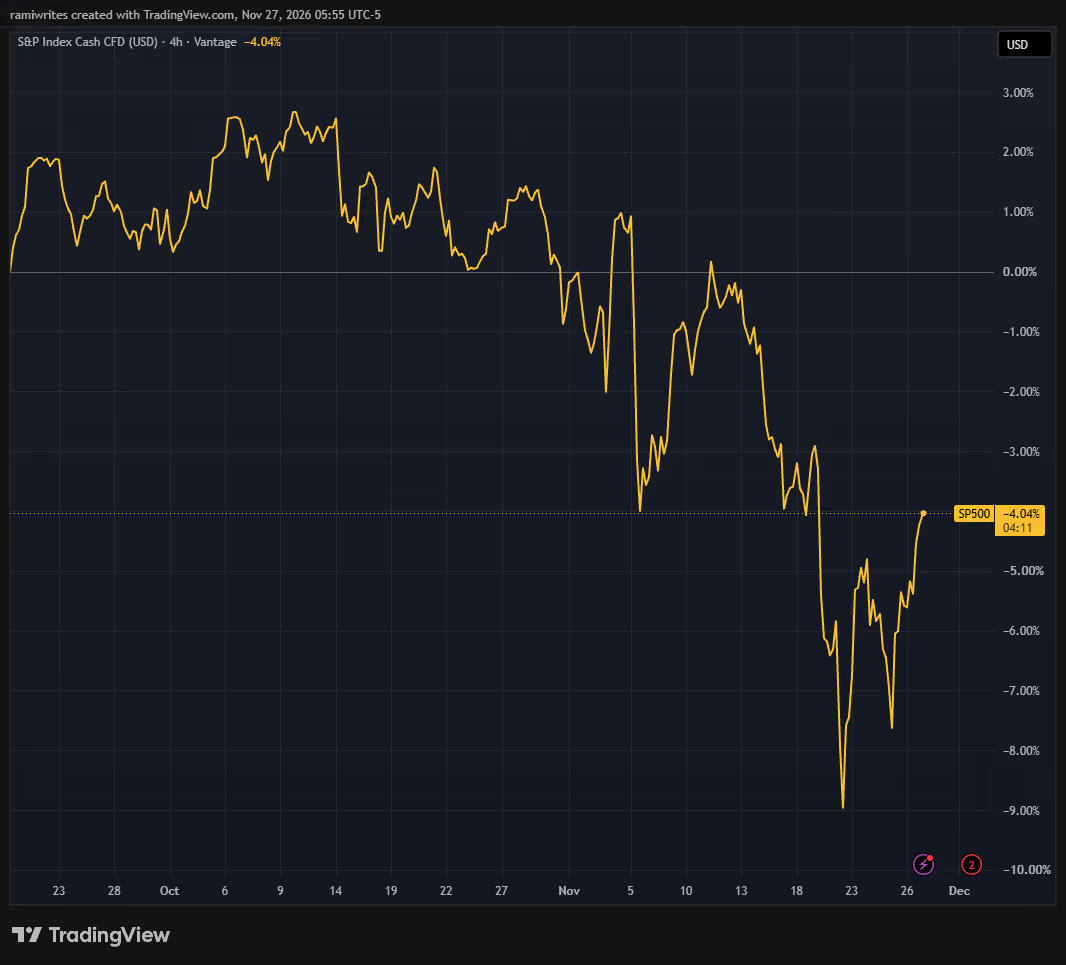
Stocks had a scare of their own. The S&P 500 fell as much as 3.2% during Wednesday's session as chip stocks sold off and Washington proposed new tariffs, then closed down just 0.25%.
The tariffs are a proposal: duties on 14 economies, including 20% on China and 15% on the European Union, with a public hearing on Jan. 25 before anything takes effect.
For the shortened week through Wednesday, the S&P 500 rose 3.9%. It's still about 8% below its Oct. 6 record.
The monthly number pointed to a quarter point in December. The yearly number decides how long borrowing stays this expensive.

Featured Contributor
Today's guest is Robert Rapier of Investing Daily, who last wrote here about why the Dow can rise while the Nasdaq tumbles. It happened again Wednesday: the Dow rose 0.3% and the Nasdaq fell 0.6%.
He wrote this after the Nov. 20 sell-off, and we've updated his prices to Wednesday's close and edited it for length. Since then, Adobe and Visa have bounced and Amazon has slipped.
Nothing here is a recommendation.
Three Stocks I'm Watching After the Sell-Off
The stock market has gone from setting records to making investors nervous in a remarkably short period.
On Friday, Nov. 20, the S&P 500 fell 3.7%, pushing it into correction territory, a drop of 10% or more from its high. The Nasdaq Composite plunged more than 5% in a single session, wiping out its gains for 2026.
The challenge is distinguishing between stocks that have become cheaper because investors are frightened and those whose underlying business prospects have deteriorated.
I don't know whether we've reached the bottom, and I wouldn't trust anyone who claims to know.
But I also know that some of the best long-term opportunities emerge when investors become overly pessimistic. Here are three stocks I'm watching, and I wouldn't approach all three the same way.
Adobe: A Profitable Business Facing an AI Reckoning
Adobe shares closed Wednesday at $232.83, about 36% below their 52-week high.
Adobe's third-quarter revenue increased 13% to a record $6.76 billion, and quarterly operating cash flow climbed to $2.52 billion. The company raised its full-year revenue and earnings guidance after the quarter.
The problem is that investors are questioning Adobe's long-term competitive position. Generative AI tools can now handle creative tasks that once required specialized software, which could pressure both pricing and subscription growth.
That's a legitimate concern, but Adobe has a large installed base, deeply integrated professional workflows and its own AI capabilities.
Adobe now trades at about 13 times its GAAP earnings and under 10 times its projected adjusted earnings. That is an unusually modest valuation for a company still producing this level of growth and cash flow.
The risk is that AI disruption proves more severe than expected.
Amazon: Spending Today for Tomorrow's Growth
Amazon closed Wednesday at $244.43, about 15% below its 52-week high, as investors grow more skeptical of its AI spending.
In the third quarter, revenue increased 12% to $201.9 billion, and operating income climbed from $17.4 billion to $28.1 billion. Amazon Web Services, the cloud-computing division, grew revenue 39% to $46 billion.
Retail is improving too. North American operating income rose from $4.8 billion to $8.7 billion, a sign that Amazon's enormous scale can translate into stronger margins.
The concern is capital spending. Heavy investment in data centers turned trailing 12-month free cash flow negative, even as operating cash flow increased substantially.
Amazon's underlying businesses are generating considerable cash, but management is spending even more. If the AI build-out proves excessive, some of that capital may earn disappointing returns.
Amazon isn't a traditional value stock, and I wouldn't call it cheap simply because its share price has declined. But for patient investors, further weakness could provide an attractive entry point.
Visa: Quality at a More Reasonable Price

Visa shows why investors shouldn't focus only on the stocks with the biggest declines. It closed Wednesday at $424.39, about 4% below its 52-week high.
Visa operates one of the world's largest electronic payment networks and earns revenue as consumers and businesses make transactions. It doesn't generally assume the credit risk behind those purchases, which sets it apart from banks.
Visa's fiscal 2026 revenue increased 15% to $45.9 billion, and adjusted earnings per share rose 16%. It processed more than 281 billion transactions and repurchased about $20.5 billion of its shares.
At about 32 times fiscal 2026 adjusted earnings, Visa is not a bargain-basement stock. A recession could slow consumer spending, and regulation and competition from other payment systems remain risks.
But its business doesn't depend on a massive capital-spending program. I would become more interested if market weakness pushed its valuation lower.
The Bottom Line
I wouldn't buy any stock solely because it has fallen 10%, 20% or even 40%. A lower share price doesn't automatically mean a better investment.
The objective is to identify companies whose long-term earnings potential remains attractive relative to the price investors are now willing to pay.
For the part of a portfolio that's meant to let you sleep, I own the essential-service companies behind America's power, pipelines, water and phone lines, whose dividends kept rising through the rough patches.
Since 2019, my Income Portfolio's worst calendar year was a 5.6% decline, against about 18% for the S&P 500 in its worst year (total return).
That doesn't make it immune from a sell-off like this one. It does mean safety and growth don't have to be a trade.
- Robert Rapier
Investing Daily
Partner content: Robert Rapier writes for Investing Daily, a paid partner of Future Finance. The views and claims above are his own and reflect his opinion at the time of writing, not Future Finance research or advice. Portfolio figures are Investing Daily's own model-portfolio figures, and past performance does not guarantee future results. Nothing here is a recommendation to buy or sell any security. As always, do your own diligence.
Paid Advertisement
Bills Come Every Month. Shouldn't Your Dividends?
Most dividend stocks pay quarterly, and often in the same months. So some months the checks pile up, and other months nothing comes in while the bills keep arriving. That's a scheduling problem, not an income problem. My new Weekly Dividend Calendar shows you how to collect at least one dividend every week for the next year from as few as eight stocks.
InvestingDaily is a paid partner of Future Finance. We receive compensation from Investing Daily if you purchase any products using our links. This compensation comes at no additional cost to you.
Final Thought
Every card purchase today pays more than one party.
The store gets the sale. The card network collects a small fee on the transaction, and the bank that issued your card takes a cut, too.
If the balance is still there when the bill comes, the bank also collects interest. That's the part Robert says Visa doesn't carry: the loan.
Of all those payments, a Fed hike changes only the interest.
Inflation already raised the price on the tag. A Dec. 9 hike would raise the price of paying later.
So every Black Friday deal carries two prices: one set at checkout today, and one set on Dec. 9 that applies only to what's still on the card.
U.S. stocks close early today, at 1 p.m. Eastern.
Tomorrow, The Closing Bell puts the whole week in one place, from Monday's Nvidia rebound to Wednesday's inflation report.
See you tomorrow.
- Rami Al-Sabeq
Editor in Chief | Future Finance
The Public's Buying The Robot. The Smart Money's Buying The Power Cord.
Every investor can name the big AI companies. Far fewer are looking at what makes them run.
The largest gains in a build-out like this often come from the layer underneath the story, the power and the infrastructure most people ignore.
Finding those overlooked plays before the crowd is the whole job of Gems Uncovered.
The crowd buys the headline. The edge is in what powers it.
See how it works right here… →
Disclaimer: This content is not financial advice, it is for informational purposes only. All investments involve inherent risk. Any financial decisions you make are solely your responsibility.






More from
Robert Rapier


Editor's Picks

Become a sharper capital allocator in 5 minutes a day.
Institutional-grade research on where the smartest capital is positioning, across AI, energy, biotech, robotics, and digital assets. Distilled into a daily read you finish before your coffee does.
Join 45,000+ readers · No spam · Unsubscribe anytime · No card needed