

Builders hit a 14-year low. Berkshire is buying
Here’s what Buffett’s successor sees →
November 25, 2026
·
10 Min Read



The briefing serious investors read first.
Free analysis before markets open. Start thinking in decades, not days.
Join 45,000+ readers · No spam · Unsubscribe anytime · No card needed
Before we begin: this report is for education, not financial advice. Nothing here is a recommendation to buy or sell any stock, company, or asset, and we make no price predictions. Investing carries risk, including loss. Please read the full disclaimer at the end.
Today’s Big Picture
Last Tuesday, the people who build America’s homes told their trade group they felt worse than at any point since April 2012.
Yesterday, the people who might buy those homes told the Conference Board they felt better than at any point since January 2025.
Both can be true at once. A steady job feels great right up until you price a 30-year mortgage at 7.28%.
The next clue to how long borrowing stays this expensive landed at 8:30 this morning: the government’s October inflation report.
It’s the Fed’s last big inflation reading before Dec. 9, when it’s expected to raise rates again, and it helps decide whether that hike is a quarter point or a half.
Meanwhile, Berkshire Hathaway has been buying homebuilders, the same companies feeling the worst.
Below: the one line in this morning’s report to check first, a correction to yesterday’s Anthropic story, and Nathan Slaughter on why Warren Buffett’s successor is betting on housing. Plus a programming note for Thanksgiving.

Paid Advertisement
The Next Crisis Won't Destroy Wealth. It Will Simply Change Hands.
A severe financial crisis does not make the world's real wealth disappear. The businesses, land, natural resources, commodities, and productive assets still exist. What changes is who owns them.
Doug Casey and David Stockman have released an urgent briefing on how to position before the transfer.
Disclosure: International Man is a paid partner of Future Finance. The forecasts, track record and claims above are the views of Doug Casey, David Stockman and International Man, and do not represent the view of Future Finance. As always, do your own diligence.
Signal vs. Noise
The Line in This Morning’s Report That Could Double the Fed’s Hike
- The noise: the growth figure that came out at the same minute.
- The signal: the one-month change in core PCE.
PCE stands for personal consumption expenditures. It tracks the prices of what households buy, and it’s the inflation gauge the Fed watches most closely.
“Core” leaves out food and energy, which swing the most from month to month.
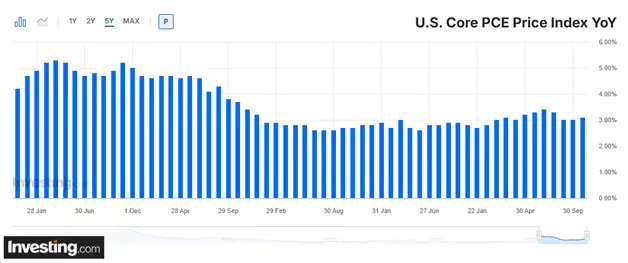
In September, core PCE rose 0.3% for the month and 3.1% from a year earlier. Going in, forecasters expected another 0.3% for October.
The yearly figure can tick up even on a calm month. Last October’s rise was unusually small, so even a modest gain this October lifts the comparison, according to Investing.com.
That’s why forecasts for the yearly number ran from 3.1% to 3.3%, and why the monthly number is the one to check first.
If core rose 0.3% or less for the month, it points to a quarter point in December. If it rose 0.4% or more, the case for a half point just got stronger.
Before the report, traders put the odds of a quarter-point hike on Dec. 9 at about 96%, and a half point at about 4%, according to CME FedWatch. Those odds update through the day.
On Sept. 30, we gave about an 85% chance that the Fed raises rates at least once more before the year is out. Dec. 9 is its last chance, and markets see it as close to certain.
The same 8:30 release brought a second estimate of third-quarter growth (the first came in at 3.4% a year), weekly jobless claims moved up a day for the holiday, and October orders for long-lasting goods. The Fed’s Beige Book, its roundup of business conditions around the country, comes out at 2 p.m.
After September’s hike, we wrote that one rate hike sets two clocks running.
The fast clock is what you pay. The prime rate, 7.00% today, would go to 7.25% after a quarter point, and card rates tied to it usually follow within a billing cycle or two.
On a $6,000 card balance, every quarter point adds about $15 a year in interest. The slow clock is what your savings account pays you.
Whatever the headline said this morning, the monthly core number is the one that can turn a quarter point into a half.
The Dow Closed Above 50,000. The S&P 500 Fell.
- The noise: the 50,000 milestone.
- The signal: money moved out of chip stocks and into most of the rest of the market.
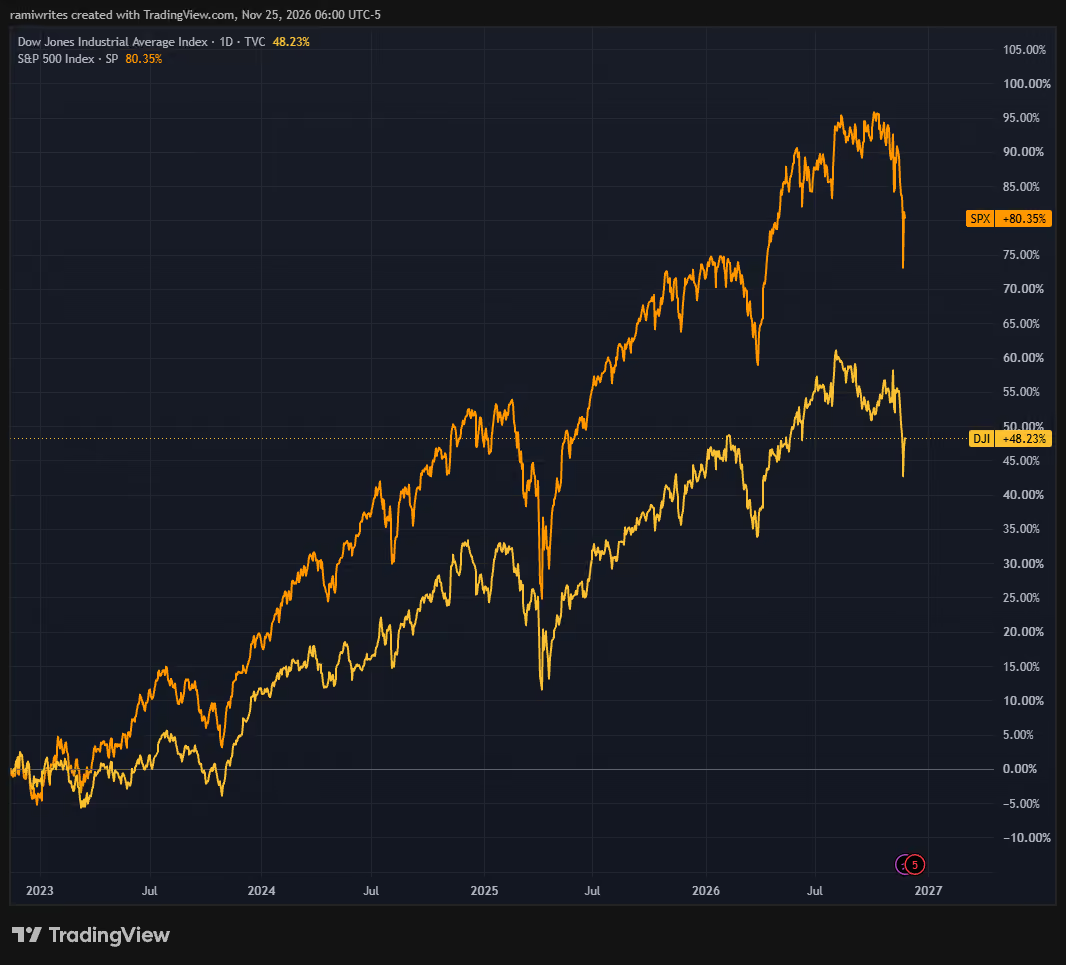
On Tuesday, the Dow Jones Industrial Average rose 0.85% to 50,018.70, its first close above 50,000.
The S&P 500 fell 0.50% to 7,201.09, its eighth loss in nine sessions. It sits 7.9% below its Oct. 6 record.
Nvidia fell about 6%, giving back part of Monday’s 31.5% jump, and a fund that tracks chip stocks lost more than 8%.
Underneath, most stocks rose: 346 of the S&P 500’s members gained and 154 fell. A fund that weights every company in the index equally rose 0.54%.
The biggest companies count the most in the S&P 500, so a bad day for a few giant chip stocks can pull the index down while the average company has a good one.
After the close, Dell showed the spending behind those chips is still growing. Revenue doubled to $54.9 billion, and its backlog of AI server orders hit a record $132.3 billion, up from $95 billion three months earlier.
Early this morning, before the inflation report, U.S. stock futures pointed lower, down about 1% for the S&P 500, on reports that the U.S. is preparing new tariffs on China and the European Union. Those are reports, not announced policy.
On Tuesday, Anthropic, the company behind the Claude AI models, closed below its $83 IPO price for the first time, at $81.91.
A correction: yesterday, we wrote that CEO Dario Amodei sold more than $280 million of stock a day after the debut. The filings show he sold about 3.38 million shares to the underwriters at the $83 offering price, as part of the IPO itself, on the day the offering closed.
He didn’t sell into the market after the debut. We got that one wrong.
The index you own decides which of Tuesday’s two markets you had.

Featured Contributor
Today, a new voice: Nathan Slaughter, chief investment strategist of High-Yield Investing at Investing Daily, who spent years at AXA/Equitable Advisors and Morgan Keegan before he began writing full-time in 2004. Nothing here is a recommendation.
Buffett’s Successor Makes a Big Contrarian Bet on This Industry
In college football, new head coaches get a short window to show fans (and financial boosters) that the program is on the right track, especially where national championship hopes run high.
Just ask LSU coach Lane Kiffin, who is already on the hot seat in the first season of a 7-year, $91 million contract. A 6-5 record will do that.
It’s a different game, but I imagine newly signed corporate CEOs also feel pressure to deliver immediate results, and few more than Greg Abel, who succeeded Warren Buffett as CEO of Berkshire Hathaway on January 1.
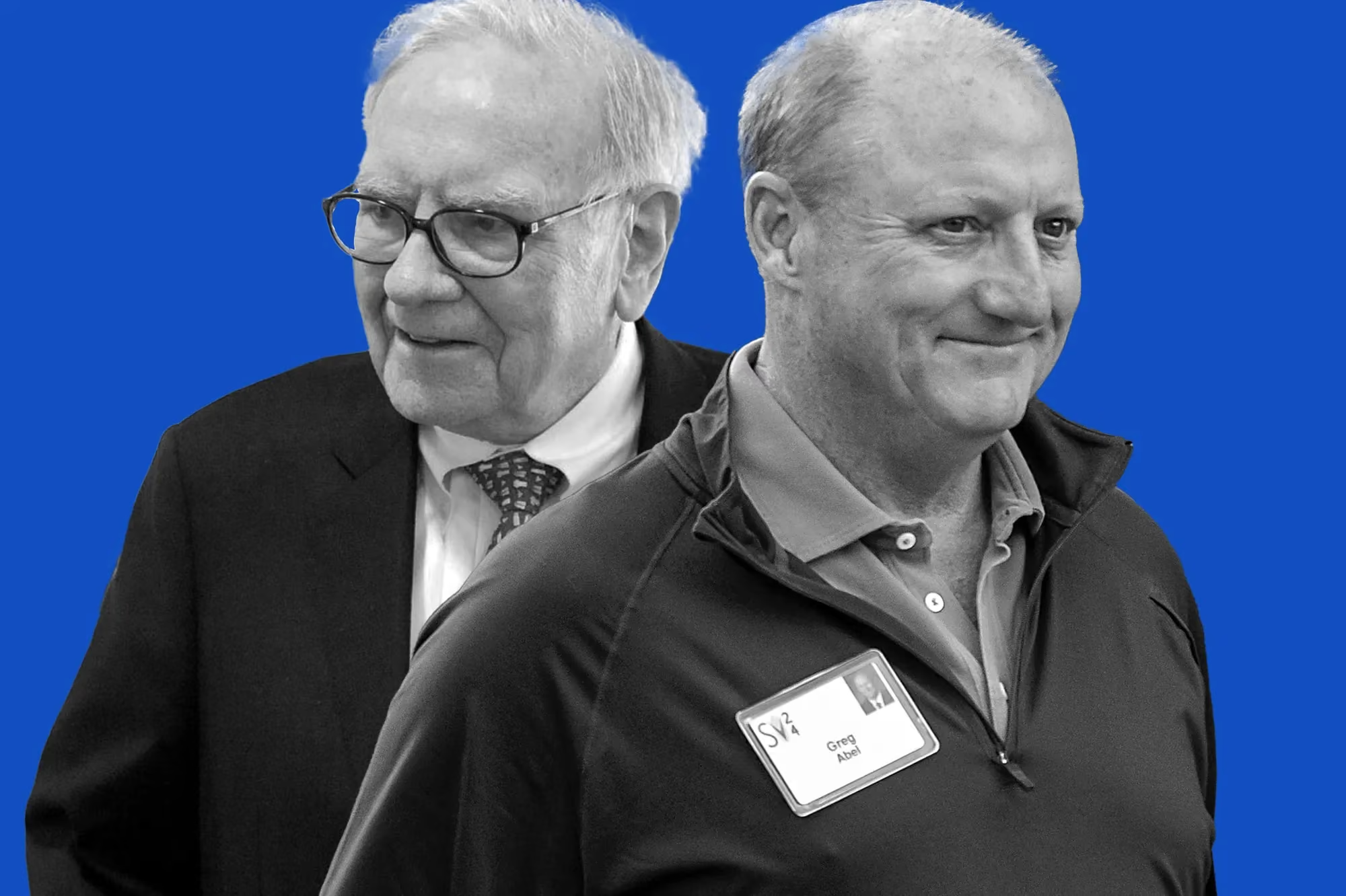
These are big shoes to fill. During his 60-year tenure, Buffett steered Berkshire stock to a cumulative return of 6,099,294%.
Yes, that’s six million percent, compared with about 46,000% for the supposedly “unbeatable” S&P 500 over the same stretch.
Buffett has since stepped down as chairman, too, to become chairman emeritus. Mr. Abel runs a company whose cash pile still tops $350 billion.
So far, so good. Berkshire class B shares have climbed from about $503 at the end of last year to about $572, a healthy 14% gain.
Berkshire’s latest filings show it bought about $2.4 billion of stock in the third quarter and sold about $2.8 billion, a net seller to the tune of $400+ million.
Under Abel, the company has recently thinned its positions in Bank of America and Capital One.
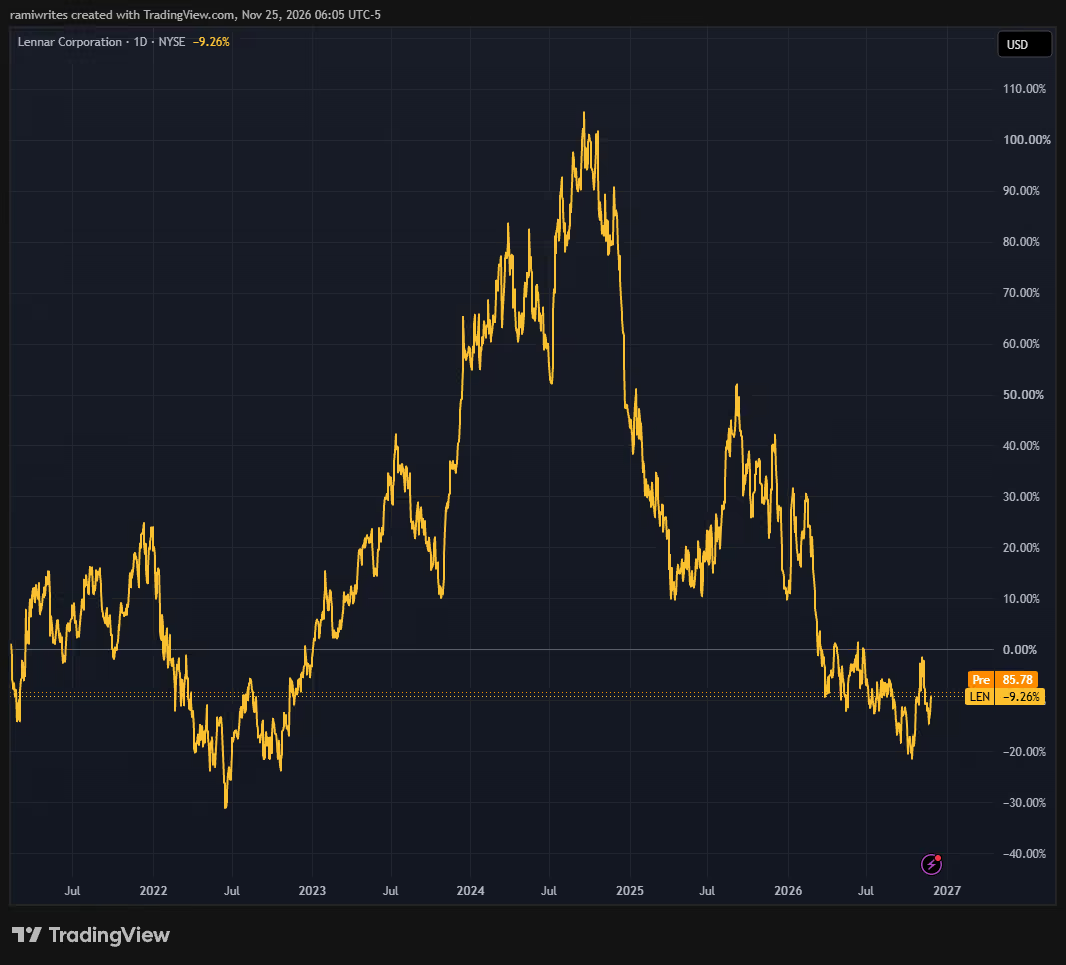
But I find the recent buys even more illuminating. Between July and September, Berkshire accumulated about 13 million shares of the homebuilder Lennar at a cost of roughly $1 billion.
That roughly doubled a stake it had built over the prior 18 months. In other words, Berkshire has doubled down on the homebuilder.

It kept buying last month, lifting its stake to about 12.5% of Lennar’s shares, according to Reuters.
Incidentally, this isn’t the firm’s only wager on homebuilding. This summer, Berkshire closed its all-cash purchase of Taylor Morrison, a deal valued at about $8.5 billion including debt.
Taylor Morrison alone delivered about 13,000 homes last year, and Clayton Properties was already a longtime Berkshire subsidiary.
“Together, we will help more Americans achieve their dream of homeownership,” Abel said of the deal.
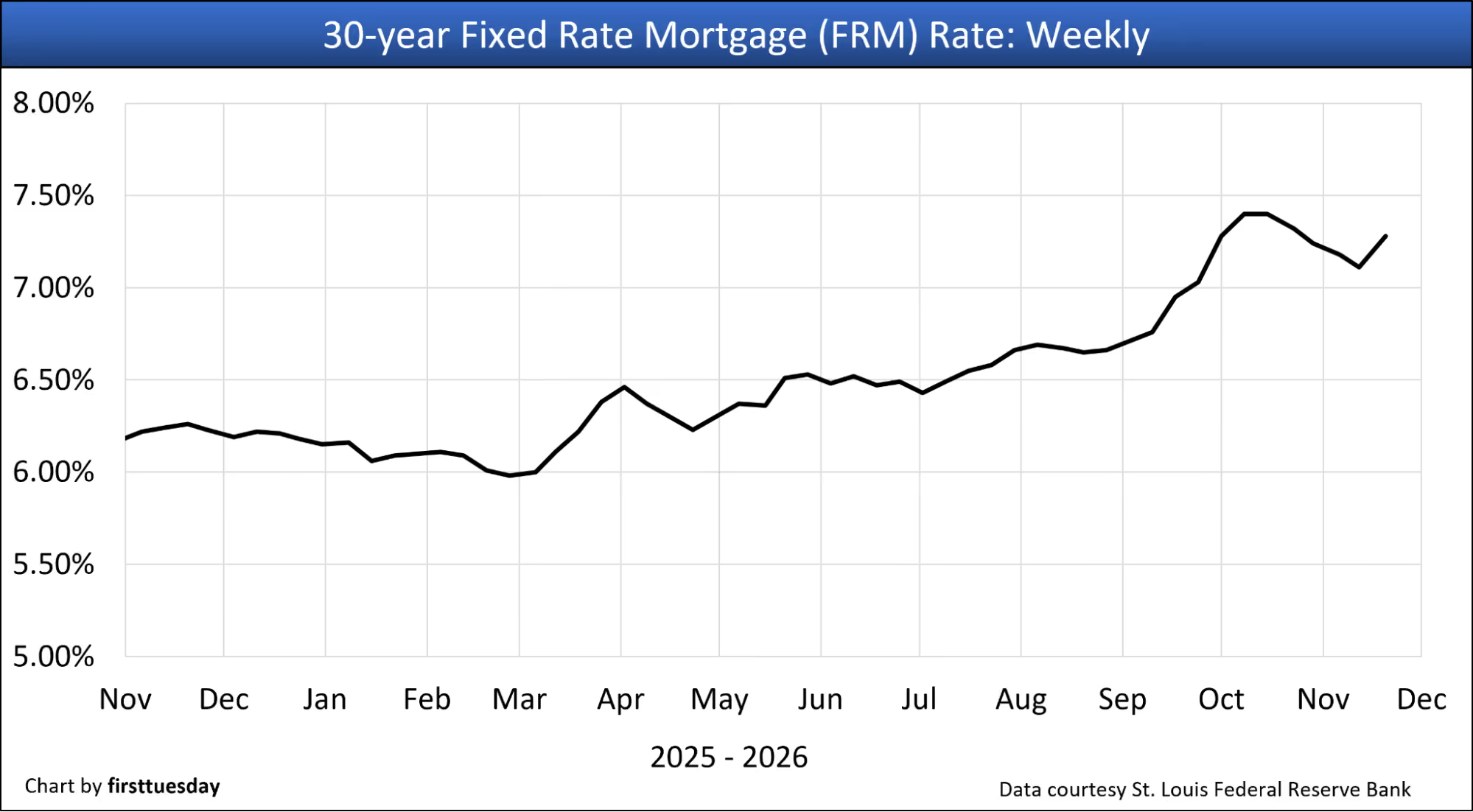
It’s no secret that affordability is a major obstacle right now. The average 30-year mortgage rate is back above 7%, at 7.28% in Freddie Mac’s Nov. 19 survey.
Throw in labor shortages and regulatory hassles, and you can see why builder confidence just sank to its lowest level since 2012, according to the National Association of Home Builders. Nearly half of builders cut prices this month.
But Abel is looking at tomorrow, not yesterday.
We have been underbuilding ever since the subprime collapse of 2008. There just hasn’t been enough construction to keep pace with population growth and new household formation.
This is a fundamental supply shortage.
Lennar is working to close the shortfall. With lean inventories in many markets, it delivered nearly 21,000 new homes last quarter and took orders for about 21,000 more.
That left a backlog of 16,857 homes worth $6.3 billion in future revenue.
It expects to deliver 22,000 to 23,000 homes this quarter at an average price of about $375,000 each, and about 80,000 for the year.
Volume is down about 3% from a year ago, and pricing incentives (mortgage buydowns, closing-cost help and the like) have pinched gross margins to 15.8% from 17.5%.
The company is sacrificing margins to keep its volume up, and this earnings slump will eventually give way to recovery.
In the meantime, Lennar took advantage of the depressed stock price by plowing about $256 million into buybacks last quarter, retiring 3 million shares. That automatically enlarges Berkshire’s stake, as well as the stakes of those who follow its lead.
Berkshire has the cash and the patience to wait for homebuilders to turn around. Most of us don’t have either, and we would rather be paid while we wait.
So I count differently.
I went through the S&P 500 one company at a time, and only 50 of the 500 still yield 4% or better.
Only 19 yield 5%. Just 7 yield 6%.
In High-Yield Investing, I follow 56 income positions with a median yield of 5.55%, and 41 of the 56 yield 4% or better.
My flagship report, The Last 4% Yields in America, covers them, along with the number almost nobody publishes: what each one yielded on the day we bought it.
See the last 4% yields in America →
- Nathan Slaughter
Chief Investment Strategist, High-Yield Investing
Partner content: Nathan Slaughter writes for Investing Daily, a paid partner of Future Finance. The views and claims above are his own and reflect his opinion at the time of writing, not Future Finance research or advice. Nothing here is a recommendation to buy or sell any security. As always, do your own diligence.
Paid Advertisement
The Retirement Risk Nobody Warns You About
Bills don't wait for quarter-end. They show up all month long. The Weekly Dividend Calendar lines up stable dividend stocks so a payment arrives every week, and some weeks you'll get up to three. You'll see exactly when you get paid and how much, so there's no more guessing.
InvestingDaily is a paid partner of Future Finance. We receive compensation from Investing Daily if you purchase any products using our links. This compensation comes at no additional cost to you.
Final Thought
The two surveys at the top of today’s issue weren’t asking about the same thing.
Shoppers were asked about their jobs and their incomes, and jobs feel easier to find than they did a month ago. Builders were asked about their buyers, and their buyers need a mortgage.
That’s how Berkshire can buy what builders feel worst about. It doesn’t need a loan, and it doesn’t need the money back soon.
For most families, how this economy feels depends on what they need to borrow. This morning’s report was the last big clue to that price before Dec. 9.
A note for the holiday: there’s no Future Finance tomorrow. U.S. stock and bond markets are closed for Thanksgiving, and so are we.
We’re back Friday, when stocks close early, at 1 p.m. Eastern, with what this morning’s numbers changed.
From all of us at Future Finance, happy Thanksgiving.
See you Friday.
Editor in Chief | Future Finance
Everyone Owns The Same Seven Stocks. The Edge Is Everywhere Else.
When 40% of the market is crowded into a handful of names, the opportunities with real room to run are the ones the crowd hasn't found yet.
That's the whole job of Gems Uncovered, the weekly research report on early, asymmetric plays before they reach the mainstream.
The crowd piles into what's already big. This is about what's next.
See how it works right here… →
Disclaimer: This content is not financial advice, it is for informational purposes only. All investments involve inherent risk. Any financial decisions you make are solely your responsibility.






Editor's Picks


Become a sharper capital allocator in 5 minutes a day.
Institutional-grade research on where the smartest capital is positioning, across AI, energy, biotech, robotics, and digital assets. Distilled into a daily read you finish before your coffee does.
Join 45,000+ readers · No spam · Unsubscribe anytime · No card needed