

A 50% drop before insiders could sell
Today they can. The date was set a year ago →
November 24, 2026
·
9 Min Read



The briefing serious investors read first.
Free analysis before markets open. Start thinking in decades, not days.
Join 45,000+ readers · No spam · Unsubscribe anytime · No card needed
Before we begin: this report is for education, not financial advice. Nothing here is a recommendation to buy or sell any stock, company, or asset, and we make no price predictions. Investing carries risk, including loss. Please read the full disclaimer at the end.
Today’s Big Picture
A year ago this week, about 86,000 people bought a brand-new digital token for 2.5 cents apiece.
It was Coinbase’s first public token sale, and the token was MON, from a new blockchain called Monad.
This morning, MON trades near 1.2 cents, about half what those buyers paid.
Until today, the people who built Monad and the investors who funded it couldn’t sell a single one of their tokens.
Today, a year after launch, about 16.6 billion MON unlock for them. That’s more than all the MON that trades today.
The date was public before the first MON ever traded.
Every investment runs on two calendars.
One is the news that changes demand, like Monday’s return of Nvidia’s CEO, which gave stocks their best day since April 2025.
The other is the schedule for new supply, and that one is written down in advance.
Below: what Monday’s rally changed and what it didn’t, why the biggest IPO on record slipped under its offer price this morning, and The DeFi Doctor on how to read a token’s unlock schedule before you buy.

Paid Advertisement
Is This How America Ends?
Whitney Tilson called the 2000 tech wreck and appeared in an Emmy-winning 60 Minutes episode on the 2008 crisis.
Now he says the next six months will bring extreme change to America, driven by AI, and that no one in the country will be able to avoid it.
His full prediction is free to watch.
Disclosure: MarketWise is a paid partner of Future Finance. The forecasts, track record and claims above are those of Whitney Tilson, Stansberry Research and MarketWise, not Future Finance research or advice. As always, do your own diligence.
Signal vs. Noise
Nvidia Won Back Nearly $1 Trillion. The Rate Hike Is Still Coming.
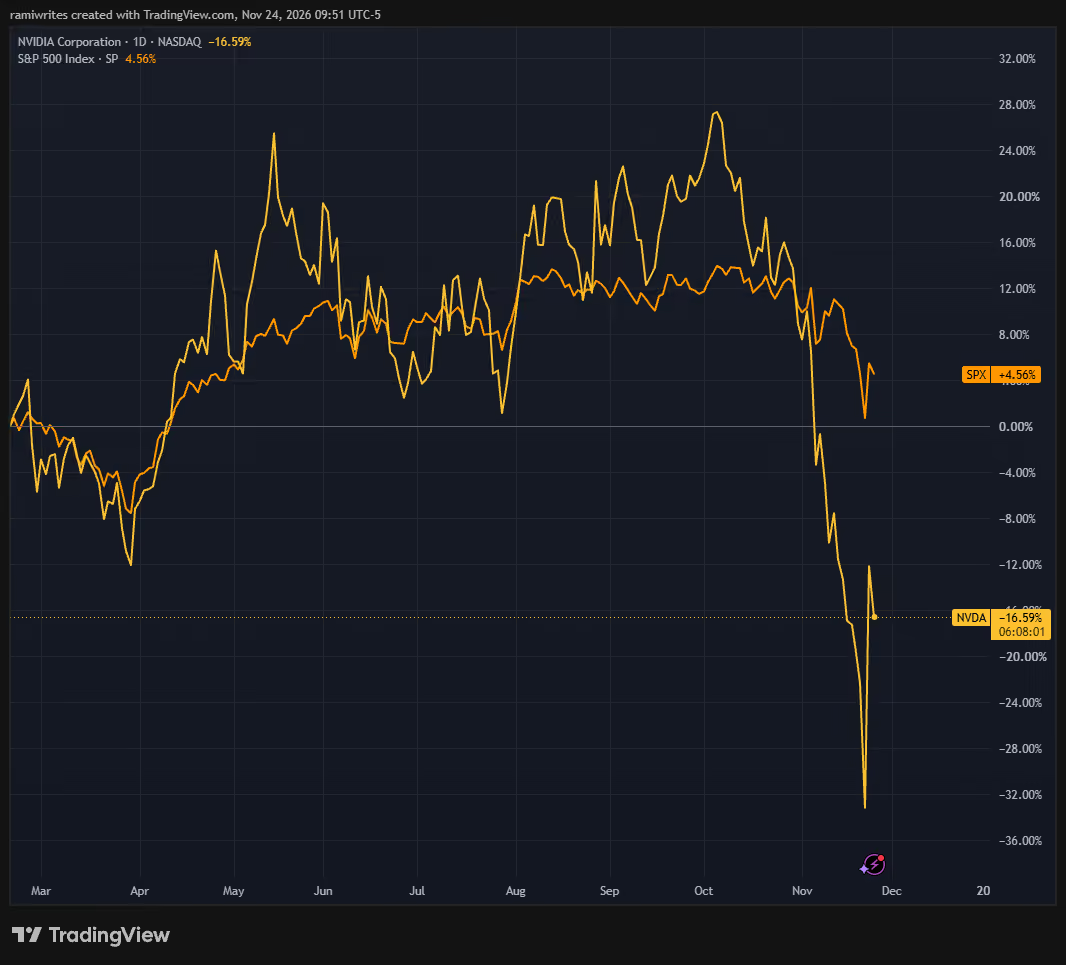
- The noise: Monday’s rally, and this morning’s pullback.
- The signal: Huang’s return settled who runs Nvidia. It didn’t change what the Fed is about to do.
On Monday, Nvidia’s directors voted unanimously to reinstate Jensen Huang as CEO, 11 days after he resigned.
The board said it had heard from senior U.S. government officials and is confident his return poses no national security risk. President Trump told CNBC he had spoken with the board “directly and indirectly.”
Nvidia rose 31.5%, its best day since May 2003, adding back nearly $1 trillion in market value.
Because it’s one of the biggest companies in the index, it lifted the whole index. The S&P 500 gained 4.73% to 7,237.17, and the Nasdaq Composite jumped 6.51%.
On Friday, the S&P 500 had closed more than 11% below its Oct. 6 record of 7,818.93, which counts as a correction. Monday’s close put it back to about 7.4% below the record.
Some of that reversed this morning. As of 8:39 a.m. Eastern, S&P 500 futures were down 1.4%, and Nvidia was down more than 5% before the opening bell.
What hasn’t changed is the Fed. Traders still see a rate hike on Dec. 9 as close to certain, according to CME FedWatch.
You can see it in the dollar. On Monday, the dollar index, which measures the dollar against six major currencies, climbed above 104 for the first time since March 2025.
That one is on our scorecard. On Sept. 30, we gave the dollar about a 30% chance of touching 104 before the year is out, the bolder half of our call that it ends 2026 above 100.
On Monday, it touched about 104.5.
A stronger dollar makes imports and trips abroad cheaper. Higher rate expectations keep borrowing expensive: the average 30-year mortgage was 7.28% last week, up from 6.26% a year ago, according to Freddie Mac.
Huang’s return reset Nvidia’s price in a morning. Wednesday’s inflation report could reset the price of borrowing.
Anthropic Dipped Below $83. Look at Who’s Selling.
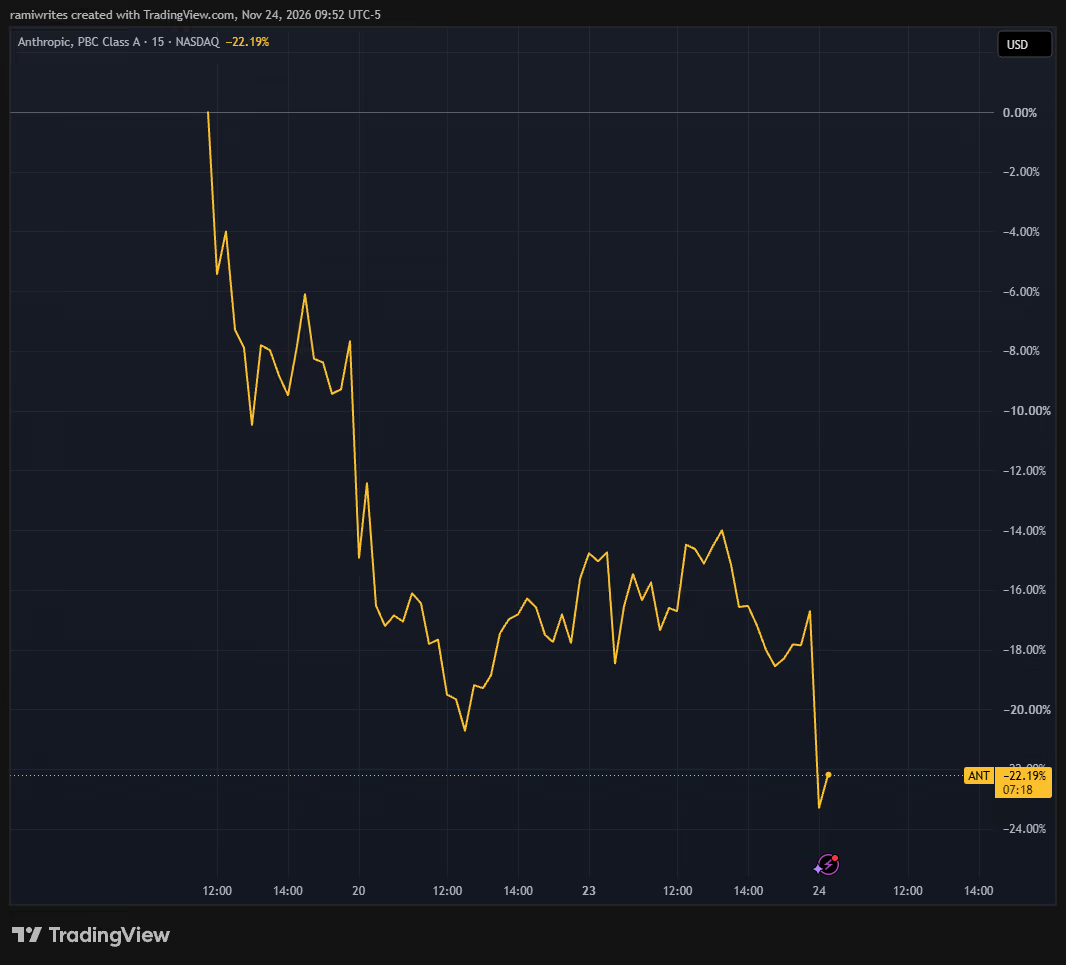
- The noise: the idea that the biggest IPO on record is already a flop, five days in.
- The signal: more shares are reaching the market, and most of that supply arrives on dates you can look up.
Anthropic, the company behind the Claude AI models, priced its shares at $83 last Wednesday. They opened Thursday at $111.50, 34% higher.
Since then, the stock has slid with the rest of tech, and it missed Monday’s rally, closing at $87.64.
Early this morning, it traded below its offer price for the first time, as low as $81.77 at 6:26 a.m. Eastern, before climbing back near $83.
Anyone who bought that first trade at $111.50 is down about 25%.
Part of the pressure is supply. A filing late Monday showed CEO Dario Amodei sold more than 3.37 million shares, worth over $280 million, a day after the debut, Reuters reported.
Most insider shares are still locked up for months. Every one of those release dates sits in the company’s filings, long before it arrives.
We wrote it on Nov. 19, the morning Anthropic started trading: the first day shows you demand, and the lockup calendar shows you supply.
Digital assets have lockups too. They’re called unlocks, and the largest one on this month’s calendar lands today.
Every share an insider sells is a share someone else has to buy.
Paid Advertisement
#1 Tech Investor: Elon's Move Will Mint 1,806,000 Millionaires
Renowned tech investor James Altucher – the man who called the rise of Nvidia, Apple and SpaceX years in advance – just uncovered Elon Musk's latest breakthrough idea…
And according to James, it's going to be even bigger than the SpaceX IPO – creating up to 1.8 million new millionaires over the coming years.
The pieces behind it are inside this briefcase – which he reveals 100% FREE in this video.
Click here now for all the details. →
Disclosure: Paradigm Press is a paid partner of Future Finance. The forecasts and claims above are James Altucher's / Paradigm's, not Future Finance research or advice. As always, do your own diligence.

Featured Contributor
Today’s guest is The DeFi Doctor, head of education at Decentralized Masters and author of Beat Banks, a twice-weekly briefing on where real yield opportunities exist in decentralized finance. Nothing here is a recommendation.
Read the Label: Monad’s Unlock, Explained
Hey, my friends.
Every box of prescription pills comes with a folded leaflet inside.
It tells you the dose and what to watch for. Most people throw it out without unfolding it.
Digital assets come with a leaflet too. It’s called the unlock schedule, and one of them comes due today.
Let’s read it together.
What a token unlock is
When a new blockchain launches, its token gets divided up. Some goes to the public, and a big share goes to the people who built the network and the investors who paid for it.
Think of it a little like stock in a startup, though tokens don’t come with the same legal rights.
Insiders usually can’t sell right away. Their tokens are locked, the same way a startup might make early employees wait a year before they can sell their shares.
The day the lock lifts is the unlock. A big batch released all at once is called a cliff.
After that, the rest usually drips out month by month, which is called vesting. All of it is published, often years in advance.
What unlocks today
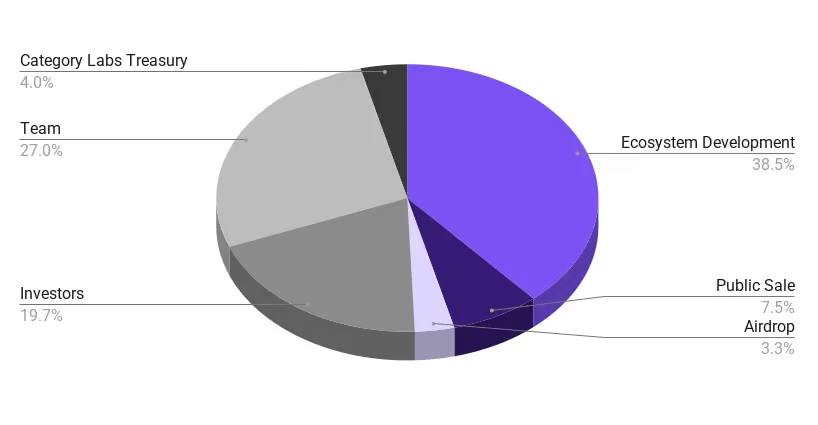
Monad is a blockchain built to run Ethereum apps faster and more cheaply. It launched a year ago today with 100 billion MON tokens.
At launch, about 10.8 billion went to the public, through Coinbase’s token sale and a giveaway to early users called an airdrop.
About half the supply, 50.6 billion MON, was locked for the team, the early investors and Category Labs, the company that built Monad.
Today, the first big batch of that comes free: about 16.6 billion MON.
For scale, about 11.8 billion MON circulate today, meaning they’re free to trade. Today’s batch is about 1.4 times that.
After today, roughly a billion more MON unlock every month until late 2029.
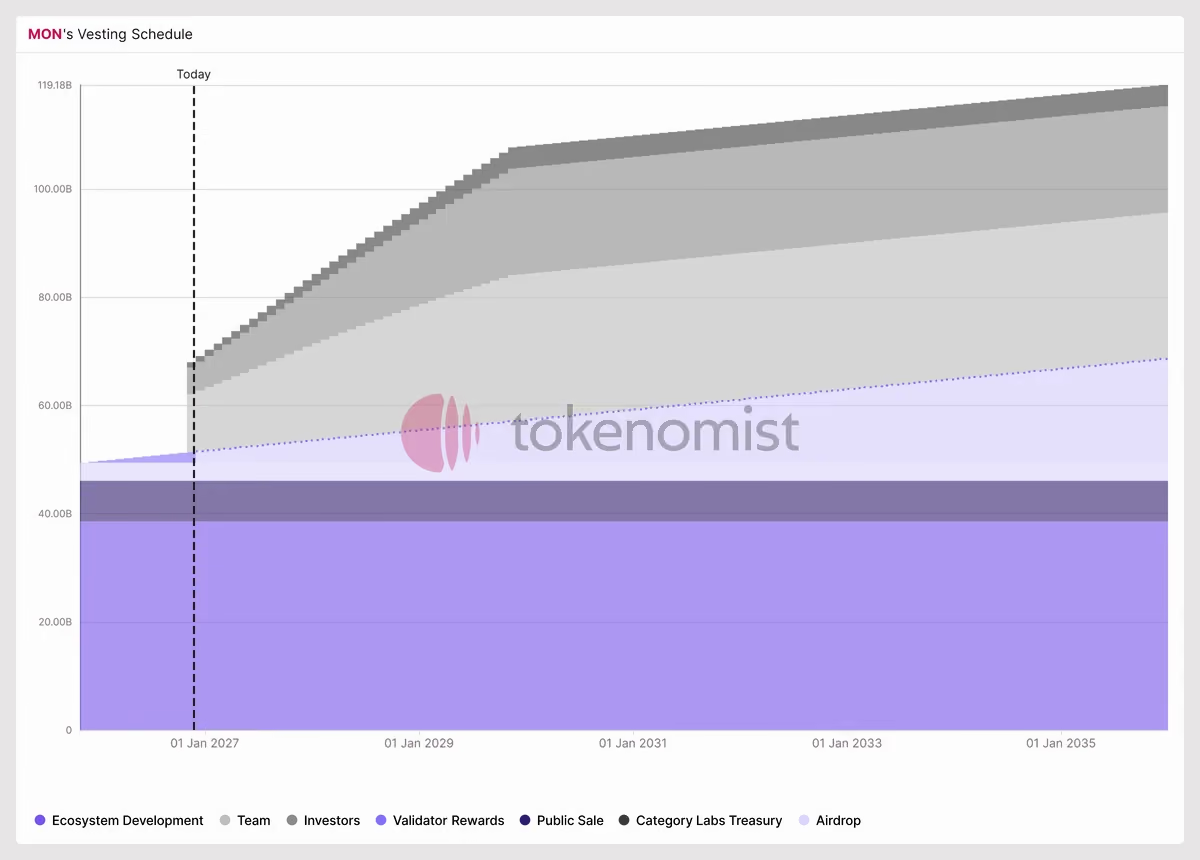
Why supply moves the price
A price is where buyers and sellers meet.
If the number of tokens free to sell more than doubles, and the number of buyers stays the same, the price usually has to fall to find new ones.
Unlocked isn’t the same as sold. Some insiders will hold.
In August, the Monad Foundation offered to buy locked MON from some early investors at a discount, with up to $60 million set aside. Almost all of them said no.
In practice, the selling pressure tends to show up early. Keyrock, a firm that trades digital assets, studied more than 16,000 unlocks.
About 90% put downward pressure on the price. The pressure often started a month before the date, and unlocks that went to teams did the most damage.
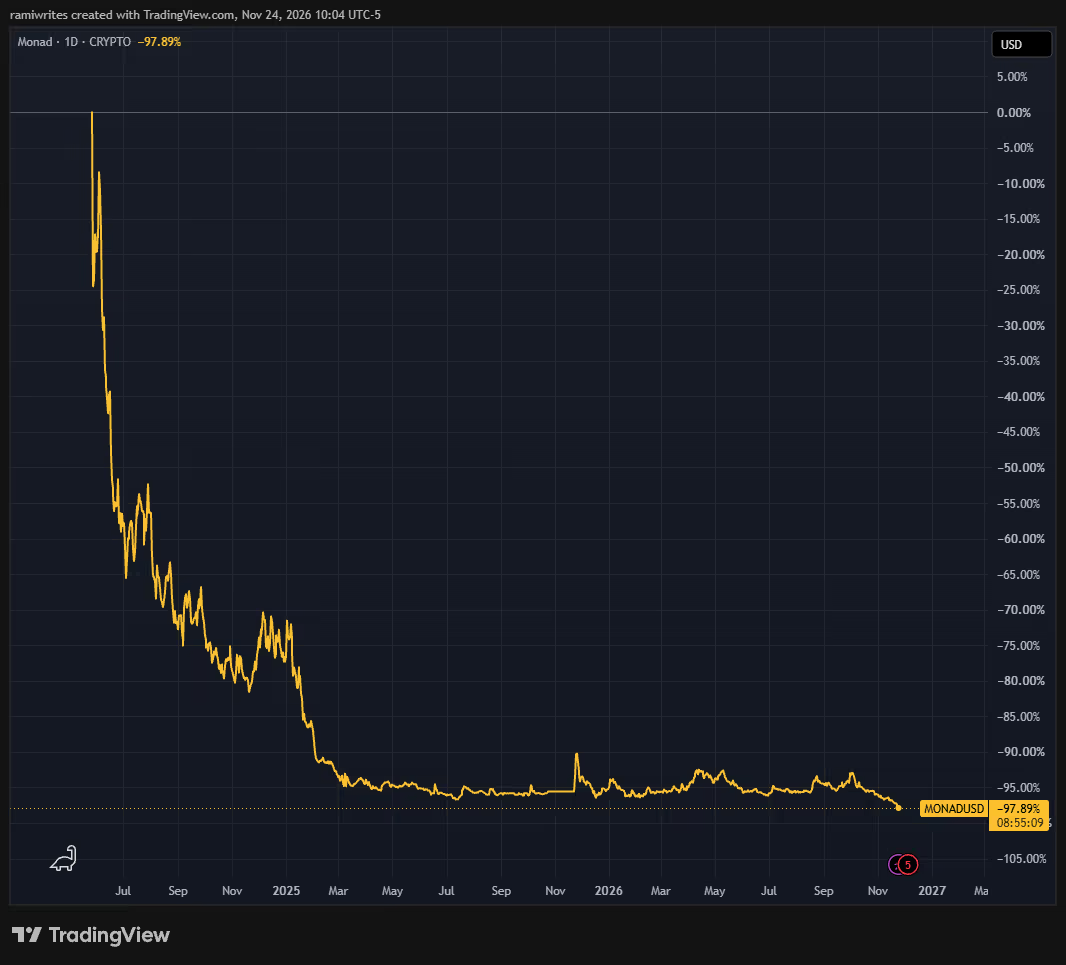
MON fits the pattern. It hit a record low this week, about half its 2.5-cent sale price and roughly 75% below its peak two days after launch.
Some of that is the whole market: Bitcoin is down about a quarter this month. But the date was there to read the whole time.
Three questions I ask before I touch a token
- How much trades today, compared with how much exists? At Monad, about 12 of every 100 MON are circulating.
- Who holds the rest, and when can they sell? Free tracking sites such as DefiLlama and Tokenomist list the dates.
- How big is the next unlock, compared with what trades now? A drip of 1% a month is very different from a batch bigger than everything already trading.
The answers give you the supply side of the story before you buy.
I’ve had November 24 circled for Beat Banks readers since October.
When something on The Board depends on a token like MON, the dates that could change it sit right next to the yield, along with a risk scorecard and the catch.
That’s what Beat Banks is: six DeFi opportunities every Tuesday, two at each risk level, and a checkup every Thursday on what moved.
In medicine, reading the leaflet takes two minutes and can save you a bad week.
Reading a token’s unlock schedule takes about as long.
- The DeFi Doctor
A 9% Yield, and the 3.7% Average Next to It
Last week, one of The DeFi Doctor’s six picks was a vault that lends out digital dollars, showing 9% a year.
In the same write-up, he told readers it had averaged about 3.7% over the past 90 days, and that today’s Monad unlock could change how much people want to borrow against MON.
That’s Beat Banks, his twice-weekly newsletter on earning yield in decentralized finance.
Every Tuesday, he picks six opportunities, two at each risk level, from 6% on a low-risk pair of Bitcoin tokens to several hundred percent on pools that need checking every day.
For each one, you get where the yield comes from, what it means in dollars on every $1,000, a risk scorecard and the catch.
Every Thursday, he follows up on what moved and what to check.
Get The DeFi Doctor’s next six picks →
Yields were current when published on Nov. 17 and change often. Higher yields carry higher risk, including the loss of principal.
Final Thought
Monday showed how fast demand can change. One board vote, and the market’s biggest AI stock was worth a different amount by lunch.
Supply doesn’t work like that. It shows up when the paperwork says it will.
Monad’s insiders have known their date for a year. Anthropic’s insiders know theirs.
And next Monday, Nov. 30, funds that copy MSCI’s stock indexes have to sell their shares of Strategy, the biggest corporate owner of Bitcoin, because MSCI drops it after the close.
Each of those dates is on the record, where anyone can look it up before they buy.
The surprises get the headlines. The calendar is the part you can read ahead of time.
Tomorrow is a calendar day, too. At 8:30 a.m. Eastern, the October PCE inflation report, a second look at third-quarter growth and weekly jobless claims all land at once.
It’s the Fed’s last big inflation reading before Dec. 9. Markets close Thursday for Thanksgiving and close at 1 p.m. Eastern on Friday.
See you tomorrow.
Editor in Chief | Future Finance
Paid Advertisement
52 weeks. 52 Potential paydays.
Most dividend stocks pay four times a year. March, June, September, December. Then weeks of silence.
Robert's colleague Nathan Slaughter built a calendar that fills every one of the 52 week-slots in a year. Four monthly payers and three quarterly holdings, sequenced so no week is empty.
Several holdings also pay bonus dividends that cluster in December through February. The same weeks the tax bill and the insurance premium land.
Disclosure: Investing Daily is a paid partner of Future Finance. The forecasts, track record and claims above are those of Nathan Slaughter and Investing Daily, and do not represent the view of Future Finance. As always, do your own diligence.
Disclaimer: This content is not financial advice, it is for informational purposes only. All investments involve inherent risk. Any financial decisions you make are solely your responsibility.





Editor's Picks

Become a sharper capital allocator in 5 minutes a day.
Institutional-grade research on where the smartest capital is positioning, across AI, energy, biotech, robotics, and digital assets. Distilled into a daily read you finish before your coffee does.
Join 45,000+ readers · No spam · Unsubscribe anytime · No card needed