

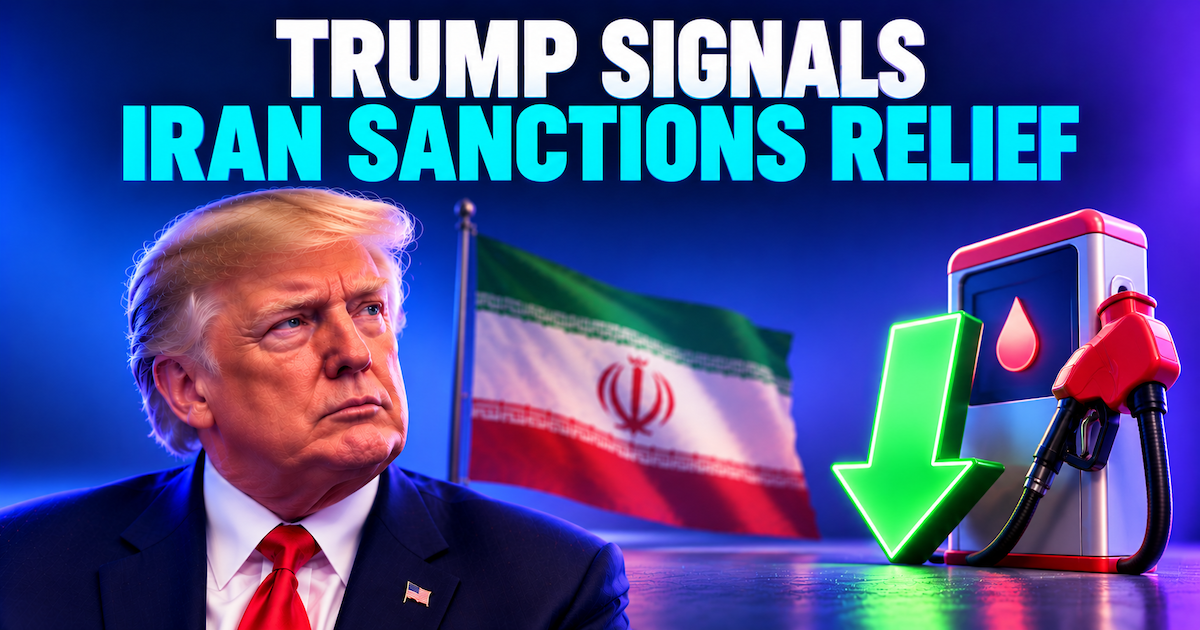
Trump Signals Iran Sanctions Relief: What It Means for Gas Prices and Your Money
Gas just hit its highest price ever for this time of year. Trump's offer to Iran could change that, if Tehran moves first.
September 28, 2026
·
5 Min Read



The briefing serious investors read first.
Free analysis before markets open. Start thinking in decades, not days.
Join 45,000+ readers · No spam · Unsubscribe anytime · No card needed
Gas is averaging $4.48 a gallon across America, the highest it has ever been at this time of year, and the reason sits halfway around the world in a narrow stretch of water off Iran.
Today brings the first real sign that could change. President Trump is willing to ease sanctions on Iran and release its frozen money, a U.S. official has confirmed, but only if Tehran makes concrete progress on its nuclear programme.
The catch is that just two days ago Trump rejected Iran's offer to reopen that waterway, and oil prices jumped as a result.
Here's what it means for you.
What Did Trump Offer Iran?
The offer is real, but it comes with strings attached.
A U.S. official told CNN on Monday that Trump would give Iran sanctions relief and unfreeze its assets as part of a final deal, and described the talks taking place through mediators as positive and constructive. There will be no deal, though, unless Iran moves on its nuclear programme first.
That is a very different position from the one Iran put forward at the United Nations on Friday, which asked Washington to lift its naval blockade of Iranian ports, waive oil sanctions and release frozen funds in exchange for reopening the Strait of Hormuz within seven days. Trump called it unacceptable.
Both sides now want roughly the same trade. They simply disagree on who has to move first.
Why Does This Matter for Gas Prices?
Before the war began in February, about a fifth of the world's oil passed through the Strait of Hormuz.
Shipping through it has collapsed since then, and Brent crude, the global oil benchmark, climbed back above $107 a barrel on Monday after Trump turned Iran's proposal down.
That flows straight through to the pump, where drivers are paying more than a dollar a gallon above what they paid a year ago. It also shows up in grocery bills, airline tickets and heating costs this winter, and it makes it harder for inflation to come down, which keeps mortgage and loan rates higher for longer.
For most households, the quickest route to cheaper gas runs through a deal in the Gulf.
What Could Happen Next?
Trump says he expects talks with Iran to resume this week, with Qatar carrying messages between the two sides.
If a deal reopens the strait, oil could fall fast. When Iran briefly declared the waterway open in April, U.S. crude dropped almost 12% in a single day.
If talks fail, the risk runs the other way. The Wall Street Journal has reported that Trump told aides he expects U.S. strikes on Iran to resume after November's midterm elections.
Either way, what you pay at the pump over the next few months will depend less on America's economy than on what happens in one stretch of water.
When Oil Moves This Fast, New Opportunities Follow
Markets can change quickly.
One stretch of water has pushed oil back above $107 a barrel, and when prices move like that, money moves with them, often into areas most people are not watching yet.
The hard part is spotting that shift early.
That's why we created The $5 Trillion Signal.
It's a free, beginner-friendly report covering five technologies we believe could attract trillions of dollars over the next decade.
It shows you what they are, why they matter, and the investment themes already forming around them.
If you want a simple way to understand where some of the biggest changes in technology and markets could be heading next, this is a good place to start.
Get your free copy of The $5 Trillion Signal below.
The briefing serious investors read first.
Free analysis before markets open. Start thinking in decades, not days.
Join 45,000+ readers · No spam · Unsubscribe anytime · No card needed
Disclaimer: This content is not financial advice, it is for informational purposes only. All investments involve inherent risk. Any financial decisions you make are solely your responsibility.
Latest


Editor's Picks

Become a sharper capital allocator in 5 minutes a day.
Institutional-grade research on where the smartest capital is positioning, across AI, energy, biotech, robotics, and digital assets. Distilled into a daily read you finish before your coffee does.
Join 45,000+ readers · No spam · Unsubscribe anytime · No card needed