

10-Year Treasury Yield Hits 5.2%: What It Means for Mortgages, Stocks and Your Money
The 10-year Treasury yield just hit 5.2%, and your mortgage, stocks and savings can all feel it. Here’s why it matters now.
September 25, 2026
·
5 Min Read



The briefing serious investors read first.
Free analysis before markets open. Start thinking in decades, not days.
Join 45,000+ readers · No spam · Unsubscribe anytime · No card needed
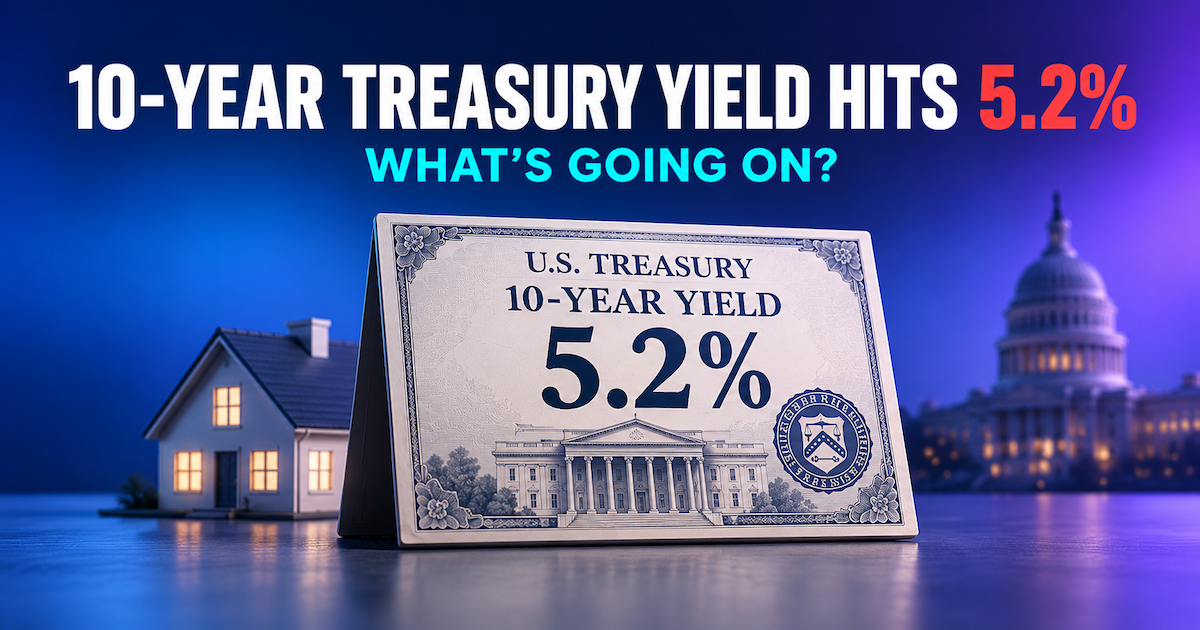
The 10-year Treasury yield has jumped above 5.2%, its highest level in 19 years, and that number can quietly affect everything from the mortgage rate on a new home to what investors are willing to pay for stocks.
It sounds like a Wall Street statistic, but the 10-year yield is really one of the prices of money in America.
When it rises sharply, borrowing becomes more expensive and the effects can spread through household budgets, businesses and retirement accounts.
What Is the 10-Year Treasury Yield?
A 10-year Treasury is essentially a 10-year loan to the U.S. government.
Investors buy the bond, receive interest and get their money back at maturity.
The “yield” is the return investors can earn at the bond’s current market price.
Bond prices and yields move in opposite directions, so when investors sell Treasuries or demand a better return to hold them, yields rise.
The benchmark yield reached 5.225% overnight, its highest since 2007, after gaining roughly 30 basis points, or 0.30 percentage points, in two sessions.
Why Is the Treasury Yield Rising?
There is no single cause.
Markets are weighing stubborn inflation, expectations that the Federal Reserve may keep rates higher, heavy government borrowing and how much return investors should demand to lock money away for a decade.
The Fed does not directly set the 10-year yield.
Investors do, based largely on where they think inflation, economic growth and interest rates are heading.
Why Does 5.2% Matter to You?
Mortgage rates often move alongside the 10-year Treasury because lenders price long-term home loans against many of the same forces.
Freddie Mac says the average 30-year fixed mortgage reached 7.03% this week, up from 6.71% at the start of September.
Higher yields can also pressure stocks.
If government debt offers more than 5%, investors may demand better returns before taking the extra risk of owning expensive shares.
Companies face higher financing costs too, which can eventually affect expansion, hiring and investment.
Savers can benefit, however, because higher market rates can support better returns on bonds, CDs and some savings products.
The Next Big Opportunity Could Be Hiding in Plain Sight
Markets can change quickly, and the hard part is understanding which shifts matter before they become obvious.
That’s why we created The $5 Trillion Signal, a free, beginner-friendly report covering five technologies we believe could attract trillions over the next decade.
It shows you what they are, why they matter, and the investment themes already forming around them.
Get your free copy of The $5 Trillion Signal below.
The briefing serious investors read first.
Free analysis before markets open. Start thinking in decades, not days.
Join 45,000+ readers · No spam · Unsubscribe anytime · No card needed
Disclaimer: This content is not financial advice, it is for informational purposes only. All investments involve inherent risk. Any financial decisions you make are solely your responsibility.
Latest




Editor's Picks



Become a sharper capital allocator in 5 minutes a day.
Institutional-grade research on where the smartest capital is positioning, across AI, energy, biotech, robotics, and digital assets. Distilled into a daily read you finish before your coffee does.
Join 45,000+ readers · No spam · Unsubscribe anytime · No card needed