

Should you sell before the Fed?
Oil crossed $100, the Fed decides Wednesday, and Tan's orders decided in July. Two of his four signals just fired.
September 11, 2026
·
8 Min Read



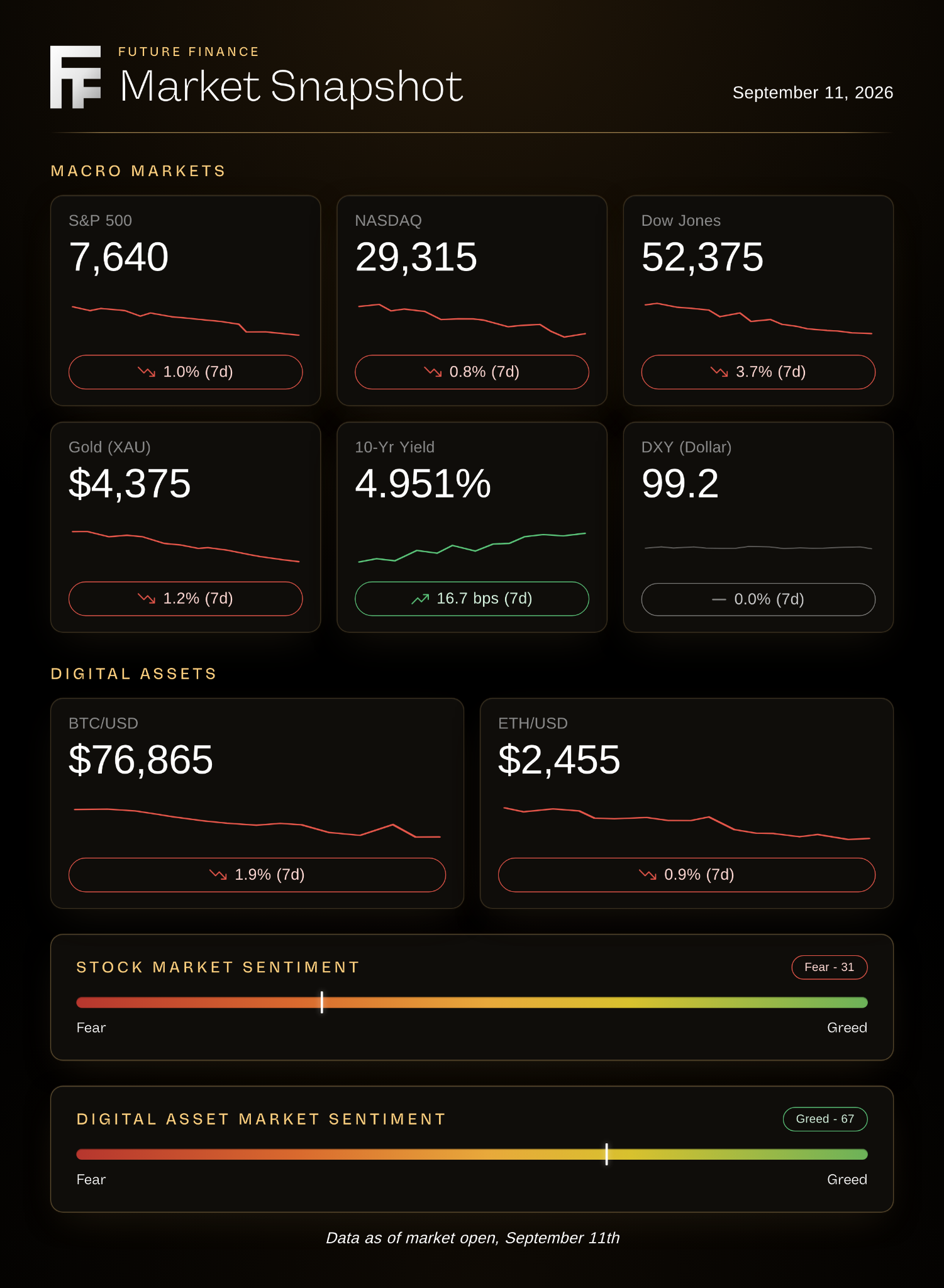
The briefing serious investors read first.
Free analysis before markets open. Start thinking in decades, not days.
Join 45,000+ readers · No spam · Unsubscribe anytime
Today’s Big Picture
At 8:30 this morning, one number decides whether money gets more expensive on Wednesday.
It’s the August inflation report, the government’s count of what a fixed basket of rent, food, gas, and insurance cost last month. Forecasters expect 0.4% for the month, with prices running about 3.4% above a year ago.
Here’s what most people get backwards about this week. The Fed meets Wednesday to decide on a hike, with the odds near 69%.
A hot number this morning locks it in. A cool one is the only thing that can stay its hand.
The reason is on every gas pump. Oil crossed $100 yesterday, diesel is at a record, and the central banks are raising rates into an energy shock, the way they did in the 1970s.
One report can move a rate decision in seconds. A plan written down in advance doesn’t need to read it.
That’s the contrast today’s guest lives by, and his scoreboard moved twice while you were reading this newsletter.
Tan tracks that scoreboard every Monday and Wednesday in The Macro Letter. Below, he tells the story of the two signals that fired, and the sale that took eleven seconds.
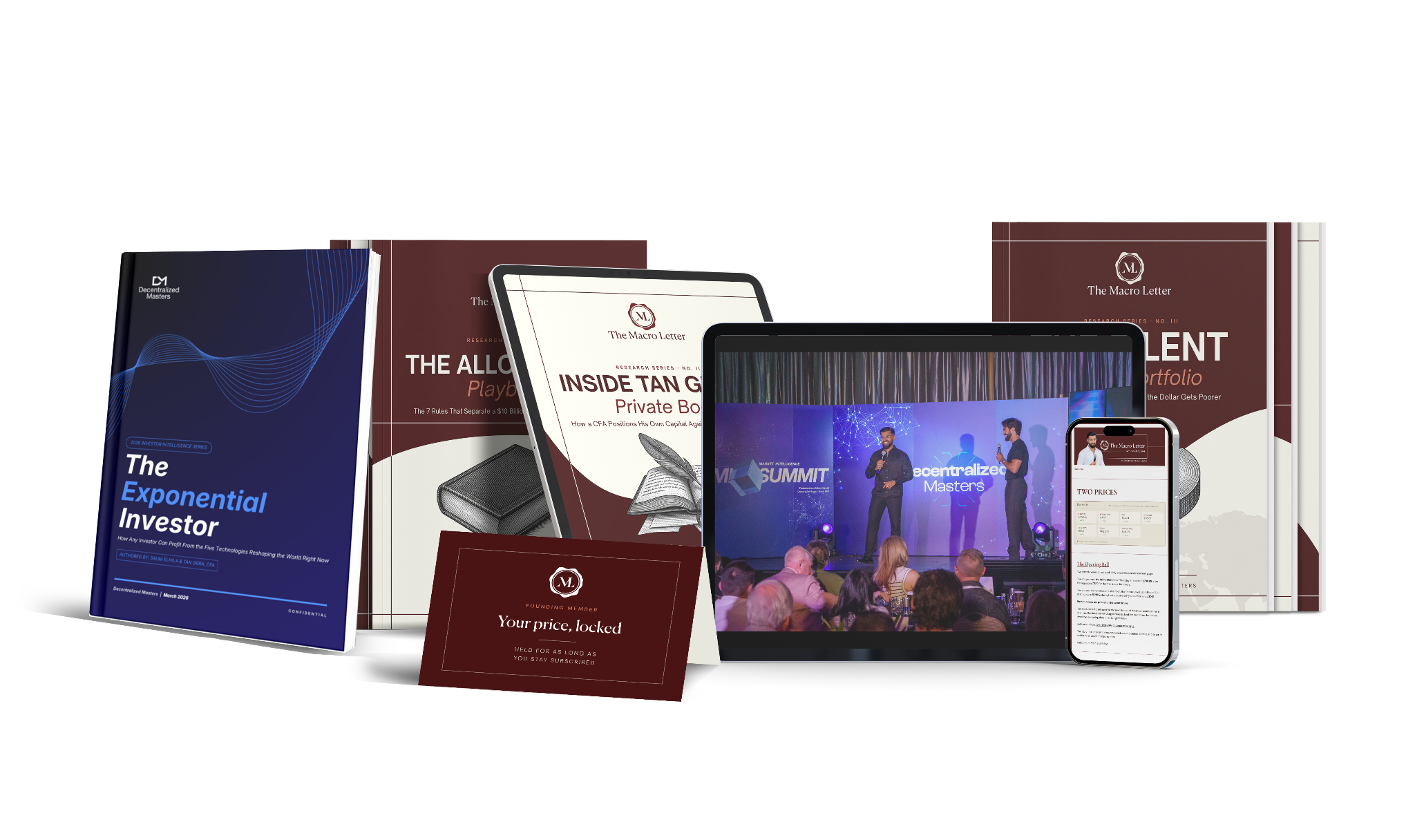
For Two Years, I Have Read the Market Every Monday. This Week, You Get the Full Read.
Every Monday and Wednesday, Tan Gera sits down with the liquidity data, the levels, and the positions, and writes up what he sees. Now it’s a newsletter.
The Macro Letter gives you the same read the DM members get: the pattern he’s tracking, the price levels that matter this week, and what he’s doing with his own money and why.
No predictions. No hype. Facts, patterns, and the plan behind the positions.
Claim your invitation to The Macro Letter →
Signal vs. Noise
Oil Crossed $100. The Fed Noticed.
- The noise: “stocks fell for a fourth day.”
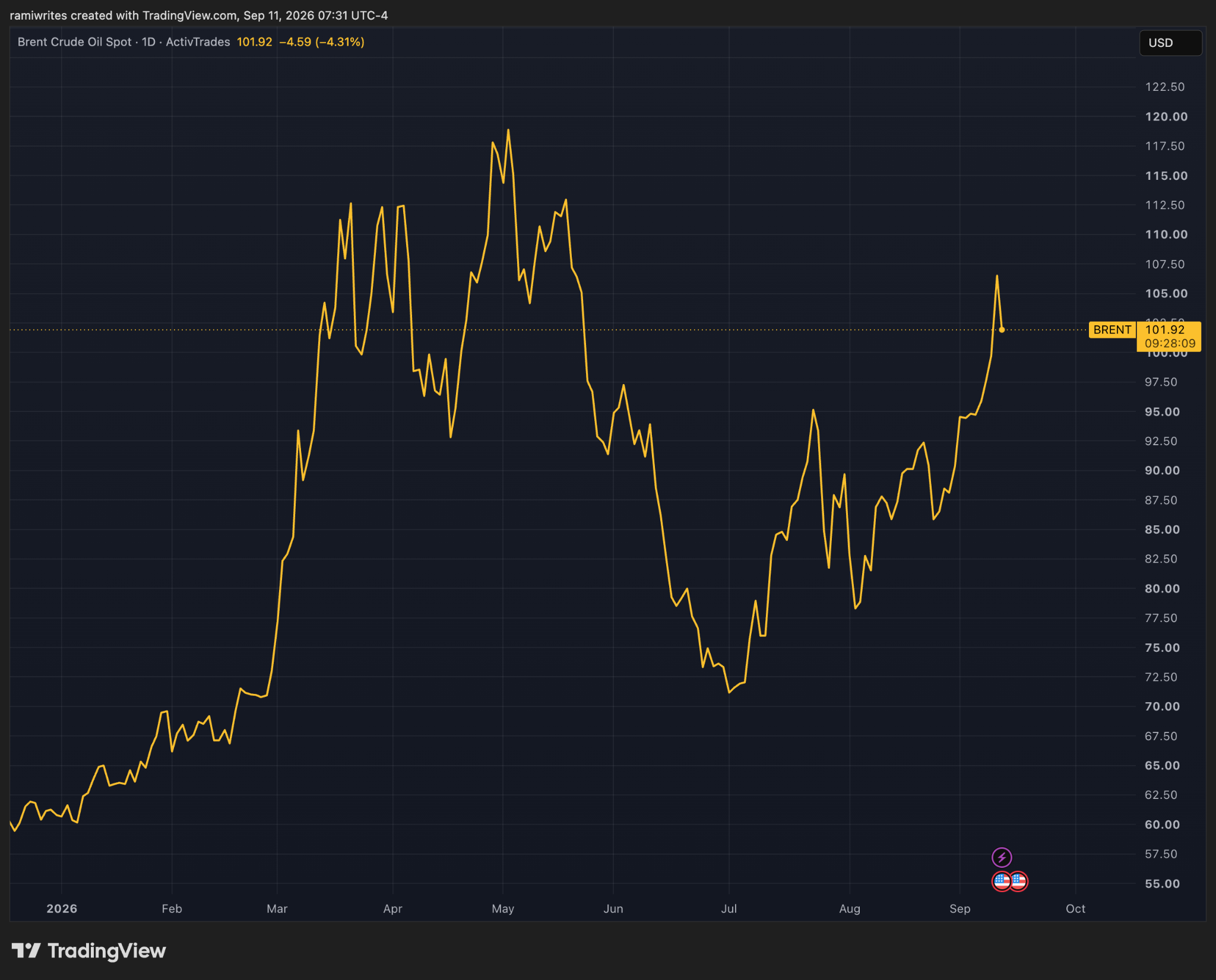
- The signal: why. West Texas crude jumped 6.7% to $102.48, its highest since May, after reports of a second Iranian attack on Navy ships and the U.S. destroying five Iranian tankers. The President said prices likely won’t fall until after the midterms.
Wholesale prices rose 0.4% in August on energy alone. The 10-year Treasury yield touched 4.90%, a decade high. And the European Central Bank hiked to 2.50% yesterday in a unanimous vote its president called “a no brainer.”
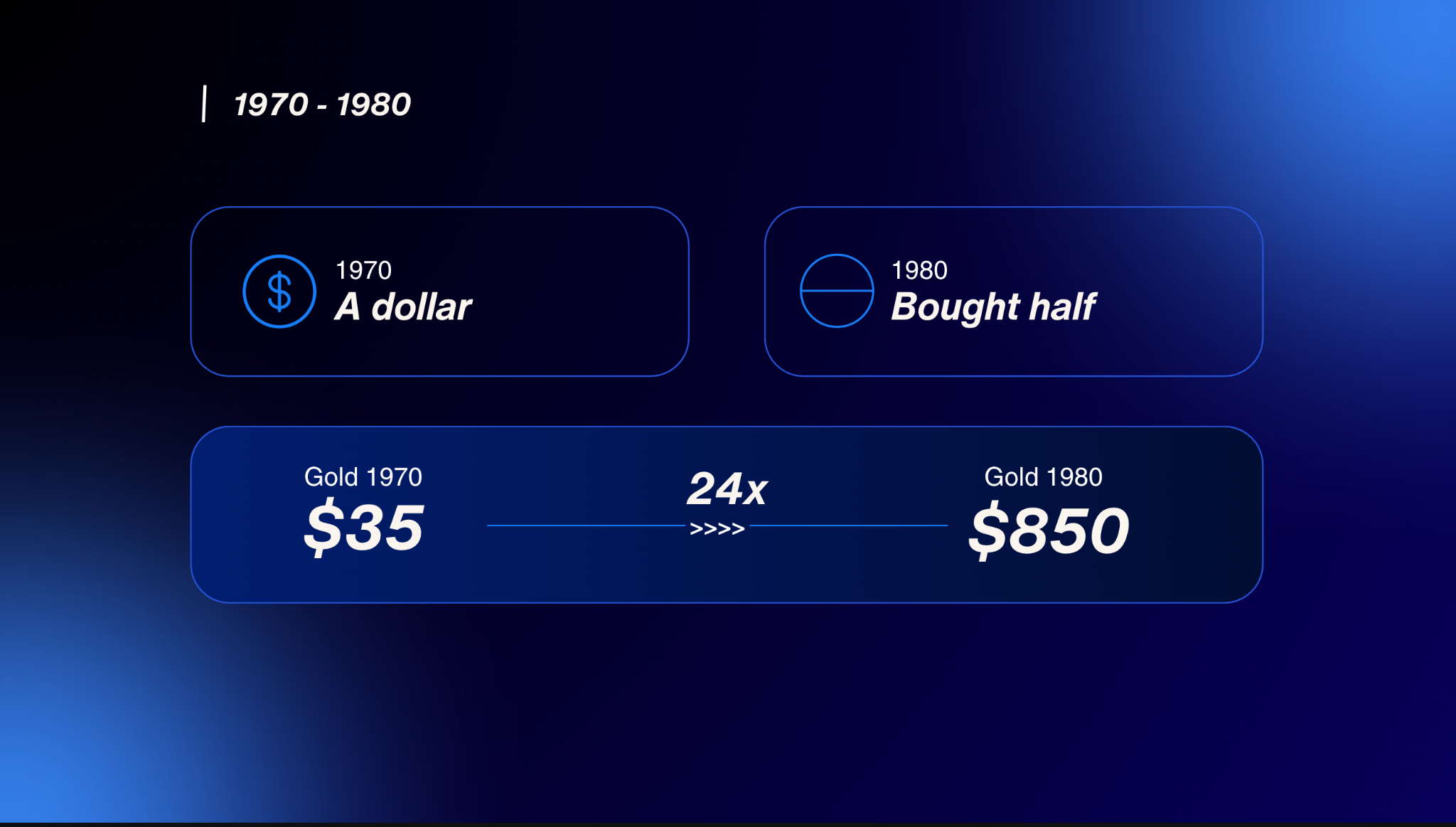
That’s the pattern beginners should hold onto: central banks raising rates into an oil shock, not despite it. The last time that combination ran this hot, gold went from $35 to $850 in nine years.
Oracle’s Backlog Grew $26 Billion in One Quarter
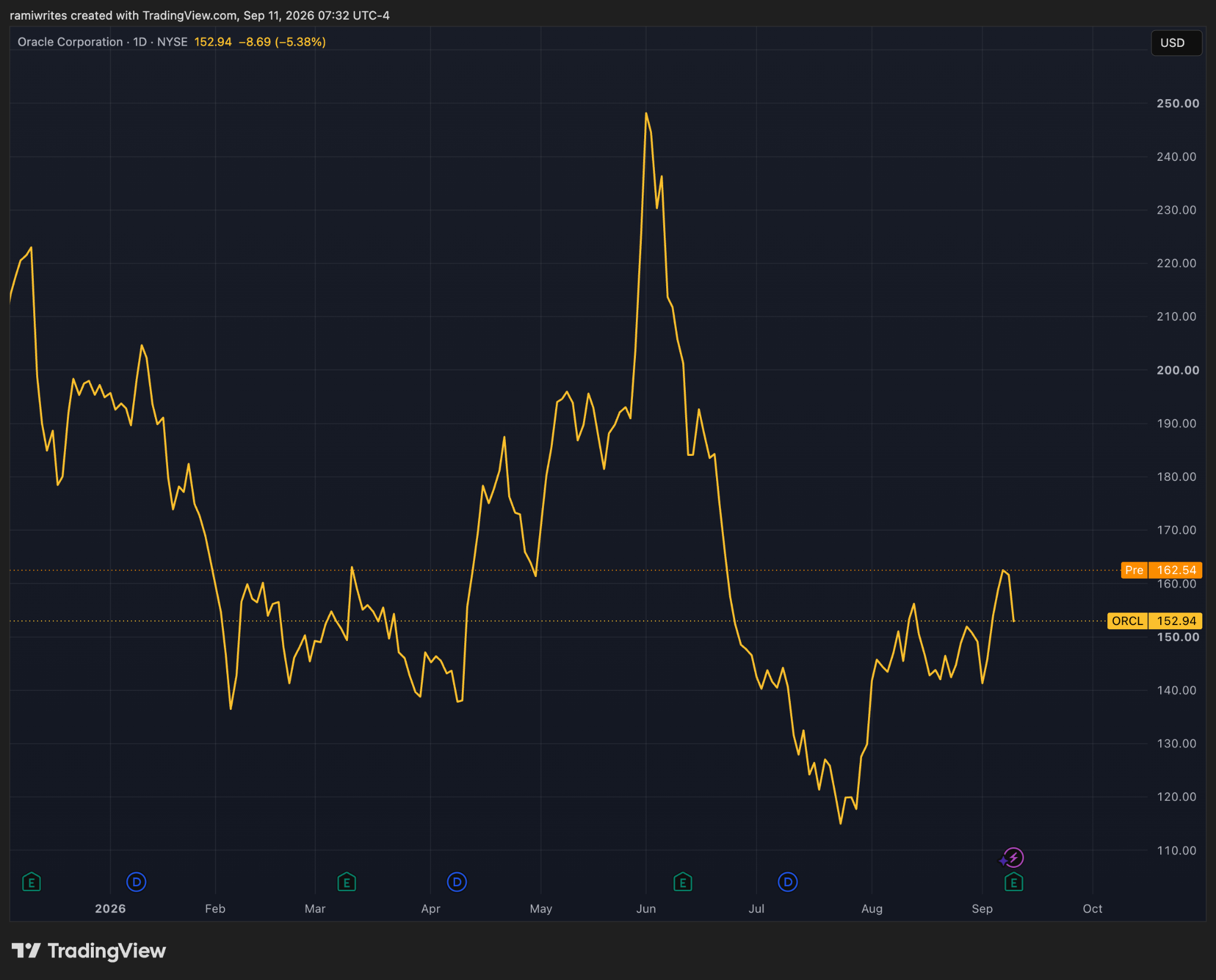
- The noise: “AI spending is slowing.”
- The signal: Oracle (NYSE: ORCL) reported revenue of $19.35 billion, cloud infrastructure up 121%, and a contracted backlog of $664 billion, up from $638 billion three months ago. The stock rose 6% after hours.
Adobe guided in line and slipped 2%. Same evening, opposite verdicts, one rule: the market pays for demand it can see in a signed contract.
The AI build-out keeps signing checks. The fight is over what money costs while they get cashed.
The Treasury Offered $6 Billion. The Market Sold It $5.19 Billion.
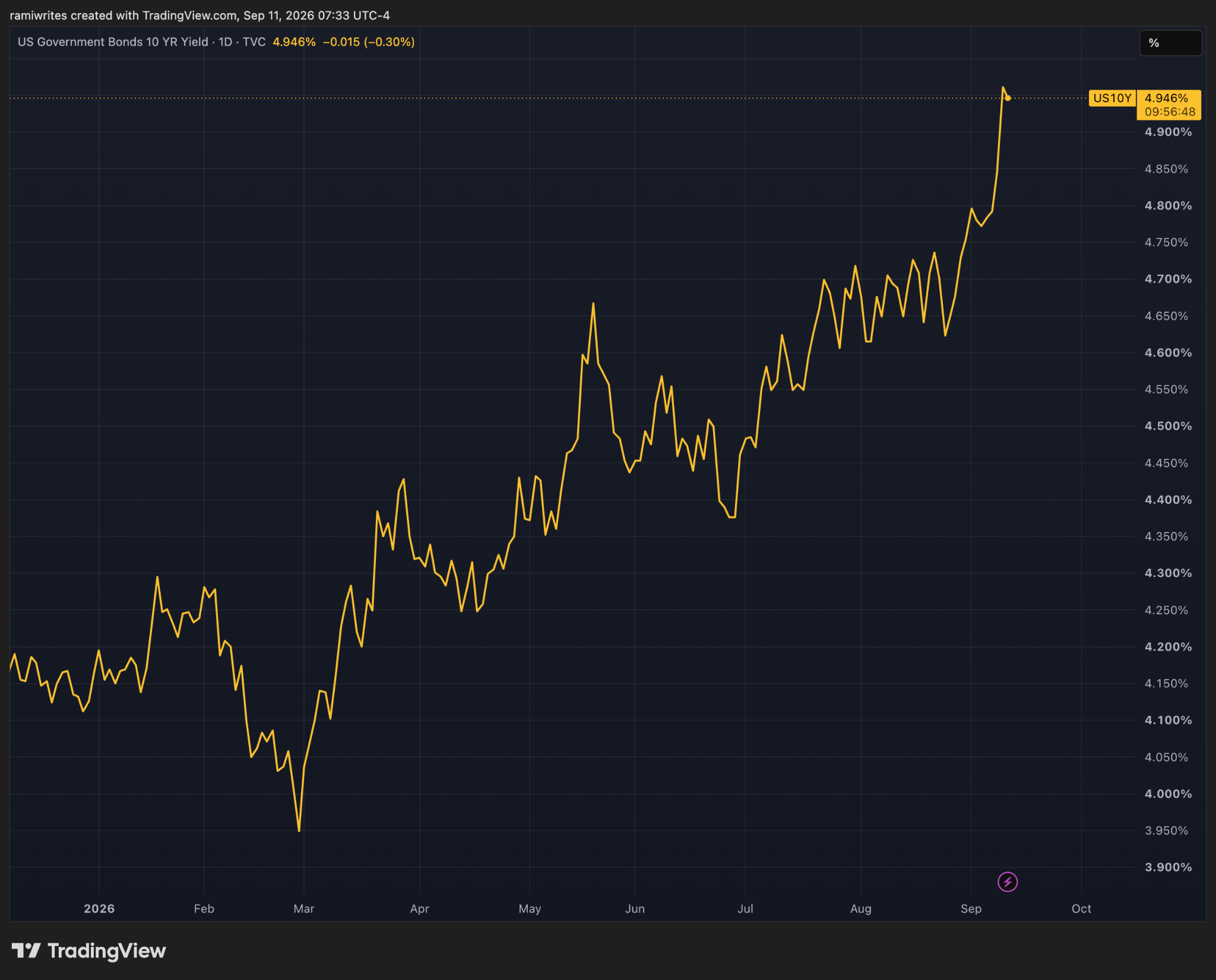
- The noise: the buyback was supposed to calm long-term rates.
- The signal: Treasury accepted $5.19 billion of its own 10-to-20-year bonds against the $6 billion it offered to buy, and long yields rose anyway. The 30-year sits above 5.3%. Stanley Druckenmiller’s warning against “defending a price” aged well inside 48 hours.
Next week decides a lot. Tuesday, the Senate’s crypto vote needs 60 votes with odds near one-in-ten, Treasury Secretary Bessent whipping votes himself.
Wednesday, the Fed and a fresh dot plot. The 21st, Europe’s tokenized settlement goes live. The 24th, Xi in Washington.

Featured Contributor
Today’s guest is Tan Gera, co-founder of Decentralized Masters. Everything below describes decisions he has made with his own money. The price levels are his, set in advance; the golden-cross history is drawn from CoinDesk’s September analysis; two counts of price attempts are his own chart reading. Nothing here is a recommendation.
Two of Four, and Why I’m Not Celebrating
On August 19, I sold gold for the first time in nine months.
It took about eleven seconds. Price touched $4,500, an order I had written in July filled, and a position that had been 44% of my portfolio became 40%. I noticed it the way you notice a text message.
I felt nothing, and that’s the whole point of this story.
The moment a plan works is the moment it feels like nothing. The feeling was spent in July, when I chose the price. August only executed it.
Then the scoreboard moved
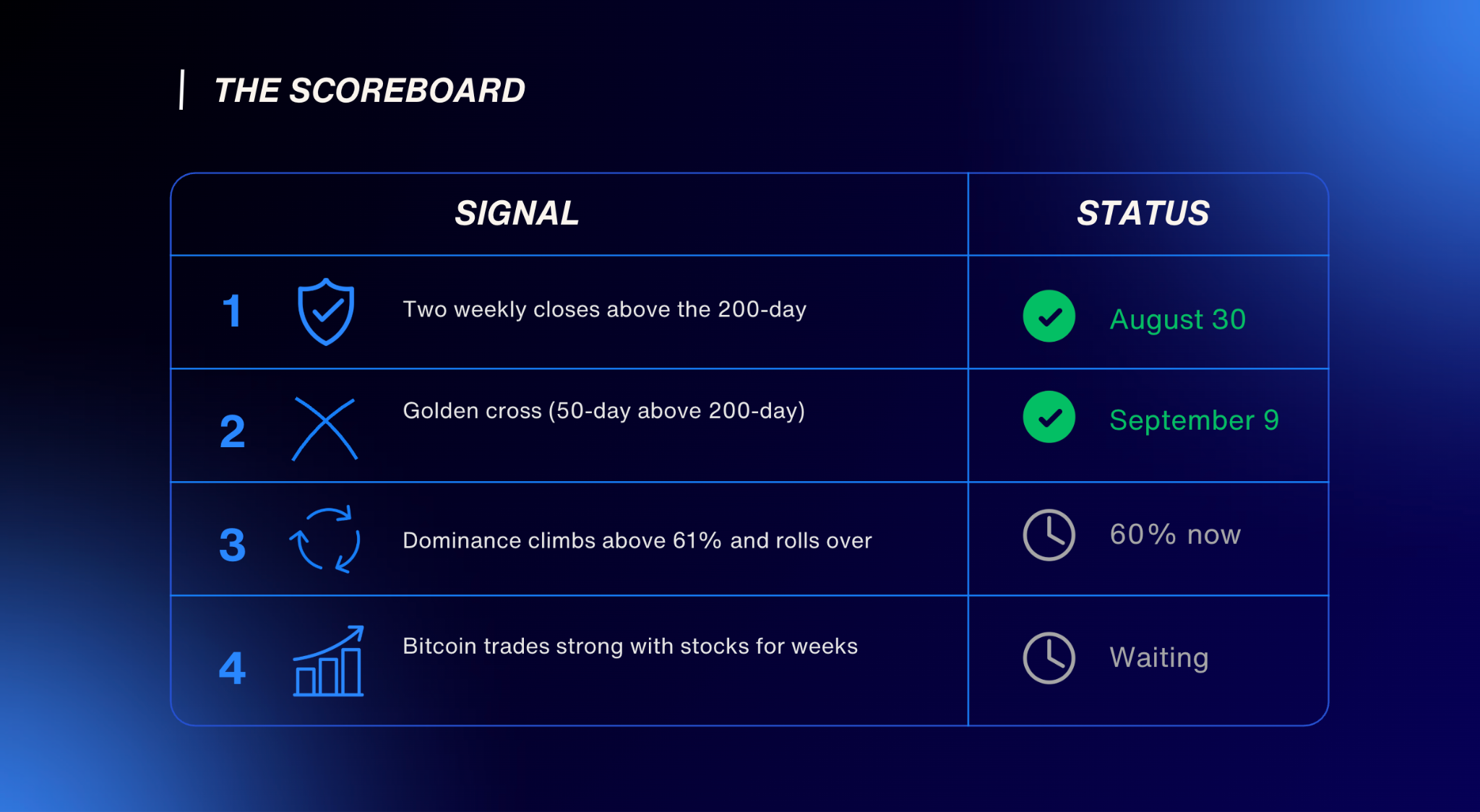
When I took over this newsletter two weeks ago, I showed you four signals I use to decide whether a Bitcoin (BTC) bottom is real. All four were dark.
On August 30, the first one lit. Bitcoin closed a second straight Sunday above its 200-day average, after 277 days below it, one of the longest stretches on record.
On September 9, the second one lit. The 50-day average crossed above the 200-day, the pattern traders call a golden cross.
Zero to two of four, while you were reading about it. I’d like to tell you I celebrated. I counted.
A coin flip with a big prize
Bitcoin has produced a golden cross twelve times since 2012. Three of them started runs that lasted a full year, averaging gains around 250%.
The other nine faded within months. Two were dead inside eight weeks.
So the signal everyone is cheering is a coin flip with a very large prize. A coin flip is not a plan. The plan is the two signals still dark.
Bitcoin’s share of the whole crypto market sits near 60%. It has to climb above 61%, then roll over, which is what every real run has done.
And Bitcoin has to beat stocks for weeks, not days. It hasn’t yet.
When those two light, I’ll say so here. Until then I have half a scoreboard and a full set of orders.
Everyone asked me the same question this week
Should you sell before the Fed?
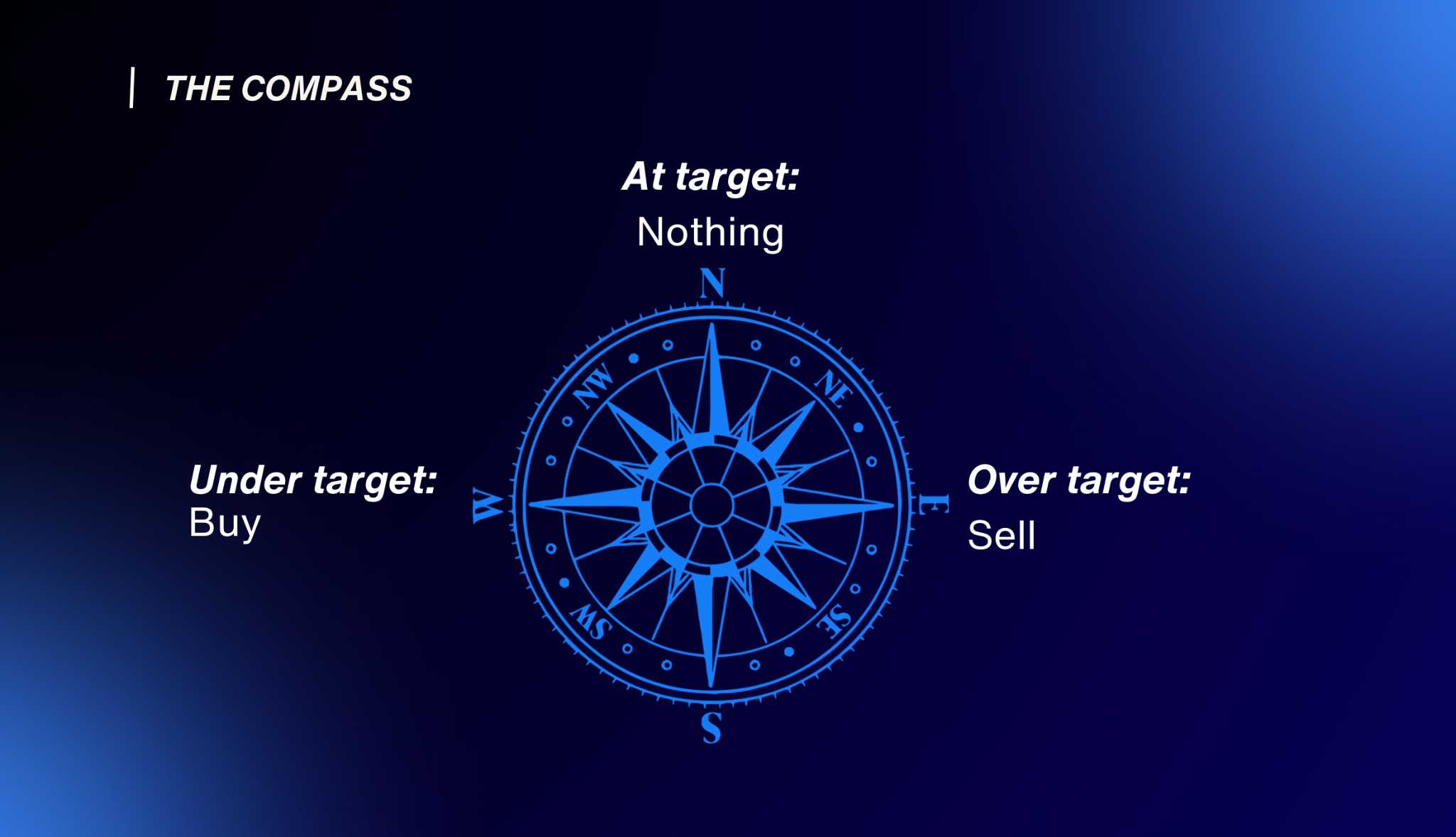
Here is how my orders answer it. If Bitcoin reaches $81,000, a slice sells, automatically. If it falls to $72,000, I buy a slice.
Then $62,000. Then $51,000, the biggest slice, at the price that would frighten everyone else.
Gold has the same shape: sells written at $4,720 and $5,000, buys written lower.
The Fed decides Wednesday. My orders were decided in July. Whatever the vote, one of those prices fills, or none do, and either way I did nothing at 2 p.m. that I hadn’t already decided at my desk in the summer.
The map on my wall
None of this is a prediction. It’s a map, and the map is from 1971.
That August, President Nixon ended the dollar’s link to gold at $35 an ounce. Then he pressured his own Fed chairman to keep rates low into an election; it’s on the White House tapes. Then an oil embargo took a barrel from $3 to $12.
By 1980, the dollar bought half of what it had, and gold traded at $850. Twenty-four times the price the government had sworn was permanent.
Now look at this year. A barrel of oil cost $67 the day before the war. It closed yesterday above $102. Diesel set a record at $5.97.
The debt passed $40 trillion, and the interest on it, about $1.2 trillion a year, now costs more than the military.
And your dollar? A pound of ground beef was $3.77 in 2017 and $6.89 this summer. The same dollar buys about a fifth less than it did five years ago.
That’s why gold is 40% of what I own, and why Bitcoin is on its way to 40%. A chart pattern can’t tell me why to own either one. It can only tell me when.
Right about the market, wrong about myself
In 2017, I called the Bitcoin top almost to the week. I was right about the market. I was wrong about myself, because I hadn’t decided in advance what to do when I was right, so I did nothing, and rode a fortune back down.
Every rule I’ve shown you this month exists because of that year. The levels. The sizes. The refusal to trade a signal until the size is written next to it.
Two of four. The next two are on my screen every morning, and my orders are already where they need to be. When the count changes, you’ll read it here first.
- Tan Gera
Co-Founder, Decentralized Masters
Final Thought
Tan’s eleven seconds is the line I’d keep from this week.
The whole purpose of a plan is to make the biggest days boring: a price touches a number, an order fills, and the decision that took real courage happened months ago, at a desk, with no crowd watching.
At 8:30 this morning a number will land, and Wednesday the Fed will act on it, and the loudest people on your screen will treat both as emergencies. Tan’s orders will treat them as Wednesday.
See you Monday.
Editor in Chief | Future Finance
Stop Lending Your Bank Money For Free

Your bank pays you close to nothing on your deposit. Then it lends that money out at several times the rate and keeps the difference. Every day. On your balance.
In that arrangement you are not the customer. You are the inventory.
Frank Trotter spent 17 years running EverBank Direct before TIAA bought it at just over $27 billion in 2016. He and co-founder Vincent Amato have now built the thing again, from scratch, with a national bank charter.
Battle Bank’s High Yield Cash Account pays 3.35% on cash you can still spend and move.
Deposits carry FDIC insurance up to $250,000 per account holder, and $500,000 on joint accounts.
The money was always yours. The yield should be too.
Open a High Yield Cash Account →
Disclosure: Battle Bank is a paid partner of Future Finance. We may receive compensation from Battle Bank if you click on our links and open an account or use certain banking products. This compensation comes at no additional cost to you.
Battle Bank, N.A., Member FDIC. APYs as of 6/16/2026, using ZIP code 32224, and subject to change. Rate comparison as published by Battle Bank.
Disclaimer: This content is not financial advice, it is for informational purposes only. All investments involve inherent risk. Any financial decisions you make are solely your responsibility.
Latest




Editor's Picks

Become a sharper capital allocator in 5 minutes a day.
Institutional-grade research on where the smartest capital is positioning, across AI, energy, biotech, robotics, and digital assets. Distilled into a daily read you finish before your coffee does.
Join 45,000+ readers · No spam · Unsubscribe anytime