
Will your portfolio survive the weekend?
Iran's response lands before Monday's market open.
May 8, 2026
·
10 min read



The briefing serious investors read first.
Free analysis before markets open. Start thinking in decades, not days.
Join 45,000+ readers · No spam · Unsubscribe anytime
📊 Today’s Big Picture
This weekend, one news story will decide what your portfolio is worth on Monday.
Not your job. Not your skill. Not your strategy.
One phone call between Washington and Tehran.
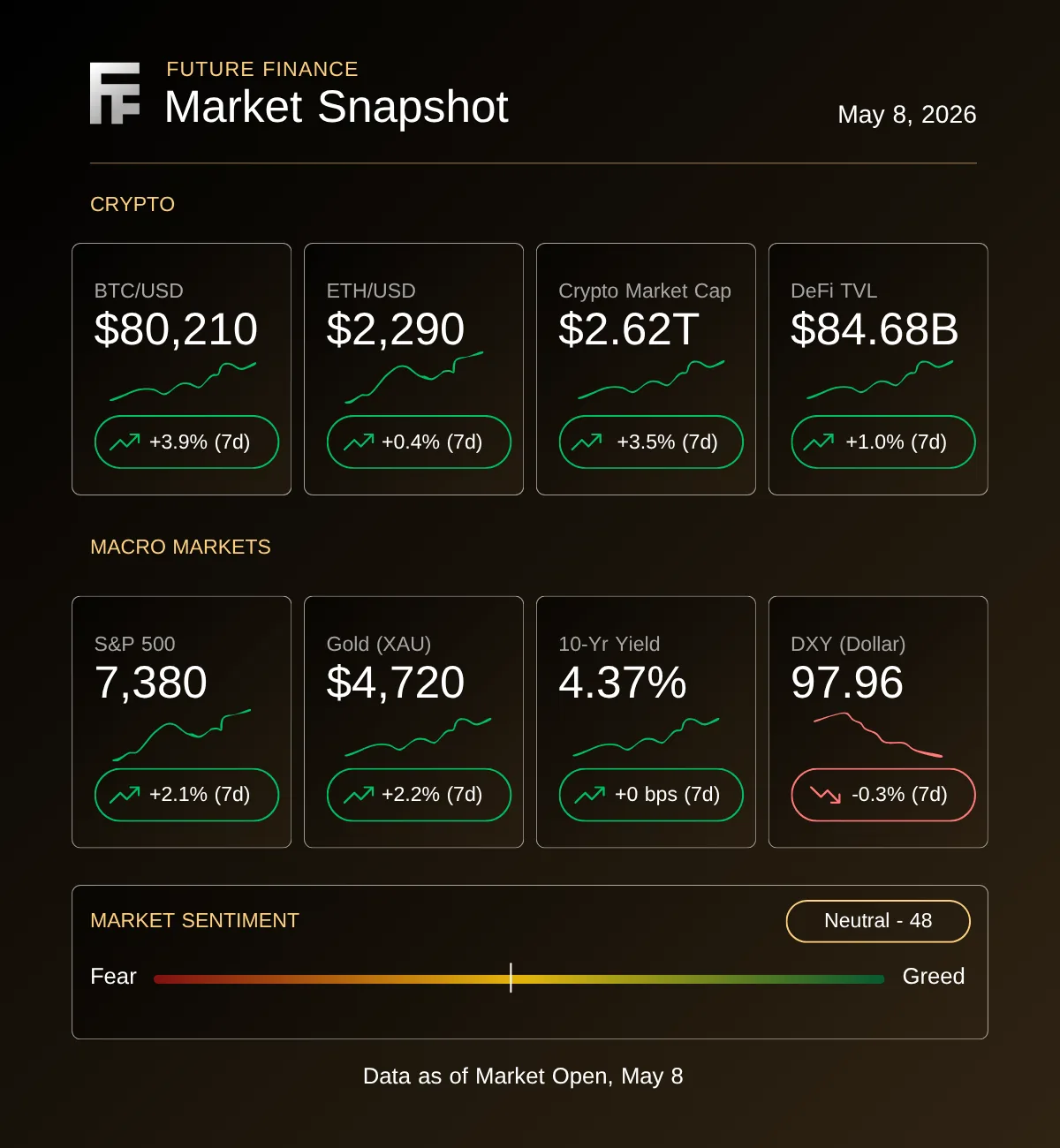
If Iran signs the deal sitting on its desk, gas prices fall, the Dow (INDEX: DJI) closes above 50,000, and Bitcoin (BTC) runs higher.
If Iran rejects it, the bombing campaign that started in February likely resumes. Oil rips back to $110. The record-high market we’re sitting on right nowis gone.
By the time you finish your coffee on Monday, you’ll know which one happened.
That is not an investment thesis.
That is gambling.
By the end of this issue, you’ll know how to build a portfolio that doesn’t live or die on a phone call between two men who’ve never met you.
🔍 Signal vs. Noise
Where We Actually Are
The headlines are confusing on purpose.
Some say a deal is imminent. Others say Iran has rejected it. Still others say Trump will start bombing Monday.
Here is what the math on the ground actually says.
The U.S. handed Iran a one-page, 14-point memorandum of understanding earlier this week. End the war. 30 days of nuclear talks. Sanctions lifted in stages. Strait of Hormuz reopened.
Iran’s response is expected this weekend.
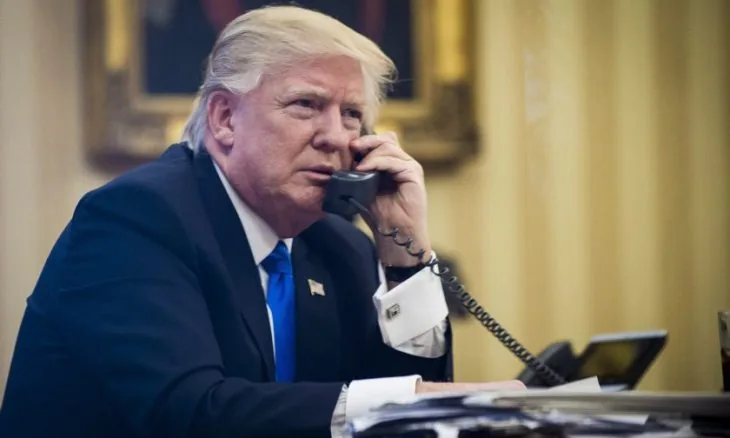
While Iran reviews it, U.S. Navy destroyers were fired on in the Strait of Hormuz Thursday. American warships struck back against Iranian missile sites and command centers.
Trump’s response on Truth Social was deliberate:
“We’ll knock them out a lot harder, and a lot more violently, in the future, if they don’t get their Deal signed, FAST!”
- Donald Trump, May 7, 2026
The message to Iran is unmistakable. Sign the deal, or the campaign that ended last week resumes.
The headlines this morning are running with three contradictory stories. Here is what each one gets wrong.
Three Headlines, Three Rebuttals
1. The first headline is that the deal is essentially done.
What the math says: Iran’s parliament speaker called the proposal “more an American wish list than a reality” on Wednesday. Iran wants nuclear talks deferred. The U.S. wants them front-loaded. Saudi Arabia refused to back the U.S. by force. The framework is real. The agreement is not.
2. The second headline is that Iran has already rejected.
What the math says: Iran’s new Supreme Leader met with the President for a closed-door 2.5-hour session Thursday. The Foreign Ministry said the deal is “under review.” If they had already rejected, Trump would already be bombing.
3. The third headline is that the market is overreacting.
What the math says: the Dow broke above 50,000 on Wednesday for the first time since February. The Nikkei ripped 5.6% Thursday to a record high. Brent crude is down ~10% on the week. None of these moves were small. None were unwarranted. They were the rational reaction to a war that might be ending this weekend.
Three headlines. Three rebuttals. The signal is in the math. The noise is in the certainty.
📰 From Around the Market
Every issue, we bring you the most important stories from around the world and show you why they matter. Think of this as your shortcut through the noise - one click per story, and you’re caught up.

The April jobs report just printed.
The U.S. labor market added fewer jobs in April than March, but more than economists were expecting yesterday.
The unemployment rate held at 4.3%. Wage growth came in at 3.7% year-over-year.
Translation: the labor market is cooling, not cracking.
For the Federal Reserve Chair whose term ends in seven days, this number was the last major data point of his time in office.
A cruise ship outbreak has the WHO saying “this is not COVID.”
A Dutch-flagged expedition cruise ship currently anchored off Cape Verde is the source of a hantavirus outbreak that has killed three passengers and infected eight.
The strain is one of the few hantaviruses transmissible human-to-human.
Contact tracing is happening across 12 countries, including seven returning passengers in the United States.
Cruise stocks have not moved on the news.
Coinbase just lost $394 million in a single quarter.
The largest U.S. crypto exchange (NASDAQ: COIN) reported its worst quarter since the FTX collapse on Thursday afternoon.
Revenue down 31% year-over-year. 14% of staff laid off the day before the report.
Their consolation prize: an all-time-high trading market share of 8.6% of the global crypto market.
When the leading exchange in the country posts a $394 million loss in the same quarter that Bitcoin ETF inflows hit $1 billion in a week, the disconnect is the story.
👀 What to Watch For

This weekend. Iran’s formal response.
The single most important thing in your portfolio happens between now and Sunday night. If Iran formally accepts the U.S. proposal, the Strait of Hormuz reopens, oil collapses through $95, and U.S. equities open Monday at fresh records. If Iran rejects, U.S. bombers were already flying on Thursday. They’d be flying again Sunday.
Watch Truth Social. Watch Pakistan’s Foreign Ministry. Watch Brent crude. The market opens at 6 PM ET Sunday and you’ll know within minutes of futures opening what side of the call we’re on.
Monday May 11. The 3-Year Treasury auction.
The U.S. Treasury auctions $58 billion in 3-year notes Monday at 1 PM ET. This is the first leg of the $125 billion quarterly refunding announced Wednesday.
Demand at this auction is the single clearest read on what foreign buyers are paying for American government debt right now. If demand is weak, yields rise across the curve. If demand is strong, every other rate-sensitive asset in your portfolio gets a tailwind. Pay attention to the bid-to-cover ratio.
Week of May 11. The Warsh confirmation vote.
The full Senate is scheduled to vote on Kevin Warsh as the next Federal Reserve Chair sometime this week. Powell’s term as Chair ends Friday May 15. If Warsh is confirmed before Friday, he runs the June 16-17 FOMC meeting, his first in the chair. If the vote slips, Powell runs that meeting as a lame duck.
💭 Today’s Final Thought
Here is the uncomfortable truth about geopolitical risk.
- It cannot be predicted.
- It cannot be modeled.
- It cannot be hedged with a call option on the VIX the day before the news breaks.
- Yet, it can be mitigated.
The investors who lost their savings in 1917 Russia didn’t lose because they were stupid. They were the most sophisticated bond investors in Europe. They had better information than you have. They had more connections than you have.
What they didn’t have was a portfolio that didn’t depend on Russian politicians being Russian politicians.
That’s the only difference between them and the investors who survived the exact same event by holding gold, holding British assets, holding American assets, holding Swiss assets.
Across multiple jurisdictions, across multiple asset classes, in their own custody when possible.
The politicians whose decisions move your portfolio this weekend will never know your name.
They will never know what you worked for.
They will never know what your retirement depends on.
So that’s the question to sit with. Not whether Iran signs, not whether the rally continues, not whether the Dow holds 50,000.
The question is whether your portfolio survives any of those outcomes.
If it doesn’t, the next 72 hours are going to be very, very expensive.
If it does, Monday morning’s news is just another news item.
Most weeks are forgotten. The portfolios built through them aren’t.
Have a great weekend.
- Rami Al-Sabeq (Editor in Chief | Future Finance)
About Future Finance
Future Finance is written by Rami Al-Sabeq, Editor-in-Chief, and his research team. His macro-to-crypto work has been featured in Unchained and Cryptonary, and his independent essays appear at RamiWrites.Substack.com.
Behind every issue sits Head of Research Tyler Hubbard, whose track record across 590+ digital asset picks has produced an 85% directional accuracy rate and a 426% average peak return. That’s as of the third-party audit measuring performance through April 30th, 2026. Follow him on TradingView here.




Editor's Pick

Become a sharper capital allocator in 5 minutes a day.
Institutional-grade research on where the smartest capital is positioning, across AI, energy, biotech, robotics, and digital assets. Distilled into a daily read you finish before your coffee does.
Join 45,000+ readers · No spam · Unsubscribe anytime