

Outlook, then planes, then banks. Connected?
The answer →
November 20, 2026
·
8 Min Read



The briefing serious investors read first.
Free analysis before markets open. Start thinking in decades, not days.
Join 45,000+ readers · No spam · Unsubscribe anytime · No card needed
Before we begin: this report is for education, not financial advice. Nothing here is a recommendation to buy or sell any stock, company, or asset, and we make no price predictions. Investing carries risk, including loss. Please read the full disclaimer at the end.
Today’s Big Picture
- Last Thursday, Microsoft lost Outlook and Teams for nearly a day.
- Last Friday, the planes stopped. A nationwide ground stop halted U.S. departures for more than four hours, and about 12,000 flights didn’t happen, according to the FAA’s chief.
- Monday, the banks.
- Tuesday, it was Apple: iCloud, the App Store and Apple Pay.
By Wednesday, the internet had a theory. It’s all connected, an AI built for hacking is behind it, and we’re all living the plot of Live Free or Die Hard.
The evidence points somewhere less cinematic, and more useful: most of these outages started with a fix.
This week still left a lesson worth keeping: owning your money and reaching it are two different things.
And the market added a second one. Through Thursday, the S&P 500 had fallen six days in a row and lost 5.1% this week.
Below: what broke and why, why almost everything fell at once, and The DeFi Doctor on becoming your own bank, including the part most people skip.

Paid Advertisement
Retirement Ends Your Paycheck. These 8 Stocks Bring It Back.
When you stop working, the steady paychecks stop too.
The newly released Weekly Dividend Calendar shows you how to collect at least one dividend payment every week for the next year by owning just eight stocks, and some weeks you'll get up to three.
InvestingDaily is a paid partner of Future Finance. We receive compensation from Investing Daily if you purchase any products using our links. This compensation comes at no additional cost to you.
Signal vs. Noise
Most of This Week’s Outages Started With a Fix
- The noise: a coordinated cyberattack, maybe run by AI, taking down America’s systems one at a time.
- The signal: every company that has given a cause so far pointed to a problem inside its own systems. None pointed to hackers.
- Microsoft: a hidden software defect that overwhelmed its servers.
- The FAA: a contractor’s equipment upgrade that flooded the air traffic network with connection requests.
- Chase: “a software bug in an on-premise hardware system,” which its owner, JPMorgan Chase, said was “not cyber-related.”
- Apple: “an internal update.”
On Wednesday, Director of National Intelligence Jay Clayton told a House hearing there was no sign so far that the outages were related.
The day before, Jonathan Gould, who heads the OCC, the main regulator for national banks, called the Chase outage “an isolated incident.”
AI does show up in this story. It shows up earlier in the chain.
AI tools have made finding software holes “fast and cheap,” one security executive told Reuters. Microsoft fixed more than 1,200 security flaws in November, nearly 20 times as many as a year earlier, according to the security firm Qualys.
Each hole needs a patch. Patches now often go into core systems within hours, he said, without the full round of testing.
That’s how a fix becomes an outage.
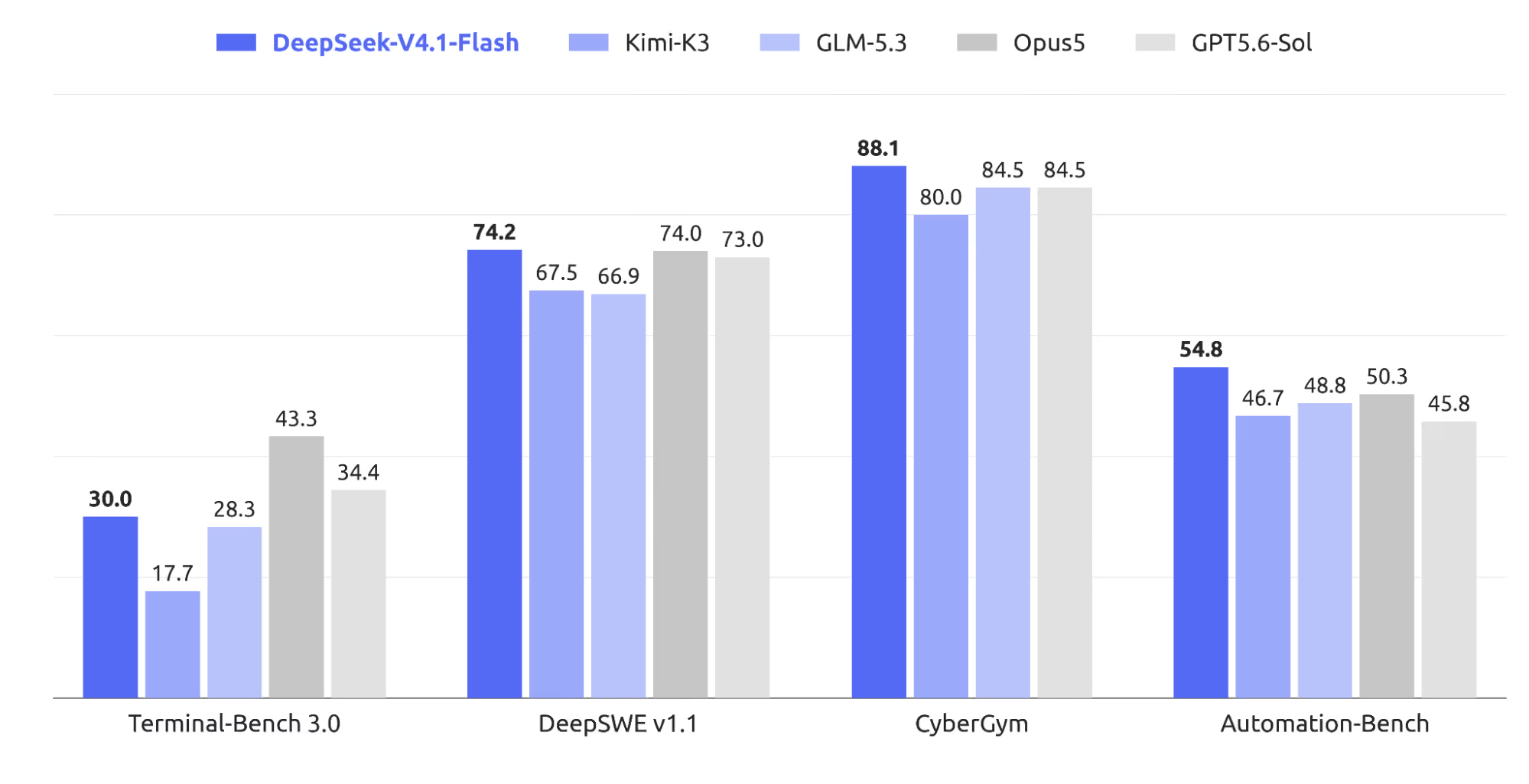
The threat behind all that patching is real. This month, a testing firm found that DeepSeek’s V4.1 Flash, a free AI model anyone can download, came close to a restricted OpenAI model at breaking into practice corporate networks (Vals AI, reported Nov. 6).
And on Thursday, JPMorgan Chase, Mastercard and Visa each said an outside vendor had been hacked. Some customer names and email addresses may have been exposed.
None reported any money lost, and all three said their payment services kept running.
For now, the likeliest culprit is the patch.
Almost Everything Fell at Once
- The noise: the bank outages spooked the market.
- The signal: the Fed and AI did most of the damage.
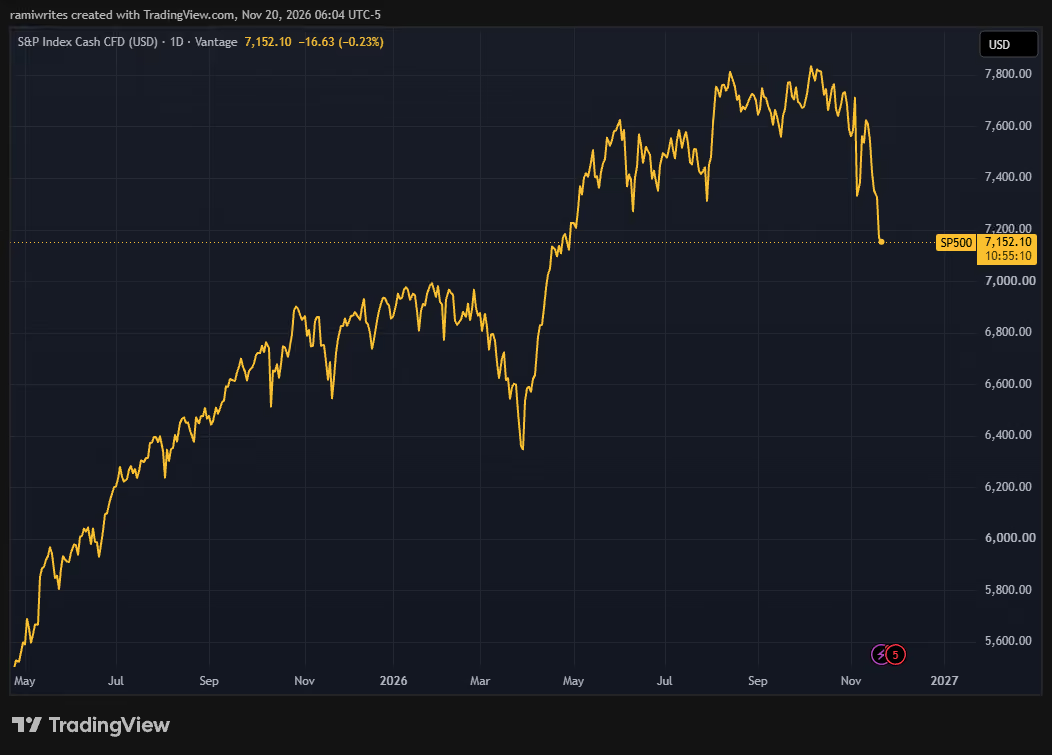
On Thursday, the S&P 500 fell 2% to 7,175.83, its sixth straight loss. The Dow Jones Industrial Average and the Nasdaq Composite each fell more than 2%.
For the week through Thursday, the S&P 500 is down 5.1%, the Dow 6.2% and the Nasdaq 5%.
Wall Street’s fear gauge, the Cboe Volatility Index, neared 29 on Thursday afternoon, its highest since March.
The selling went well past U.S. stocks:
- Asian shares: on track for their worst week since March 2020.
- Gold: about $3,601 an ounce early Friday, headed for a 7.3% weekly loss.
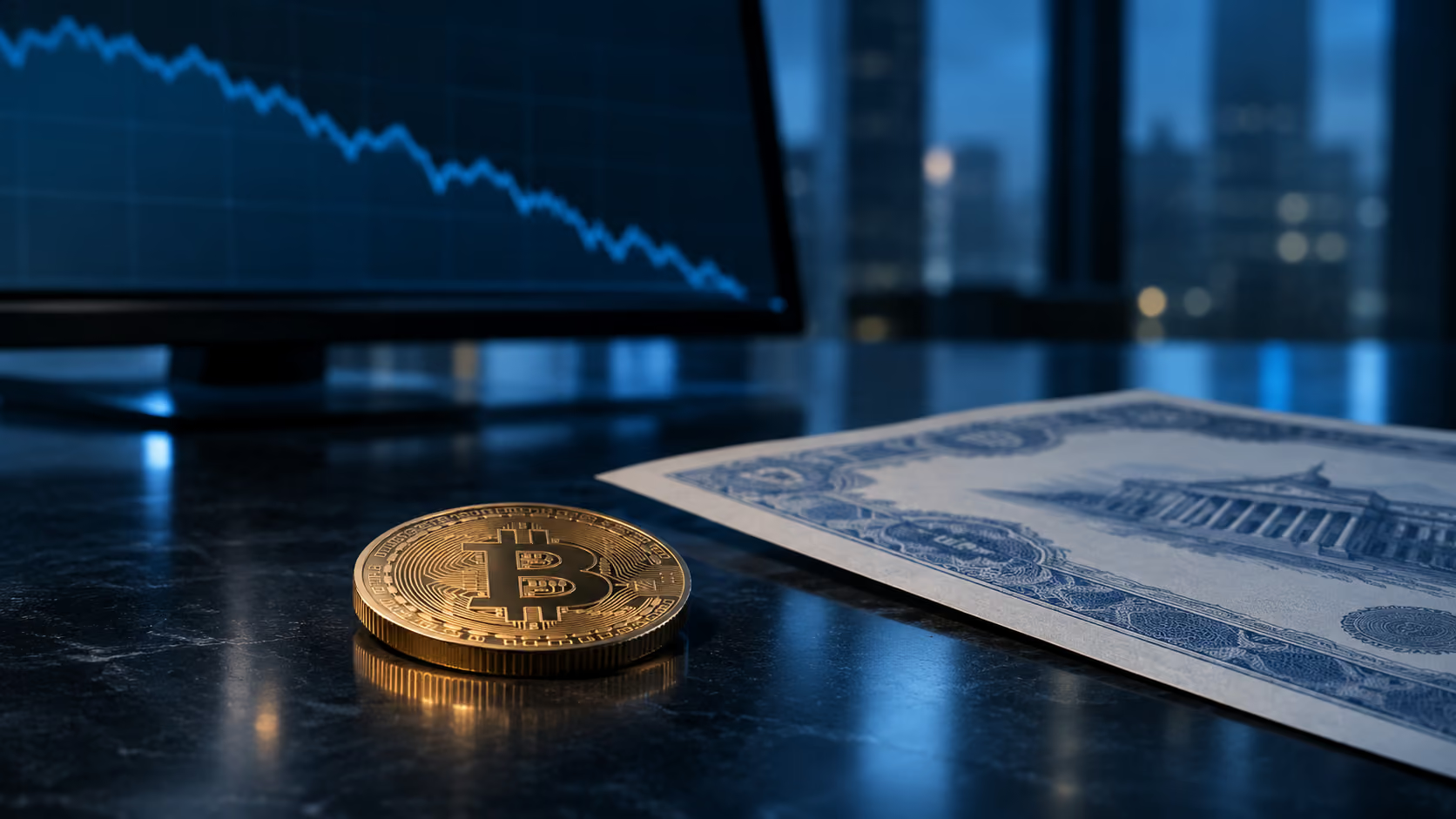
- Bitcoin: near $63,000 early Friday, down more than 20% this month.
The one big winner was the U.S. dollar, which hit its strongest level since April 2025 this week.
The common thread is the Fed. Traders now put the odds of a December rate hike at 96%, according to CME FedWatch, after the Fed’s own minutes made the case.
With cash and Treasuries paying about 5%, everything else has to compete for your money, from tech stocks to gold to Bitcoin.
AI stocks led the way down. Nvidia fell 3.3% on Thursday, even after an upbeat forecast.
Futures pointed lower again early Friday. As of 1:18 a.m. Eastern, S&P 500 futures were down 0.5% and Nasdaq 100 futures were down 1%.
When cash pays 5%, everything else has to earn its place.

Featured Contributor
Today’s guest is The DeFi Doctor, the head of education at Decentralized Masters and the owner and author of Beat Banks, a twice-weekly briefing on where real yield opportunities exist in decentralized finance. Nothing here is a recommendation.
Become Your Own Bank. Bring a Downtime Plan.
Hey, my friends.
On Monday afternoon, more than 20,000 reports of problems with Chase hit Downdetector by 2:22 p.m. Eastern, according to Fortune.
Chase said customers still had access to their accounts and their money.
Both can be true.
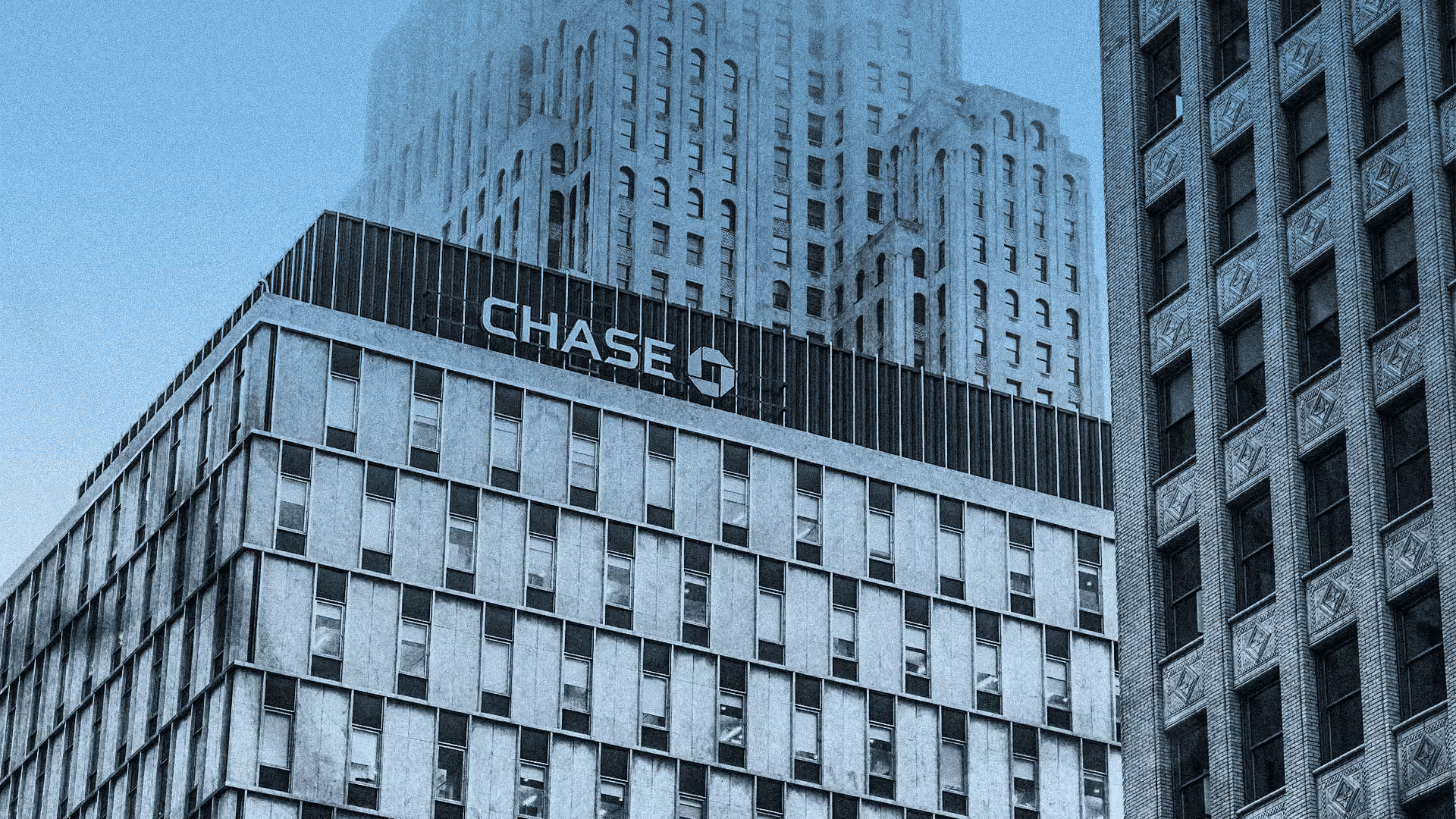
The money was in the vault. The door was stuck.
In medicine, we plan for exactly this. Hospitals keep backup generators, and paper charts for the day the computer system goes down.
It’s called a downtime plan, and nobody thinks it’s paranoid.
Most people don’t have one for their money.
To me, that’s what “becoming your own bank” means: a backup that doesn’t run on any one company’s software.
Here’s how it works.
Stablecoins are digital dollars designed to stay worth $1. You can hold them in a wallet only you control, and send them any hour of any day, holidays included.
The networks underneath have a strong record. Bitcoin’s has run about 99.99% of the time since 2009, and its last outage was in March 2013.
But becoming your own bank also makes you the IT department.
Three things I want every reader to know before they start:
1. Your keys are your account. Lose your recovery phrase, and nobody can reset it. There’s no help desk and no “forgot password.”
2. A wallet on an exchange is still someone else’s bank. On Oct. 30, Binance said about $6.3 billion had been stolen, possibly the biggest digital-asset theft on record, and it suspended withdrawals. It said it would cover the losses. For a while, though, its customers couldn’t reach their money either.
3. Access isn’t value. Bitcoin went from about $81,000 at the start of November to about $63,000 today. A wallet you control holds whatever you put in it, falling prices included. Stablecoins aim to hold $1, and they depend on the company behind them and the code they run on.
So if I wrote a downtime plan for my own money, it would have three lines:
A bank account for paychecks and bills.
Some cash at home for a bad Monday.
A slice in a wallet you control, sized so that losing it wouldn’t change your life.
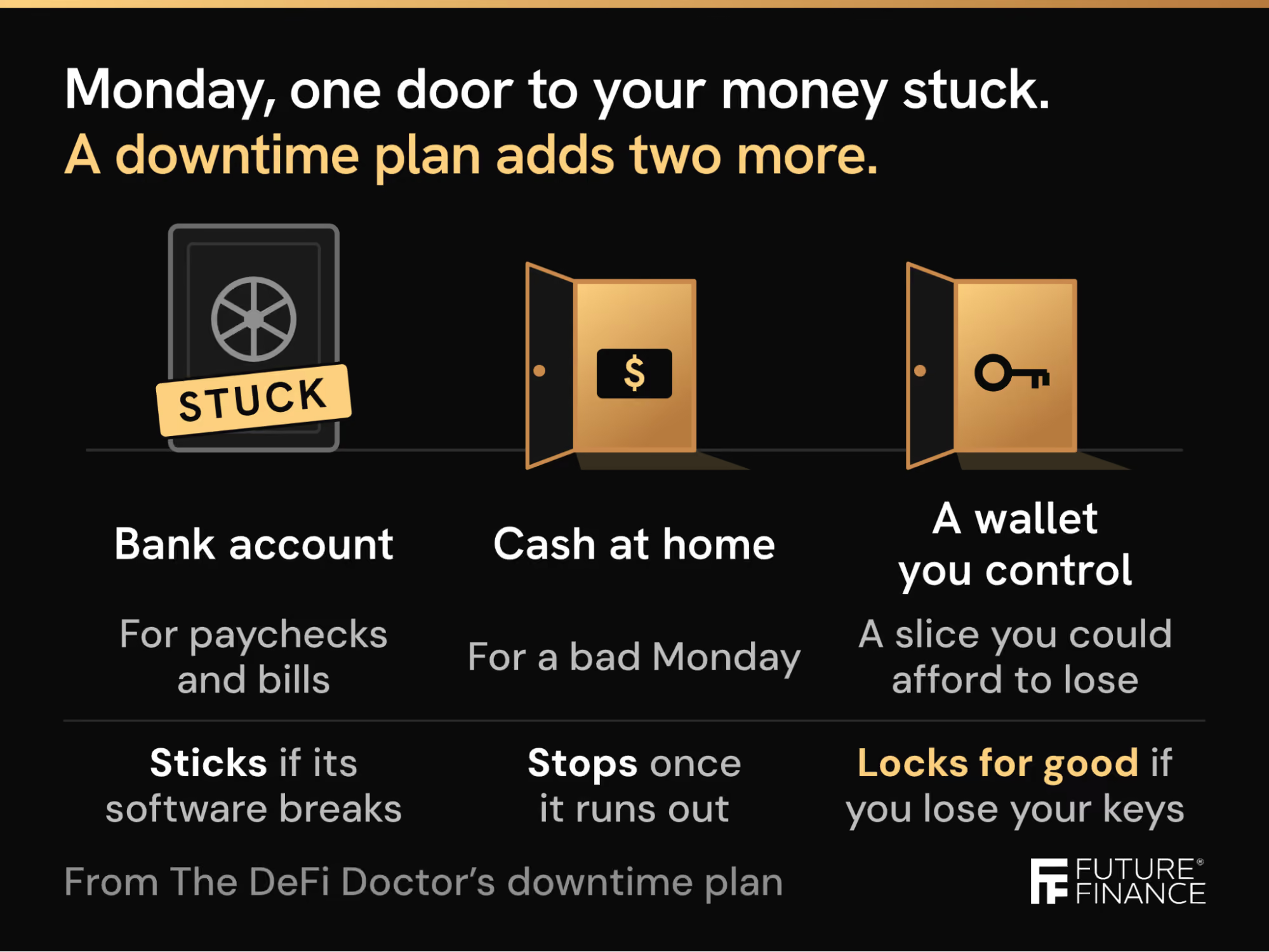
That last line is where I spend my week.
Twice a week in Beat Banks, I put six DeFi opportunities through a checkup, each with a risk scorecard, and I tell you straight when something looks wrong.
On Thursday, I told readers to hold off on new deposits into one lending vault, and to check that withdrawals still worked, after its deposits fell more than 95% from their peak.
Every good hospital has a downtime plan. Your money deserves one, too.
- The DeFi Doctor
Your Savings Account Pays 0.39%. Here’s What Else Doc Found.
The average U.S. savings account pays 0.39% a year, according to the FDIC’s Nov. 16 figures.
On $1,000, that’s about a penny a day.
The DeFi Doctor goes looking for better, twice a week.
Beat Banks is his DeFi yield newsletter. Every Tuesday, he picks six opportunities, two at each risk level. For each one, he explains in plain English where the yield comes from, what it means in dollars and what could go wrong.
This Tuesday, they ranged from 6% on a low-risk pair of Bitcoin tokens to well over 100% on pools that need checking every day.
Every pick comes with a risk scorecard. Every Thursday, Doc follows up on what moved, what broke and what to check.
Yields were current when published on Nov. 17 and change often. Higher yields carry higher risk, including the loss of principal.
Final Thought
This week asked two questions about your money.
Can you reach it?
And what’s it worth?
For most people, the first answer came back yes by Monday night. Chase said transactions were posting normally again by about 6:30 p.m. Eastern.
The second is still being answered, and the Fed holds the pen.
Today at 10 a.m. Eastern, the University of Michigan publishes its final read on November consumer sentiment. Monthly stock options also expire today, which can make the last hour of trading jumpy.
Next week is short. The PCE index, the Fed’s favorite inflation gauge, comes out Wednesday at 8:30 a.m. Eastern. Markets close Thursday for Thanksgiving and close early on Friday.
Plan for the bad day and the bad week. They don’t always arrive together.
See you tomorrow.
Editor in Chief | Future Finance
Paid Advertisement
The Treasury Values Its Gold At $42.22 An Ounce.
Government debt is approaching $40 trillion. Washington spends roughly $2 trillion more each year than it takes in. There has not been a complete independent physical audit of Fort Knox for many decades.
Doug Casey warns that confidence can blow away like a pile of feathers in a hurricane.
See what he and David Stockman recommend →
Disclosure: International Man is a paid partner of Future Finance. The forecasts, track record and claims above are the views of Doug Casey, David Stockman and International Man, and do not represent the view of Future Finance. As always, do your own diligence.
Disclaimer: This content is not financial advice, it is for informational purposes only. All investments involve inherent risk. Any financial decisions you make are solely your responsibility.
Latest


Editor's Picks
Become a sharper capital allocator in 5 minutes a day.
Institutional-grade research on where the smartest capital is positioning, across AI, energy, biotech, robotics, and digital assets. Distilled into a daily read you finish before your coffee does.
Join 45,000+ readers · No spam · Unsubscribe anytime · No card needed