

Unanimous on the hike. Split on the reason…
The minutes show why most of the Fed wants one more hike, and why that reason may not survive the next two reports. Tan Gera reads the room. →
October 8, 2026
·
5 Min Read



The briefing serious investors read first.
Free analysis before markets open. Start thinking in decades, not days.
Join 45,000+ readers · No spam · Unsubscribe anytime · No card needed
Today’s Big Picture
Three weeks ago, the Fed raised rates after a 12 to 0 vote and followed it with a short press conference.
Yesterday at 2 p.m., it published the minutes of that meeting, the closest thing we get to a transcript of the room.
The headline is the one everyone expected. Most officials think another hike “would likely be appropriate by year end.”
The part worth your time is the reason.
Many officials described September’s hike as risk management, a kind of insurance. Others said their own forecasts required it.
The vote was unanimous on what to do. The minutes show it split on why.
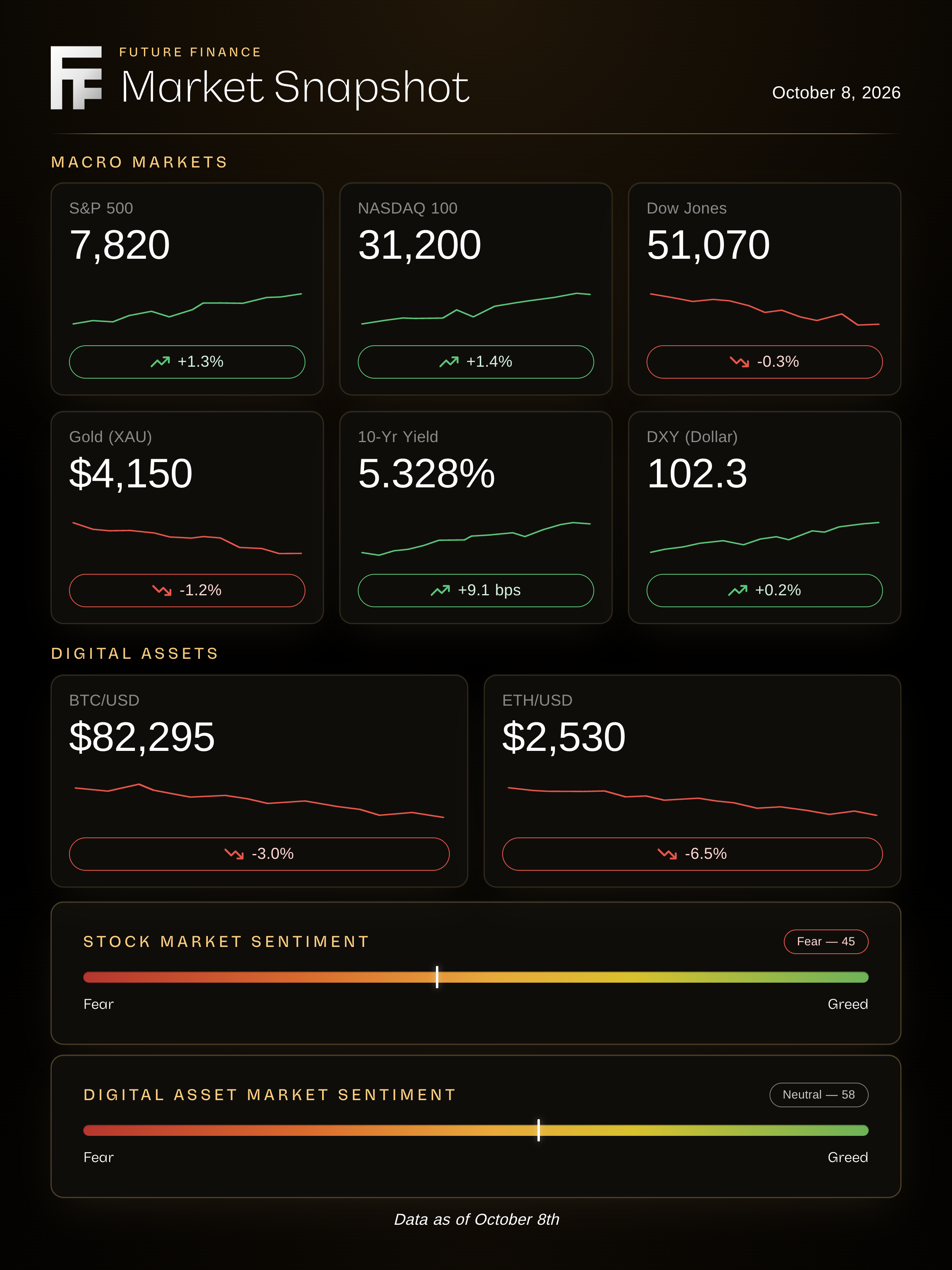
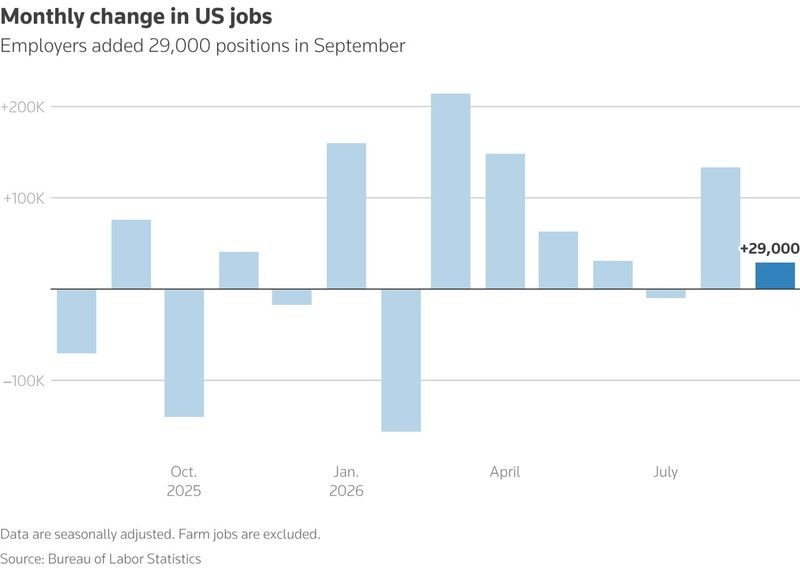
That matters, because insurance is the easiest purchase to cancel. Since the meeting, inflation came in softer than the Fed’s own staff expected, and September added just 29,000 jobs.
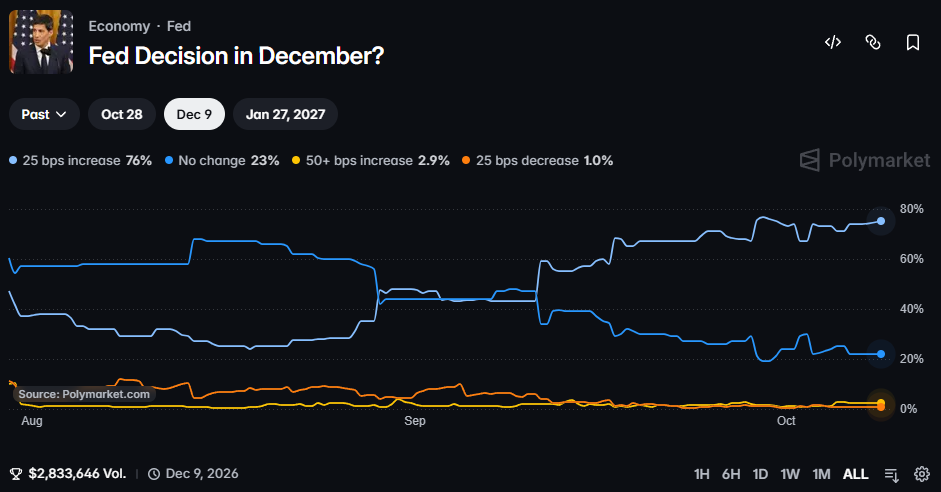
Traders put the odds of a hike October 28 at about one in five, and still see one by December as likely.
Below, Tan Gera reads the minutes: who wanted what, what worries them, and the question Kevin Warsh didn’t answer at 2:30.
Signal vs. Noise
Buyers Showed Up for the 10-Year
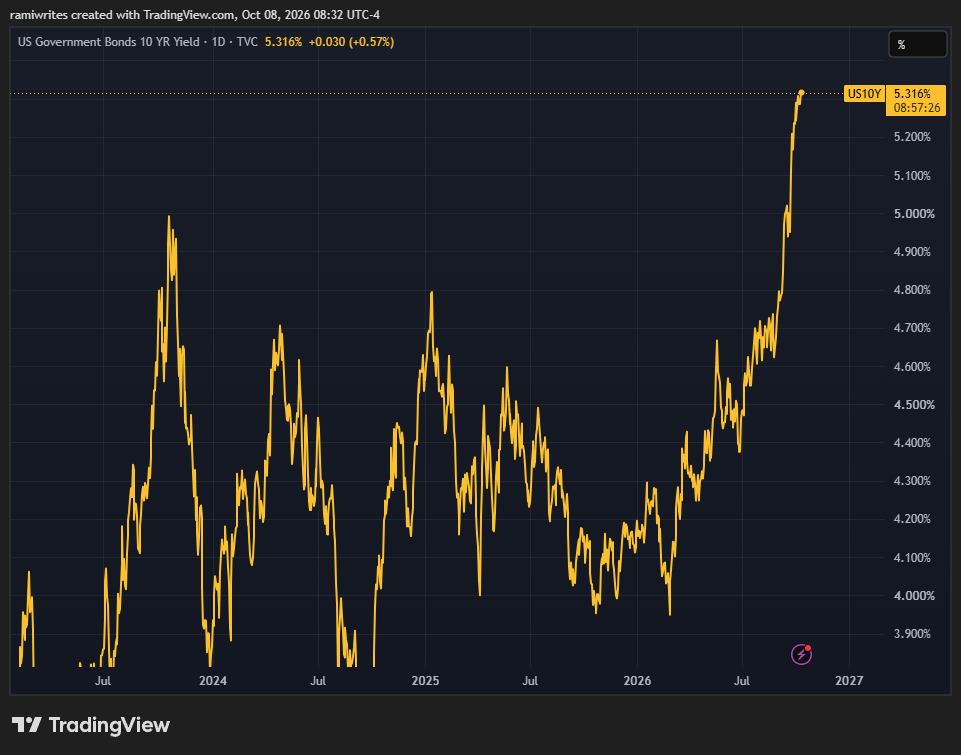
- The noise: the 10-year Treasury yield touched 5.35% on Wednesday, its highest since 2002, and the government sold 10-year debt at its highest auction yield since 2000.
- The signal: who showed up to buy it. The Treasury sold $39 billion of 10-year notes at 5.300%, below the 5.317% the market expected going in. Bids totaled 2.77 times the amount on offer, against a recent average of 2.54.
Investors, including foreign buyers and funds, took about 80% of the sale. Dealers, the banks obligated to bid at every auction, were left with just 2.5%, against an average near 9%.
For beginners: when dealers end up with very little, the debt found willing buyers on its own. We called auctions the other earnings report yesterday, and this one passed. The 10-year eased to about 5.28% by the close.
Today’s test is harder: $22 billion of 30-year bonds at 1 p.m., with that yield near 5.67%.
Small Companies Felt the Yields First
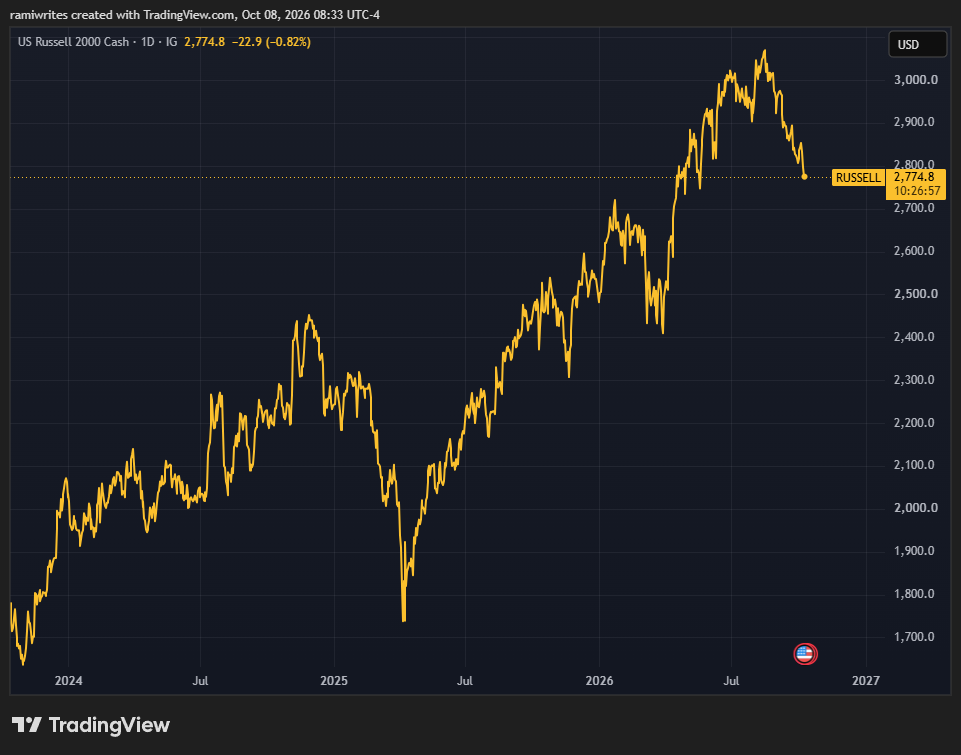
- The noise: the S&P 500 slipped 0.2% Wednesday, a few points off Tuesday’s record.
- The signal: the Russell 2000, an index of about 2,000 smaller U.S. companies, fell 1.3%, roughly six times as much.
Smaller companies borrow more of their money at floating rates, so their interest bills climb soon after yields do. Big companies with cash piles and long-dated debt can wait it out.
For beginners: the Russell 2000 is often read as a gauge of Main Street, because its companies sell mostly at home and lean harder on banks for credit.
Frank Curzio flagged highly leveraged companies as a risk heading into earnings yesterday. Small caps are where that shows up first, and nothing in the minutes points to lower rates soon.
Ethereum’s Biggest Buyer Named Its Stopping Point

- The noise: Ethereum fell about 6% Wednesday, to roughly $2,560, as TOKEN2049, crypto’s big conference in Singapore, got underway.
- The signal: what Tom Lee said on stage there. His company, BitMine, holds about 6 million ETH, roughly 4.9% of all Ethereum in existence, and he set 5% as a hard cap.
“We only need to get another 100,000 ETH to get to 5%,” Lee said. “That’s a hard cap.” BitMine’s shares fell about 7% on the day.
For beginners: when the largest steady buyer of an asset tells you when it will stop, the market starts pricing that day in early. The U.S. Ethereum funds had already seen six straight days of withdrawals.
Bitcoin funds took in about $119 million on Tuesday, so this is an Ethereum story more than a crypto one.

Featured Contributor
Today’s featured piece is from Tan Gera, Decentralized Masters’ co-founder and CEO, who writes The Macro Letter. A CFA charterholder and former investment banker, he left traditional finance to pioneer his own decentralized portfolio strategy, and his battle-tested approach has helped thousands of investors navigate any market condition.
Twelve Votes, Two Reasons
Three weeks ago, I told you to ignore the number and read the sentences after it.
I gave you four of them. The vote came in 12 to 0, and the forecasts pointed to one more hike this year.
Kevin Warsh sidestepped the question about the Treasury buying back its own bonds, and kept the press conference short.
Yesterday the Fed published the fifth sentence, and the longest one: the minutes of that meeting. Here’s what I took from them.
What they agreed on
The hike itself. All 19 officials in the room, voters or not, supported it.
The direction. The minutes say “most participants assessed that another increase in the target range for the federal funds rate would likely be appropriate by year end.”
The forecasts say the same thing in numbers. Twelve of the 18 officials penciled in one more quarter-point hike this year, four penciled in two, and two penciled in none.
Almost all of them saw the risks to inflation tilted higher. Several said rates were “not restrictive or only mildly restrictive,” which is how a central bank says it hasn’t finished.
Where they split
A unanimous vote tells you what a committee did. It doesn’t tell you why, and the why decides what happens next.
Many officials called a higher path “prudent on risk-management grounds,” providing “insurance against inflation remaining persistently above target.”
In plain English: inflation will probably cool on its own, but being wrong would cost enough to pay a premium now.
Others, “a number of participants” in the Fed’s wording, saw a higher path “as necessary based on their modal outlooks rather than on risk-management grounds.” For them, the fire is already on the way.
Those two groups voted the same way in September. They may not vote the same way in October.
Insurance is the first thing you cancel when the house stops smelling like smoke.
What changed since
Since they met, the house smells a little less like smoke. In September, a majority said the job market had “strengthened a bit.”
Then September’s jobs report showed just 29,000 new jobs, and the two months before it were revised down by a combined 60,000. Core inflation, the measure the Fed watches most, came in at 3.0% for August, two-tenths below what the Fed’s own staff had estimated.
The market heard it. Odds of a hike at the October 27–28 meeting fell to about one in five after the jobs report, and the minutes didn’t move them. The debate has moved to December.
You can hear the split in public now, too. New York Fed President John Williams says there is “no need for urgency.” Dallas Fed President Lorie Logan says rates need to rise “an additional 50 basis points or more.”
For the officials hiking on insurance, that’s a reason to wait. For the ones hiking on conviction, it’s one soft month.
What worries them
Two lines stood out to me.
The first is energy. Many officials warned that “the longer energy prices remained elevated,” the greater the risk they spread into everything else. Brent crude is back near $100 this week.
The second is patience. Some noted that inflation has run above 2% for more than five years, and that “elevated inflation rates could begin to affect inflation expectations.”
Once people expect higher prices, they ask for higher wages and charge higher prices, and inflation starts feeding itself. That doesn’t show up in the data yet, and the hawks would rather not wait until it does.
The answer Warsh didn’t give
At the press conference, someone asked about the Treasury buying back its own long bonds while the Fed raised rates. Warsh steered to growth and geopolitics.
The minutes come closer to an answer. The New York Fed’s markets desk cited commentary linking higher term premiums, the extra yield investors demand to hold long bonds, to three things: geopolitics, “uncertainty related to” the buyback program, and heavy borrowing to fund AI infrastructure.
A few officials also stressed “the importance of planning for market stress” in Treasurys, and suggested sharper tools for it “while limiting the Federal Reserve’s footprint in the Treasury market.”
I read that as a committee that has thought about a bad day in the bond market, and doesn’t want to be the buyer that rescues it.
What I’m doing
Nothing, again.
My orders are where I wrote them: $81,000 and $72,000 for Bitcoin, $4,000 for gold. The Fed isn’t one of my signals, and neither are its minutes.
What the minutes change is the calendar I’m watching. September’s inflation report lands October 14, and the Fed meets October 27–28. If inflation runs hot again, the insurance buyers turn into conviction buyers, and October is back on the table.
I said three weeks ago that the first hike is rarely the story, and the third one is. The minutes say the second is a question of when.
The third is already in the forecasts. Four of the 18 officials see it this year, and eight see it by the end of 2027.
Keep reading the sentences. They’re telling you more than the vote did.
That’s what I’ll be doing on Monday in The Macro Letter, the note I write twice a week on rates, inflation and my own portfolio. I’ll go through these minutes line by line before the October 14 report, and show you where my orders sit for each way it could go.
- Tan Gera
Co-founder and CEO, Decentralized Masters | The Macro Letter
A CFA Charterholder’s Read on the Market, Straight to Your Inbox
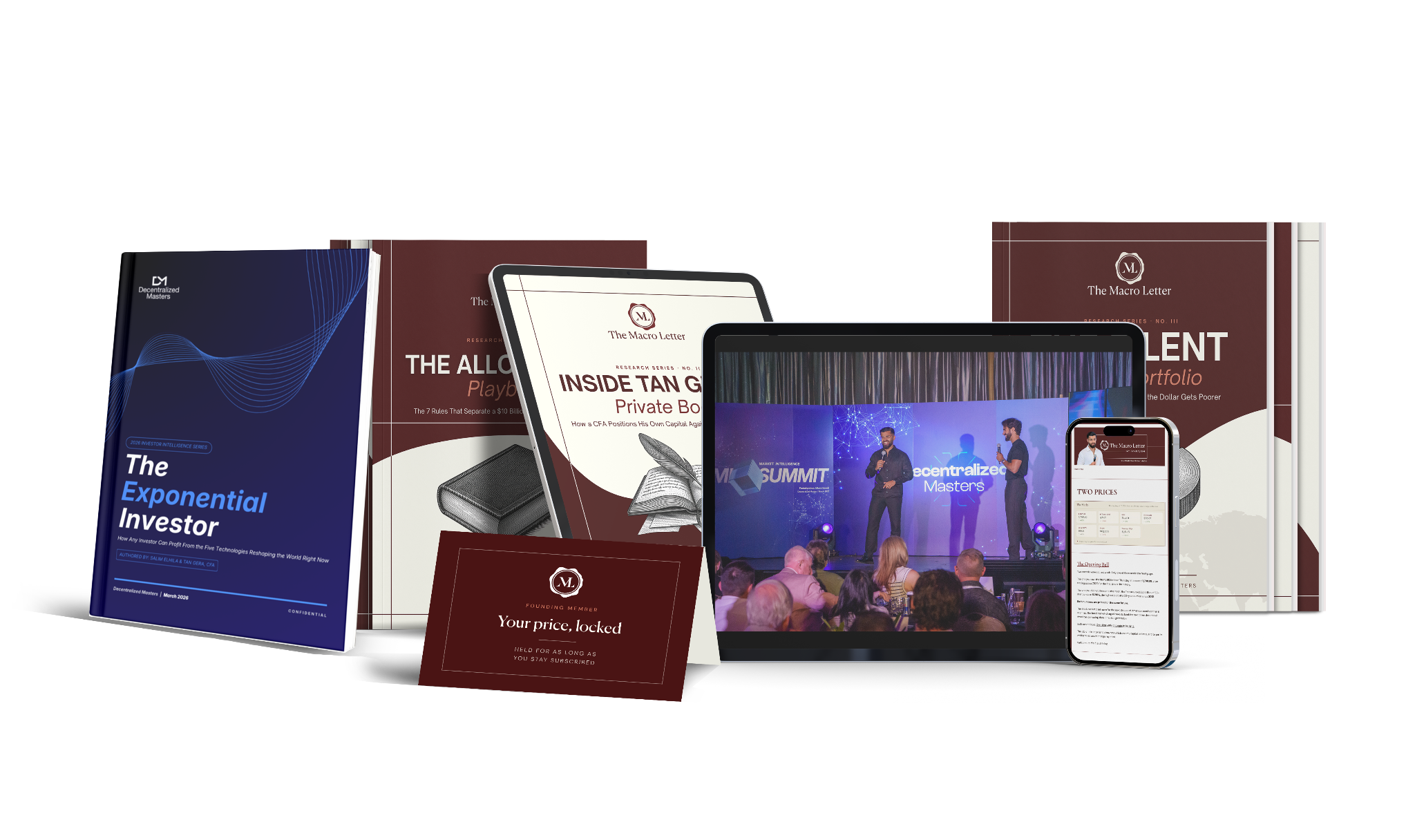
You just read Tan Gera’s take on the Fed’s minutes, and the orders he isn’t changing because of them.
The Macro Letter brings that thinking to your inbox twice a week, directly from Tan, a CFA charterholder who shares his own portfolio in the open. You get the levels he sets before the market reaches them, every move he makes with his own money, and an honest grade on the calls that missed.
Plain numbers, with every term explained.
Get The Macro Letter in your inbox →
Positions described are Tan’s own portfolio, shared for transparency, and are not a recommendation to buy or sell any asset. Past performance is not indicative of future results.
Final Thought
Most of us buy insurance the way the Fed did in September: before the evidence is in, because being wrong would cost too much.
The minutes say most of the committee bought that policy together. Whether they renew it depends on the next two reports, and nobody in that room knows how those will read.
That’s the case for a plan that doesn’t need the Fed’s answer. Decide what you’d own if rates rise again, and what you’d own if they don’t, before October 28 decides for you.
There’s more on how DM builds that kind of plan at the bottom of this issue.
Tomorrow, Delta’s forecast and how the 30-year auction went. On Sunday, the first edition of The Earnings Ahead, starting with the big banks.
See you then.
Editor in Chief | Future Finance
Nobody Can Predict This Fed. You Don't Have To.
When the Fed itself can't agree on its next move, and the chair has stopped giving hints, trying to trade the outcome is a game you're set up to lose.
The ABN system from Decentralized Masters is built for exactly this moment: money spread across assets that each do their job in a different environment, so you don't have to be right about the Fed, the war, or the dollar to come out ahead.
Stop betting on one outcome. Own a plan that survives all of them.
Watch the free ABN training here…
Disclaimer: This content is not financial advice, it is for informational purposes only. All investments involve inherent risk. Any financial decisions you make are solely your responsibility.
Latest


Editor's Picks

Become a sharper capital allocator in 5 minutes a day.
Institutional-grade research on where the smartest capital is positioning, across AI, energy, biotech, robotics, and digital assets. Distilled into a daily read you finish before your coffee does.
Join 45,000+ readers · No spam · Unsubscribe anytime · No card needed