

Nvidia’s CEO sent one email. $200B moved.
The rest of the market barely blinked →
November 9, 2026
·
8 Min Read




The briefing serious investors read first.
Free analysis before markets open. Start thinking in decades, not days.
Join 45,000+ readers · No spam · Unsubscribe anytime · No card needed
Before we begin: this report is for education, not financial advice. Nothing here is a recommendation to buy or sell any stock, company, or asset, and we make no price predictions. Investing carries risk, including loss. Please read the full disclaimer at the end.
Today’s Big Picture
On Sunday, Nvidia’s CEO emailed his staff an apology. The same day, the company’s directors opened an investigation into him.
By this morning, Nvidia was down about 5% before the opening bell, from Friday’s close of $186.64. That’s roughly $225 billion, more than most companies in the S&P 500 are worth.
Nothing in the apology was about chips, sales or profits.
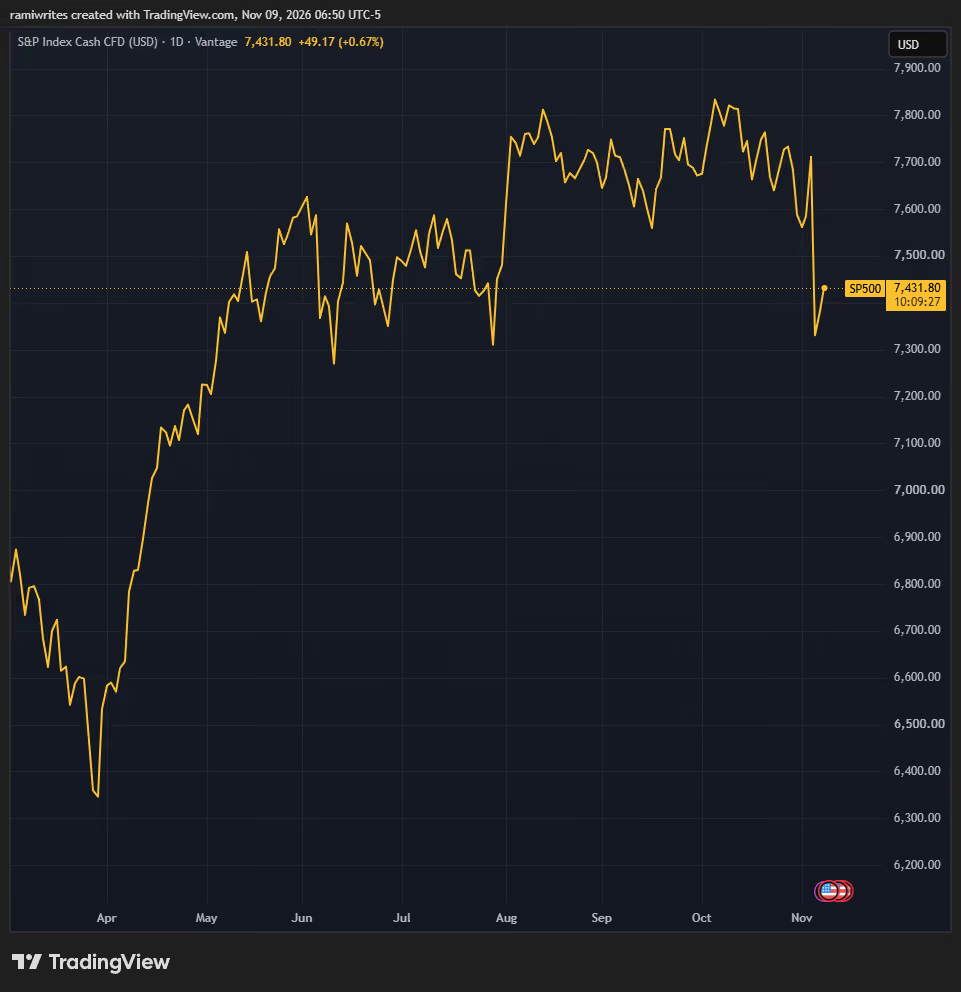
And the rest of the market? S&P 500 futures dipped 0.4% when trading opened Sunday night, then turned higher.
When a price rests on years of expected growth, even news that has nothing to do with profits can move billions.
Below, why the S&P 500 looks cheap and expensive at the same time. Then, in my Featured Lead, the full story, and what history says happens to a stock when investors start pricing the person in charge.
[[IMAGE TO ADD: Market Snapshot 2026-11-09 dashboard]]
Paid Advertisement
The Next Crisis Won’t Destroy Wealth. It Will Simply Change Hands.
A severe financial crisis does not make the world’s real wealth disappear. The businesses, land, natural resources, commodities, and productive assets still exist. What changes is who owns them.
Doug Casey and David Stockman have released an urgent briefing on how to position before the transfer.
Disclosure: International Man is a paid partner of Future Finance. The forecasts, track record and claims above are the views of Doug Casey, David Stockman and International Man, and do not represent the view of Future Finance. As always, do your own diligence.
Signal vs. Noise
The S&P 500 Looks Cheap and Expensive at the Same Time
- The noise: the idea that stocks got cheap after last week’s drop.
- The signal: it depends which ruler you use.
Ruler one: the forward price-to-earnings ratio. It divides the S&P 500’s price by the profits analysts expect over the next 12 months. On Thursday it was 17.7, below its five-year average of 19.8, according to FactSet.
Ruler two: the Shiller CAPE. It divides the price by 10 years of actual, inflation-adjusted profits. It sits near 39. Its long-run average is about 17, and it peaked at 44 in 1999.
Same market, two very different answers. One ruler counts profits that have already happened. The other counts profits analysts expect.
Here’s the gap in one line. This year, analysts raised their 12-month profit estimates for the S&P 500 by 33.6%. The index itself was up 7.4% through Thursday.
So the market looks cheap only if those profits show up.
That’s why anything that shakes confidence in the companies expected to deliver them hits so hard, whether it’s a CEO’s conduct on Sunday or new worries about data-center rules on Thursday.
For beginners: a price-to-earnings ratio tells you how many dollars investors pay for each dollar of yearly profit. The higher it is, the more of the price is a bet on the future.

Featured Lead
Today’s Featured Lead comes from me, Rami Al-Sabeq, Editor in Chief of Future Finance. I’ve written about digital assets and markets since 2020, and I oversee every newsletter at Decentralized Masters, including Gems Uncovered, Beat Banks and The Macro Letter.
Nothing below takes a political side, and nothing here is a recommendation.
The Founder Premium: What Happens When a Stock’s Story Is One Person
What happened
On Sunday, Jensen Huang, who co-founded Nvidia in 1993, emailed his staff. “I was unfaithful to my wife,” he wrote. “There is no excuse for what I did. I am deeply sorry.”
Nvidia’s directors opened an independent investigation the same day. The reason: a New York Times report, citing anonymous U.S. government sources, that the woman may have been working for Chinese intelligence.
China’s Foreign Ministry calls that “a groundless accusation, slander, and a smear.”
The directors say they have “no reason to believe that either national security or NVIDIA secrets were compromised,” and that they have confidence in Huang.

Why one person moved $225 billion
Nvidia’s chips were the same on Monday morning as they were on Friday afternoon.
What changed overnight was how investors felt about one man.
Huang has run Nvidia for 33 years, and the company hasn’t announced a succession plan. For most investors, Huang and the Nvidia story are the same thing.
And Nvidia is now so big, roughly 7% to 8% of the S&P 500, that it outweighs the smallest 250 companies in the index combined. When investors rethink Huang, everyone with an S&P 500 index fund feels it.
Analyst Dan Ives of Yorkville Ives & Co. wrote that there’s “clearly risk” Huang could be removed depending on the investigation, “as he is so important to the Nvidia story and strategy globally.” He also wrote that he expects Huang to stay.
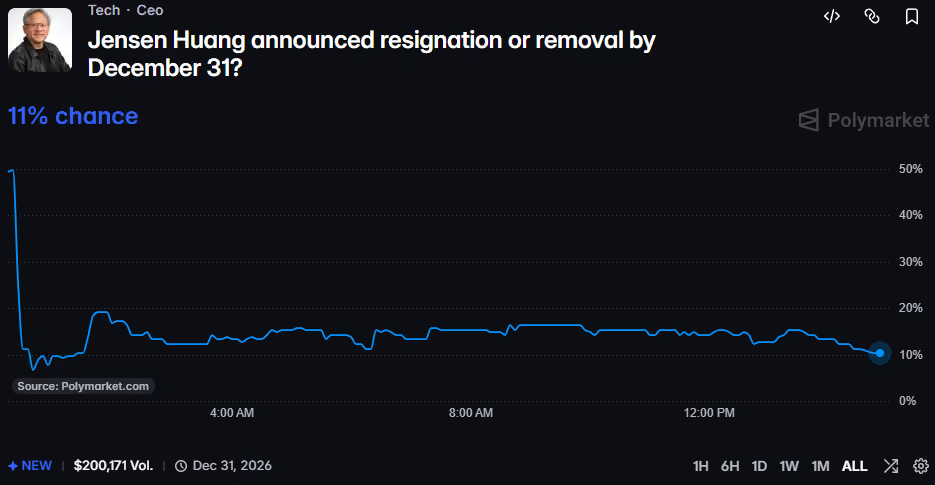
Traders on Polymarket, a prediction market, put the odds he leaves by Dec. 31 at about 11%.
Wall Street calls this key-person risk. I think of the flip side as the founder premium: the extra price investors pay because a particular person is in charge.
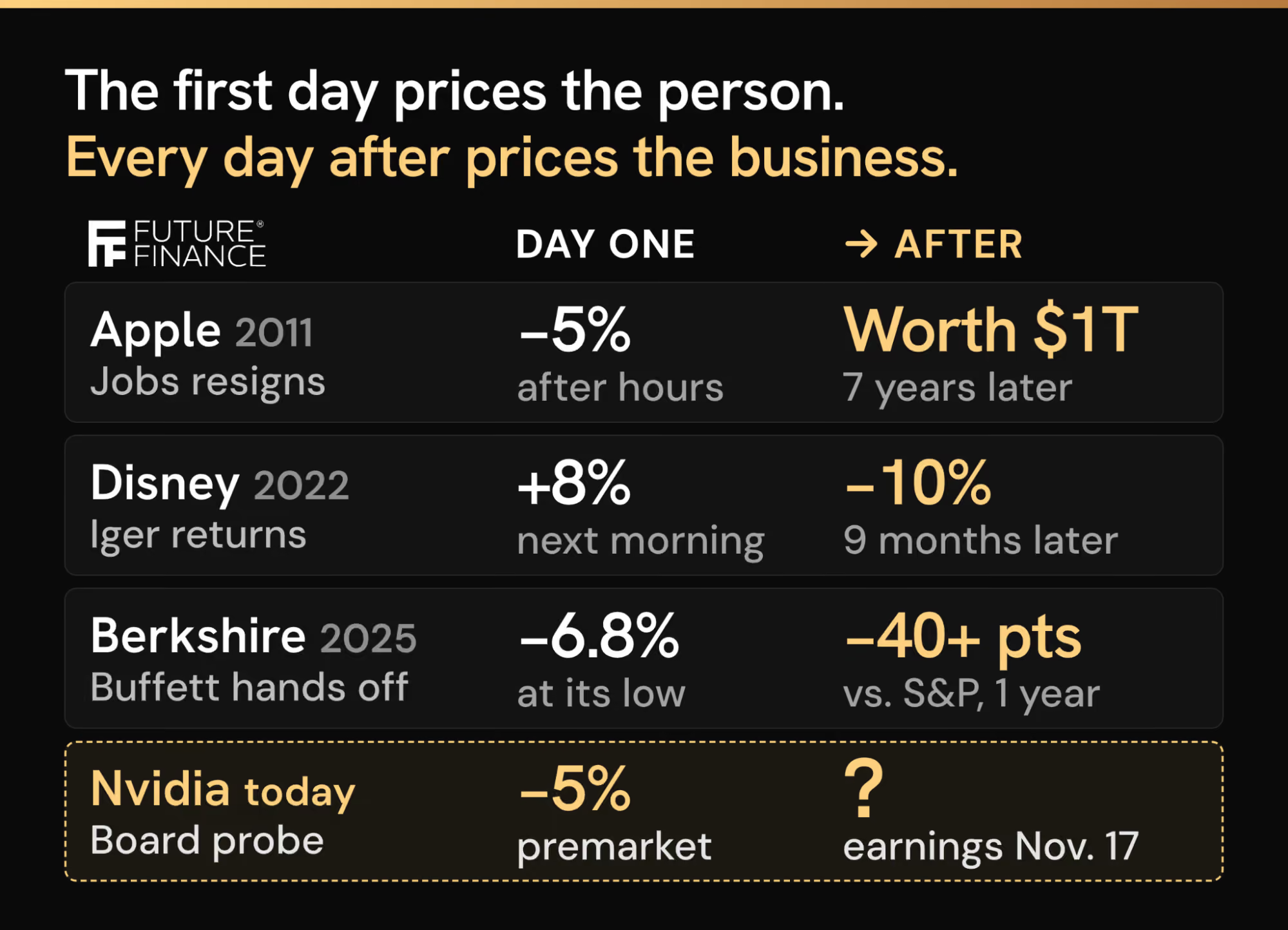
You can’t see it on a balance sheet. You only find out how big it was when the person changes. Three times, the market had to find out.
Apple, August 2011
Steve Jobs resigned as CEO after the market closed on Aug. 24, 2011. Apple fell about 5% in after-hours trading.
By the next morning, the drop had shrunk to less than 2%.
Seven years later, under Tim Cook, Apple became the first U.S. company worth $1 trillion.
The market feared losing the founder. The business answered the fear.
Disney, November 2022
On a Sunday night, Disney announced that Bob Iger, its longtime CEO, was coming back to replace his own successor.
The stock jumped about 8% the next morning.
Nine months later, Disney closed at its lowest price since 2014, about 10% below where it traded before Iger returned.
The market paid up for the person. The business didn’t keep up.
Berkshire Hathaway, May 2025
On a Saturday, Warren Buffett told shareholders he would hand the CEO job to Greg Abel at the end of the year.
Berkshire had hit a record high the day before. On Monday, it fell as much as 6.8%.
Over the following year, it trailed the S&P 500 by more than 40 percentage points, The Irish Times reported this May.
When Buffett made his announcement, investors were paying 1.8 times Berkshire’s book value, the accounting value of what it owns. Its long-term average is about 1.4 to 1.5. The paper argued that a premium like that made it hard to say life after Buffett was already priced in.
Some of what investors had been paying for was the person.
What it means for Nvidia
Three stocks, three different endings. In each one, the first day’s move was about a person.
What came after depended on the business, and on how much of the person was already in the price.
That’s why a story like Sunday’s matters more when valuations are high. When you pay today for profits that are years away, you’re also betting on who will be there to deliver them.
For Nvidia, the next test of the business comes on Nov. 17, when it reports earnings. What the investigation finds will matter too.
The first day prices the person. Every day after that prices the business.
Paid Advertisement
#1 Tech Investor: Elon’s Move Will Mint 1,806,000 Millionaires
Renowned tech investor James Altucher – the man who called the rise of Nvidia, Apple and SpaceX years in advance – just uncovered Elon Musk’s latest breakthrough idea…
And according to James, it’s going to be even bigger than the SpaceX IPO – creating up to 1.8 million new millionaires over the coming years.
The pieces behind it are inside this briefcase – which he reveals 100% FREE in this video.
Click here now for all the details.
Disclosure: Paradigm Press is a paid partner of Future Finance. The forecasts and claims above are James Altucher’s / Paradigm’s, not Future Finance research or advice. As always, do your own diligence.
Final Thought
Before Nvidia reports on Nov. 17, this week brings its own tests.
- Tuesday: October’s inflation report, at 8:30 a.m. ET.
- Wednesday: Veterans Day. Stocks trade; the bond market is closed.
- Thursday: the Treasury sells $25 billion of 30-year bonds.
Friday’s jobs report came in strong, at 165,000 jobs with unemployment at 4.1%, and the odds of a December rate hike climbed back to about 77%.
And one of our Sept. 30 calls landed Sunday night: Bitcoin traded below $75,000, touching about $73,700, its lowest since August. We grade all five on Dec. 31.
When so much of a price is a bet on the future, the future can move it on a Sunday.
See you tomorrow.
Editor in Chief | Future Finance
Paid Advertisement
You Built Your Retirement Savings. Who Decides Where It Can Go?
Many investors assume that owning an IRA means controlling it.
But when an account limits investments to a narrow selection of stocks, bonds and mutual funds, that control may be more limited than it appears.
A Checkbook IRA gives eligible investors direct control over retirement funds and the ability to pursue a broader range of investment choices when opportunities emerge.
For independent investors, the issue is not simply how much they have saved. It is whether their retirement structure gives them the flexibility to act.
See How a Checkbook IRA Expands Your Options →
Disclosure: Battle Bank is a paid partner of Future Finance. We may receive compensation from Battle Bank if you click on our links and open an account or use certain banking products. This compensation comes at no additional cost to you.
Battle Bank, N.A., Member FDIC. APYs as of 6/16/2026, using ZIP code 32224, and subject to change. Rate comparison as published by Battle Bank.
Disclaimer: This content is not financial advice, it is for informational purposes only. All investments involve inherent risk. Any financial decisions you make are solely your responsibility.
Latest



Editor's Picks

Become a sharper capital allocator in 5 minutes a day.
Institutional-grade research on where the smartest capital is positioning, across AI, energy, biotech, robotics, and digital assets. Distilled into a daily read you finish before your coffee does.
Join 45,000+ readers · No spam · Unsubscribe anytime · No card needed