

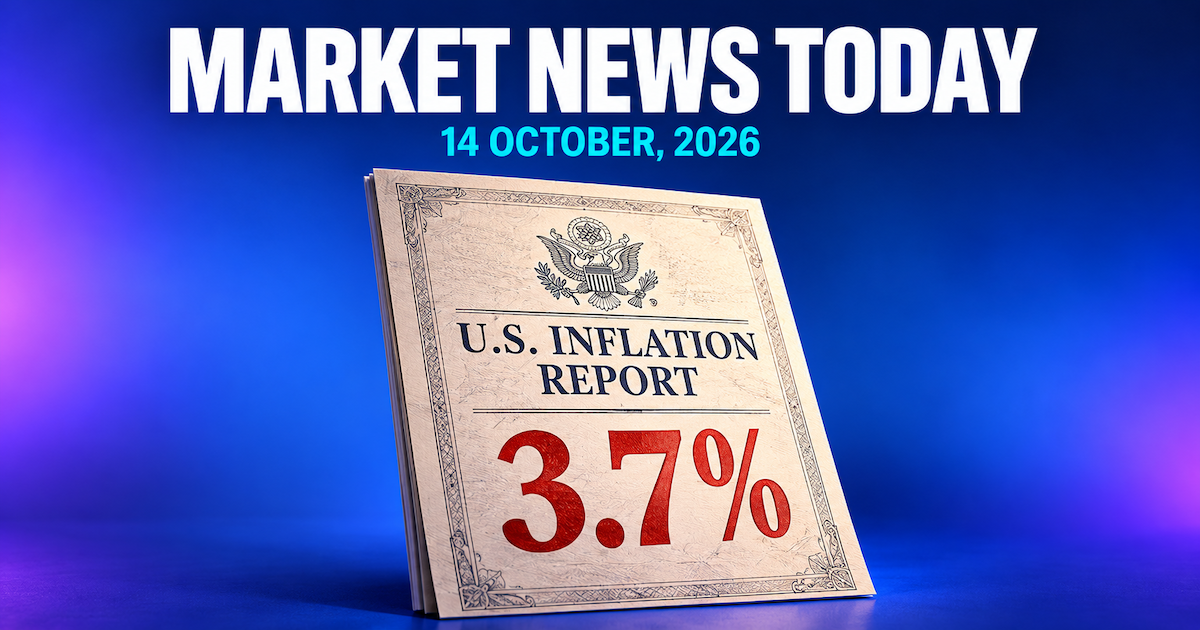
Market News Today October 15 - PPI Jumps 6.3% in Biggest Surge Since 2022, Chip Stocks Sink for an Eighth Day
September’s PPI just jumped 6.3%, the most since 2022. Will it reach your grocery bill? See what businesses are now paying.
October 15, 2026
·
3 Min Read



The briefing serious investors read first.
Free analysis before markets open. Start thinking in decades, not days.
Join 45,000+ readers · No spam · Unsubscribe anytime · No card needed
Before prices reach the checkout, they show up in what businesses pay, and that number just jumped by the most in more than four years.
September’s producer price index, the government’s measure of wholesale inflation, came in far hotter than expected, a day after consumer prices did the same. It landed on a morning when chip stocks fell for an eighth straight day and nervous investors piled into government bonds.
We’ve broken down all three, starting with the report that tells you where your bills are heading next.
September PPI Jumps 6.3%: What Wholesale Inflation Means for Your Bills
The producer price index tracks what businesses pay for goods and services before those costs reach you, which makes it an early warning for what you’ll pay in stores.
In September it rose 1.3% in a single month, more than double the 0.5% economists expected and the biggest monthly jump since March 2022. Over the past year, wholesale prices are up 6.3%, the fastest pace since December 2022.
Energy did most of the damage. Wholesale gasoline prices jumped more than 20% in a single month, goods prices overall rose by the most since that record began in 2009, and food prices climbed 1.2%.
Even with food and energy stripped out, core wholesale prices rose 0.7% in September and 5% over the year, a sign the pressure is spreading beyond the pump.
Businesses usually pass higher costs on, so this points to more pressure on grocery bills, shipping and services in the months ahead. Retail sales still came in stronger than expected, which shows Americans are spending through it, for now.
Coming a day after a hotter consumer inflation report, it gives the Fed one more reason to consider raising rates again at its October 28 meeting.
Why Are Chip Stocks Falling Again? The AI Selloff Hits an Eighth Day
While prices kept rising, the stocks that powered this year’s rally kept falling.
Chip stocks fell for an eighth straight day, with Taiwan Semiconductor down more than 4% and memory maker Sandisk, this year’s best-performing stock in the S&P 500, down another 6% after a 5% drop on Wednesday. South Korea’s main stock index plunged more than 7%.
The Nasdaq fell more than 1% at the open while the Dow edged higher, as investors moved out of tech and into steadier corners of the market.
Part of the worry came from Anthropic itself. Its results showed growth slowing even as quarterly revenue hit $16.8 billion, and investors are increasingly nervous about how much AI companies have borrowed to build out.
For anyone whose 401(k) leans on tech, eight straight down days are a reminder that the AI trade can cut both ways.
Why Are Treasury Yields Falling? Investors Rush to Safety
As money left tech, much of it went somewhere unexpected: government bonds.
The 10-year and 30-year Treasury yields fell about 0.13 percentage points on Thursday morning, the 30-year’s biggest one-day drop since November 2024, as investors bought bonds for safety.
That is unusual on a day of hot inflation data, which normally pushes yields higher, and it shows how much fear the AI selloff is creating.
Because mortgage and car loan rates follow these yields, a lasting drop would bring borrowers some relief. But one day’s move, driven by nerves rather than better news on prices, is not a trend yet.
Borrowers may get a brief break, but it is arriving for the wrong reasons.
Money Is Fleeing the AI Trade. The Early Money Usually Knows Where It’s Going.
Eight straight days of chip selling and a sudden rush into bonds show how fast money moves when sentiment turns, and moments like this are often when the next big winners quietly take shape. By the time it feels obvious, the early money has usually already moved.
That is why we created The $5 Trillion Signal, a free report that shows you, in plain English, the five technologies where serious money is flowing right now, who is backing each one, and the early signals worth watching before the crowd catches on.
It lands in your inbox instantly, so you can read it tonight while it is still early.
Get your free copy of The $5 Trillion Signal below.
The briefing serious investors read first.
Free analysis before markets open. Start thinking in decades, not days.
Join 45,000+ readers · No spam · Unsubscribe anytime · No card needed
Disclaimer: This content is not financial advice, it is for informational purposes only. All investments involve inherent risk. Any financial decisions you make are solely your responsibility.
Latest



Editor's Picks

Become a sharper capital allocator in 5 minutes a day.
Institutional-grade research on where the smartest capital is positioning, across AI, energy, biotech, robotics, and digital assets. Distilled into a daily read you finish before your coffee does.
Join 45,000+ readers · No spam · Unsubscribe anytime · No card needed