

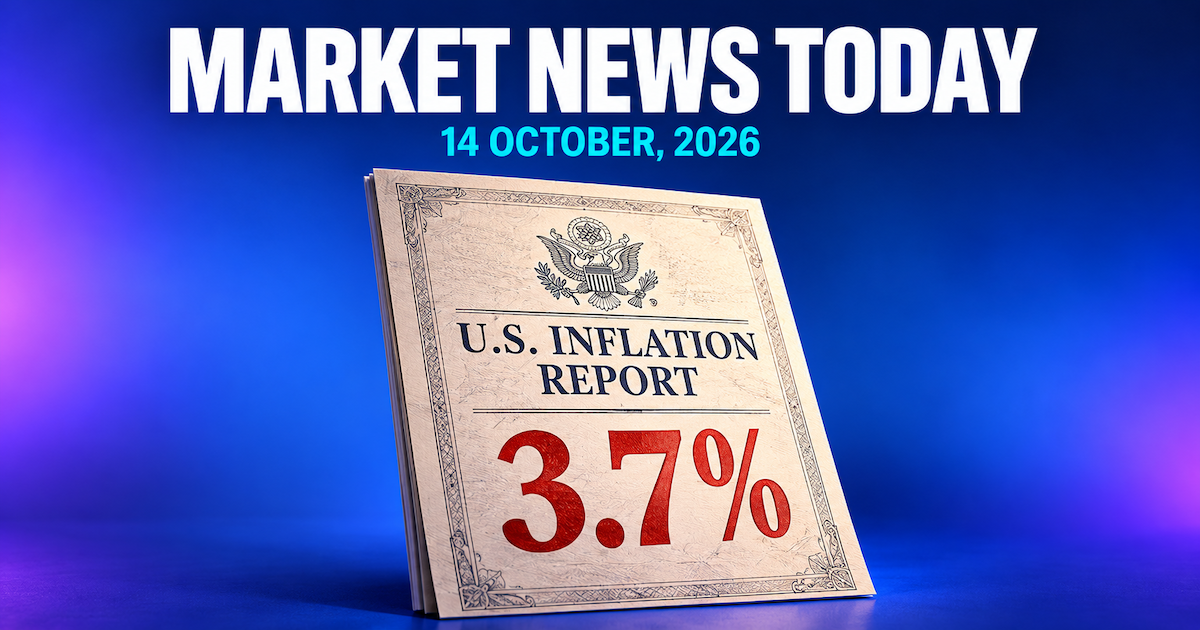
Market News Today October 14 - Inflation Hits 3.7%, Social Security Gets a 3.6% Raise, Tech Slides as Yields Jump
Social Security just announced a 3.6% raise for 2027. But inflation is already running hotter. See what you’ll really keep.
October 14, 2026
·
3 Min Read



The briefing serious investors read first.
Free analysis before markets open. Start thinking in decades, not days.
Join 45,000+ readers · No spam · Unsubscribe anytime · No card needed
The cost of living rose faster than Wall Street expected last month, and this time the pressure spread well beyond the gas pump.
There’s always a flood of market news, so we’ve pulled together what matters most for your money: a hotter inflation reading, the Social Security raise it just locked in, a fresh jump in borrowing costs, and another selloff in tech.
Let’s start with the number that set off everything else.
September CPI: Inflation Hits 3.7% and Locks In a 3.6% Social Security Raise
Inflation is moving in the wrong direction again.
Consumer prices rose 3.7% over the past year in September, up from 3.4% in August and above the 3.6% economists expected. Core inflation, which strips out food and energy, rose 2.6%, also ahead of forecasts.
Higher gas and energy prices did much of the damage, but the increases spread to everyday costs like car repairs, doctor visits, airfares and clothing.
The same report set next year’s Social Security raise. The Social Security Administration announced a 3.6% cost-of-living adjustment for 2027, worth about $75 a month for the average retiree and the biggest increase since 2023.
For anyone on a fixed income, that is welcome news, but it pays for price rises that have already happened, and some of it could be eaten by higher Medicare premiums, which are due to be announced in November.
Why Are Treasury Yields Rising Again? A Fed Rate Hike Is Back in Play
Hotter inflation hit the bond market almost immediately.
The 10-year Treasury yield, the benchmark for mortgages and car loans, climbed back to about 5.3%, close to the 24-year high it touched earlier this month. Traders now see roughly a 39% chance the Fed raises rates again at its October 28 meeting, up from about 22% a day earlier.
That matters to anyone borrowing. The average 30-year mortgage rate was already 7.40% last week, up from 6.30% a year ago, and another Fed hike would push credit card and home equity rates higher too.
Two weeks out from the Fed’s next decision, today’s report made a hike much harder to rule out.
Why Are Tech Stocks Falling? AI’s Borrowing Binge Comes Into Focus
Rising rates are toughest on the market’s most expensive stocks, and that is where the selling landed.
The Nasdaq fell about 1.5% by early afternoon and the S&P 500 about 1%, extending Tuesday’s losses, while the Dow held up better, down about 0.3%.
The sharpest drop came from CoreWeave, which rents out AI computing power and has borrowed heavily to build it. Its shares fell about 16%, and the interest rate investors demand on its bonds jumped to nearly 15%.
Investors pay up for tech because of the profits they expect years from now, and higher interest rates make those future profits worth less today. They also make debt more expensive for AI companies that have borrowed billions to build data centres.
For anyone with a 401(k) leaning on tech, the AI trade now has two problems at once: stubborn inflation and a growing pile of debt.
Inflation Just Changed the Math. The Early Money Is Already Moving.
Hotter inflation, a 3.6% Social Security raise and a jump in borrowing costs all landed in a single morning, and moments like this are often when the next big winners quietly take shape.
By the time it feels obvious, the early money has usually already moved.
That is why we created The $5 Trillion Signal, a free report that shows you, in plain English, the five technologies where serious money is flowing right now, who is backing each one, and the early signals worth watching before the crowd catches on.
It lands in your inbox instantly, so you can read it tonight while it is still early.
Get your free copy of The $5 Trillion Signal below.
The briefing serious investors read first.
Free analysis before markets open. Start thinking in decades, not days.
Join 45,000+ readers · No spam · Unsubscribe anytime · No card needed
Disclaimer: This content is not financial advice, it is for informational purposes only. All investments involve inherent risk. Any financial decisions you make are solely your responsibility.
Latest




Editor's Picks



Become a sharper capital allocator in 5 minutes a day.
Institutional-grade research on where the smartest capital is positioning, across AI, energy, biotech, robotics, and digital assets. Distilled into a daily read you finish before your coffee does.
Join 45,000+ readers · No spam · Unsubscribe anytime · No card needed