

Clarity Act Fails in the Senate: What Happens to Digital Asset Rules Now
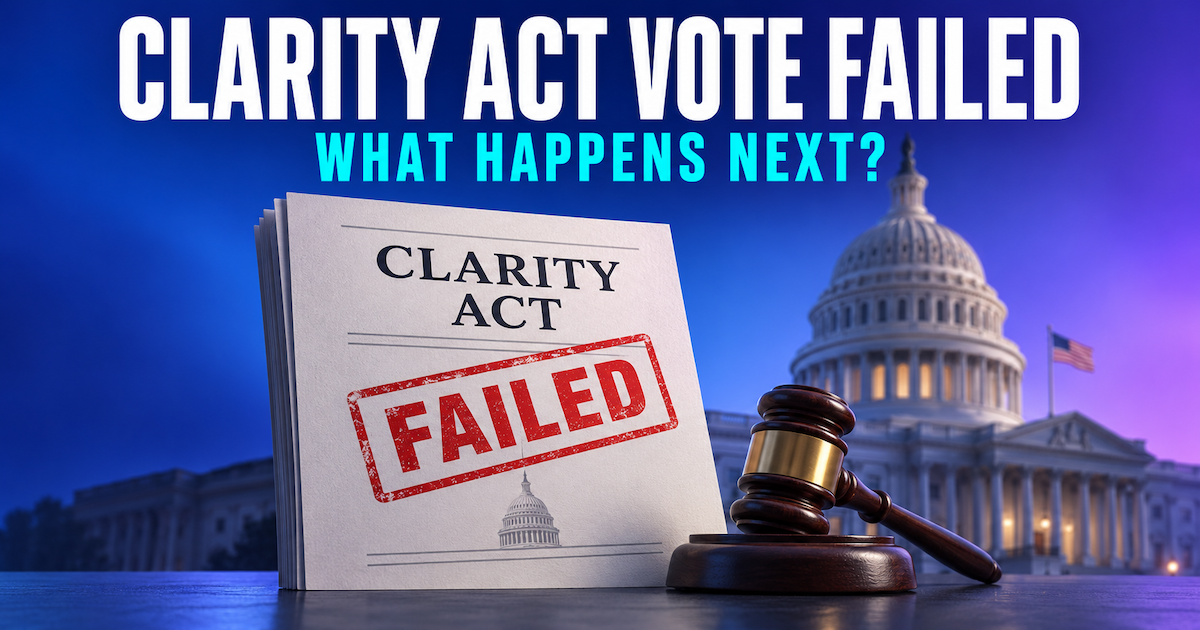
The Senate just killed the biggest digital asset bill in U.S. history. Bitcoin fell instantly. Here's what happens next.
September 15, 2026
·
5 Min Read



The briefing serious investors read first.
Free analysis before markets open. Start thinking in decades, not days.
Join 45,000+ readers · No spam · Unsubscribe anytime
If you hold bitcoin in a brokerage account or an ETF, the rules governing that holding were supposed to be written into law this year.
Instead they stay where they have been for a decade, in the hands of two federal agencies that can change their minds at any time.
The Digital Asset Market Clarity Act fell short of the 60 votes it needed to advance in the Senate on Tuesday, ending the industry's biggest legislative push and sending prices down with it.
Bitcoin slid to around $76,000, down roughly 2.6% on the day, while Coinbase, Circle and Bullish extended earlier losses.
What Was the Clarity Act Meant to Do?
The bill would have settled the oldest argument in the industry, which is who actually regulates what.
It defined how the government should treat different types of tokens and handed the Commodity Futures Trading Commission clear authority over spot markets, replacing a decade of enforcement actions and court rulings with an actual rulebook.
The House passed it in July 2025 by 294 votes to 134.
Negotiators then produced more than 600 pages of compromise, only to deadlock over ethics provisions designed to stop senior government officials from holding business interests in the industry they oversee.
Why Does This Matter If You Do Not Own Any?
Because the alternative to a law is a rulebook that can be rewritten by whoever holds office next.
The Securities and Exchange Commission and the CFTC are both drafting rules now, and SEC chairman Paul Atkins has openly said those rules will not hold up without legislation behind them.
Agency guidance can be erased exactly the way it was written, which means banks, brokerages and fund managers deciding whether to offer these products to ordinary savers are being asked to build on ground that shifts every four years.
What Happens Next?
This Congress winds down at the end of the year, and a new one arrives in January.
Democrats are favoured to take the House, which would put committees hostile to the industry in charge of any future attempt.
Senator Cynthia Lummis, who led the effort, has warned the next realistic window may not open until 2030.
Congress Is Five Years Behind. Your Money Does Not Have to Be
The internet had no rules for years. Neither did online banking, or index funds, or the app on your phone that moves money in seconds.
By the time Washington got around to writing laws for any of it, the people who understood it early were already ahead.
The same thing is happening right now, and it is far bigger than one bill in the Senate.
Trillions of dollars are moving into five technologies most people have not looked at yet.
We put together a free report explaining what they are, why that money is going there, and what to watch as it moves.
Get your free copy of The $5 Trillion Signal below.
The briefing serious investors read first.
Free analysis before markets open. Start thinking in decades, not days.
Join 45,000+ readers · No spam · Unsubscribe anytime
Disclaimer: This content is not financial advice, it is for informational purposes only. All investments involve inherent risk. Any financial decisions you make are solely your responsibility.
Latest



Editor's Picks



Become a sharper capital allocator in 5 minutes a day.
Institutional-grade research on where the smartest capital is positioning, across AI, energy, biotech, robotics, and digital assets. Distilled into a daily read you finish before your coffee does.
Join 45,000+ readers · No spam · Unsubscribe anytime