

10-Year Treasury Yield Hits 5% – Why Your Mortgage and Stocks Could Feel It Next
The 10-year Treasury yield just crossed 5%, its highest since 2023. Here's why this could hit your money and markets next.
September 14, 2026
·
5 Min Read



The briefing serious investors read first.
Free analysis before markets open. Start thinking in decades, not days.
Join 45,000+ readers · No spam · Unsubscribe anytime
If you’re planning to buy a home, borrow money or invest in stocks, today’s bond-market move could hit closer to home than you think.
The 10-year Treasury yield climbed above 5% today, its highest since 2023.
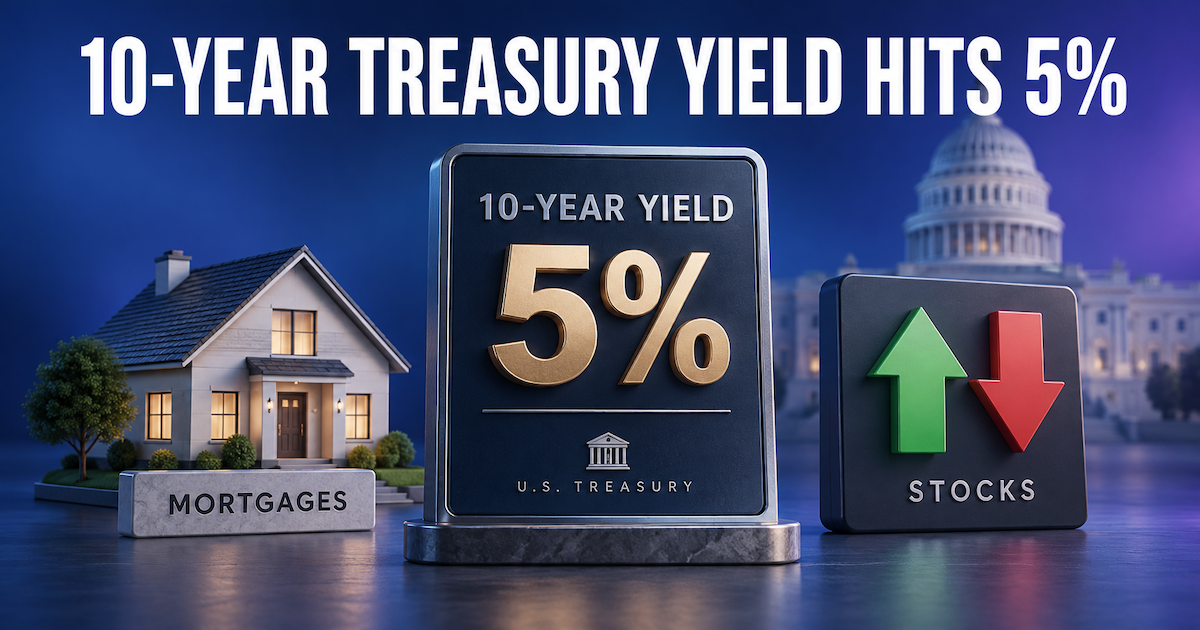
That matters because this rate helps shape the cost of a new mortgage, what businesses pay to borrow and how investors value the stocks in your portfolio. If it stays elevated, buying a home or financing a business could get harder, while expensive shares face more pressure.
Why Did the 10-Year Treasury Yield Hit 5%?
The 10-year Treasury yield crossed 5% as investors sold government bonds amid renewed inflation fears.
Bond prices and yields move in opposite directions, so heavier selling pushes yields higher.
Oil near $110 a barrel is adding to concerns that inflation could remain stubborn, while markets are also preparing for another possible Federal Reserve rate hike.
Heavy government borrowing and enormous corporate spending on AI infrastructure are adding even more competition for investor money.
Why Does a 5% Treasury Yield Matter to Ordinary Americans?
The 10-year Treasury sits underneath huge parts of the U.S. financial system.
Mortgage rates often move alongside it, and 30-year mortgage rates are now around 7%.
Higher yields can also mean more expensive car loans, business borrowing and corporate debt.
For someone buying a home, even a small rise in rates can add hundreds of dollars to a monthly payment.
For companies, higher financing costs can mean less money available for hiring, expansion or investment.
Could 5% Hurt the Stock Market?
This is where investors become nervous.
When U.S. government bonds offer roughly 5% returns, stocks have to compete harder for investor money.
That can be especially painful for expensive growth and technology shares whose valuations depend heavily on profits expected years into the future.
The number itself is not a cliff.
But if yields keep climbing towards 5.5% or 6%, borrowing conditions could tighten further and investors may begin moving more money away from riskier assets.
When 5% Changes the Rules, You Want to See the Next Move Early
A move like this can quietly change which parts of the market win and lose.
Higher rates can pressure some sectors while sending capital towards entirely different opportunities.
That is why we created The $5 Trillion Signal.
It shows the five technologies we believe could attract enormous investment over the next decade, the themes forming around them, and the signals worth watching before those moves become obvious.
Get your free copy of The $5 Trillion Signal below.
The briefing serious investors read first.
Free analysis before markets open. Start thinking in decades, not days.
Join 45,000+ readers · No spam · Unsubscribe anytime
Disclaimer: This content is not financial advice, it is for informational purposes only. All investments involve inherent risk. Any financial decisions you make are solely your responsibility.
Latest



Editor's Picks



Become a sharper capital allocator in 5 minutes a day.
Institutional-grade research on where the smartest capital is positioning, across AI, energy, biotech, robotics, and digital assets. Distilled into a daily read you finish before your coffee does.
Join 45,000+ readers · No spam · Unsubscribe anytime