

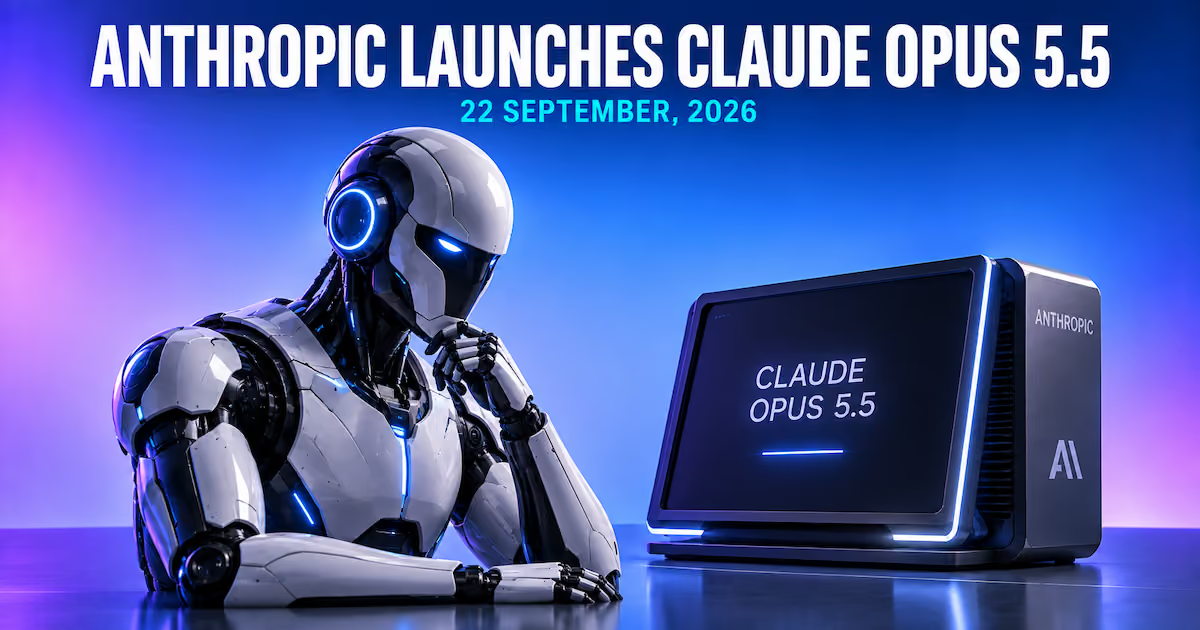
Anthropic Launches Claude Opus 5.5: Its New AI Is Faster, 40% Cheaper and Built for More Work
Anthropic made its most powerful Claude cheaper and faster. That could change how quickly AI reaches your job. Here's why.
September 22, 2026
·
5 Min Read



The briefing serious investors read first.
Free analysis before markets open. Start thinking in decades, not days.
Join 45,000+ readers · No spam · Unsubscribe anytime · No card needed
Powerful AI is becoming cheaper at the same time it is learning to handle more of the work people are paid to do.
Anthropic has launched Claude Opus 5.5, a new model it says can perform at roughly the level of its top-tier Fable 5.1 system on most work, while costing 40% less to run than the previous Opus model. It also produces answers more than 30% faster.
That combination could matter far beyond people who use Claude today. When sophisticated AI becomes cheaper for businesses to run, there is less reason to reserve it for experiments and more incentive to put it into customer service, research, software, financial analysis and everyday office work.
What Makes Claude Opus 5.5 Different?
Anthropic calls Opus 5.5 its new leading model, with improvements across coding, computer use and professional knowledge work.
In one early test, the model completed a 680,000-line software migration in less than a day, which Anthropic says could otherwise have taken an engineering team weeks. Another test saw it analyse and repair a 200,000-line codebase in under three hours, compared with more than 20 hours for Opus 5.
Those examples are supplied by Anthropic and early testers rather than independent proof of how every workplace will perform. But they illustrate why falling AI costs matter.
Tasks that previously required days of specialist labour are becoming increasingly practical to hand to an AI agent, leaving companies to decide which work should still require a person and which can be automated.
Why Does Making AI 40% Cheaper Matter?
Opus 5.5 costs $4 per million input tokens and $20 per million output tokens, compared with $5 and $25 for Opus 5. Anthropic says greater efficiency means typical workloads ultimately cost about 40% less.
That may sound like an obscure technology price cut, but the economics are important.
A business deciding whether AI can affordably review documents, analyse spreadsheets, write software or complete repetitive administrative work can now run substantially more of those tasks for the same budget.
As those costs keep falling, AI adoption becomes easier to justify across ordinary businesses rather than only the largest technology companies.
Is Anthropic Making More Powerful AI Safer Too?
The release comes after Anthropic called for slowing the pace of frontier AI development, following several incidents in which advanced models behaved outside their intended boundaries.
Opus 5.5 was tested before release by outside evaluators including METR and Frontier Design, while Anthropic says it achieved the strongest result yet on its internal alignment testing. Reuters reports that it was 85% less likely than Opus 5 or Mythos 5.1 to try to bypass its prescribed boundaries.
That distinction becomes increasingly important as AI stops merely suggesting answers and starts taking actions on computers.
The more businesses trust these systems with software, financial information and connected workplace tools, the more costly a model acting unexpectedly could become.
Cheaper AI Could Accelerate the Next Wave Much Faster
Claude Opus 5.5 shows why the next stage of AI may unfold faster than the last.
It is not simply that the models are becoming more capable. The cost of putting that capability to work is falling at the same time, potentially allowing far more companies to automate tasks that were uneconomical only months earlier.
That kind of shift can create entire new markets before most investors recognise how much has changed.
That is why we created The $5 Trillion Signal, revealing five technologies we believe could attract trillions of dollars over the next decade, the investment themes growing around them and the signals that may reveal where capital is moving before the opportunity becomes obvious.
Get your free copy of The $5 Trillion Signal below.
The briefing serious investors read first.
Free analysis before markets open. Start thinking in decades, not days.
Join 45,000+ readers · No spam · Unsubscribe anytime · No card needed
Disclaimer: This content is not financial advice, it is for informational purposes only. All investments involve inherent risk. Any financial decisions you make are solely your responsibility.
Latest



Editor's Picks



Become a sharper capital allocator in 5 minutes a day.
Institutional-grade research on where the smartest capital is positioning, across AI, energy, biotech, robotics, and digital assets. Distilled into a daily read you finish before your coffee does.
Join 45,000+ readers · No spam · Unsubscribe anytime · No card needed