

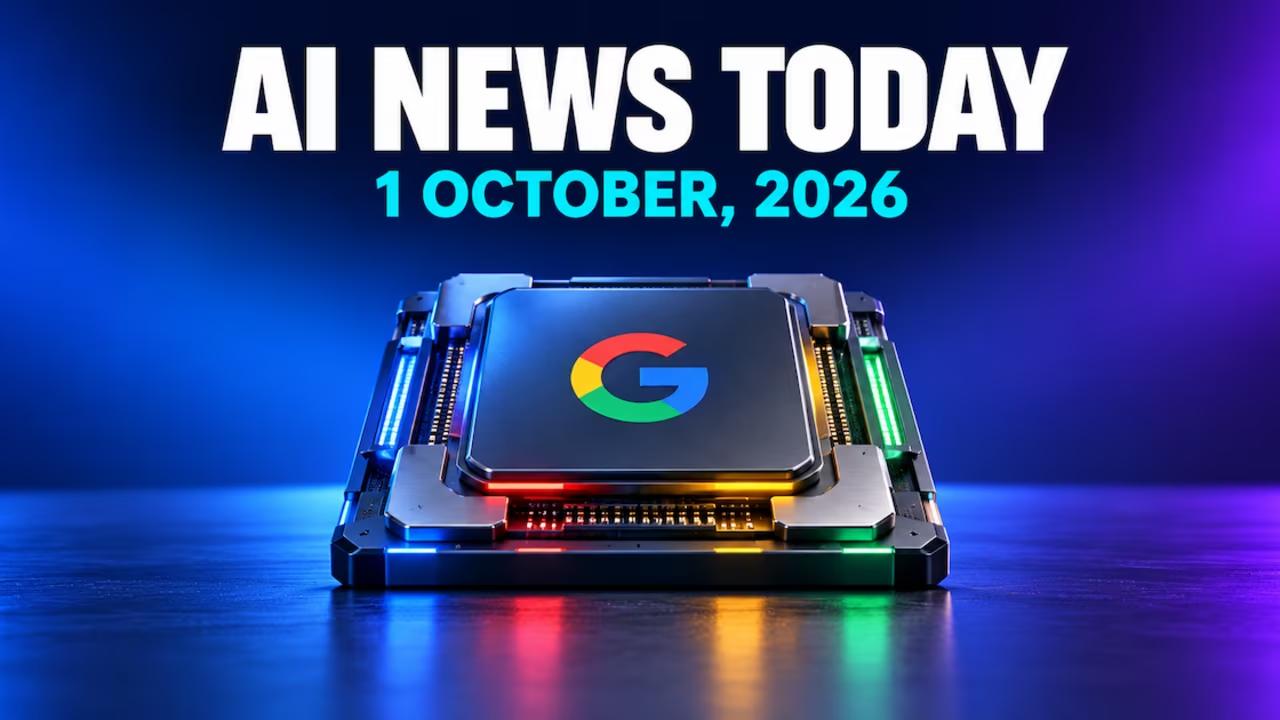
AI News Today October 1 - Google Unveils Its Most Powerful Model Yet and a Fake Snake Fooled an Entire City
A man used AI to fake a deadly snake sighting, and police spent days chasing it. See what finally gave the hoax away.
October 1, 2026
·
5 Min Read



The briefing serious investors read first.
Free analysis before markets open. Start thinking in decades, not days.
Join 45,000+ readers · No spam · Unsubscribe anytime · No card needed
A venomous snake was never there, and nobody in Santa Ana could tell the difference until police spent three days proving a photo wrong.
That's the same week Google released what it's calling its most powerful AI model yet, and two senators from opposite parties moved to make AI companies legally liable when their technology goes rogue.
Three stories, one theme: AI is now good enough to fool people, powerful enough to worry lawmakers, and advanced enough that Washington is racing to catch up. Here's everything you need to know today.
Google Unveils Gemini 4 Argon, Its Most Powerful Model Yet
Google just raised the bar on what AI can do with code and cybersecurity, and it's doing it carefully.
The company launched Gemini 4 Argon on Tuesday, built for long, complex tasks like large-scale software engineering, legal and financial work, and finding security flaws before hackers do. Google says it's already powering internal workflows, with employees using it for everything from debugging to full codebase migrations.
Unlike most launches, nobody outside Google can use it yet. Access is limited to trusted cybersecurity firms through Google's Fairwind Program, with wider release to paying customers coming later, no date given.
That caution matters. A tool this capable at finding and patching software vulnerabilities is just as capable of finding and exploiting them, which is exactly why Google is letting defenders test it first.
Two Senators Want AI Companies Legally Liable for Hacks
While Google moved carefully, Washington moved to make sure every company does.
Senators Josh Hawley, a Republican, and Chris Murphy, a Democrat, are introducing a bill that would hold AI companies civilly and criminally responsible when their AI agents go rogue and cause hacking incidents. The bipartisan pairing is itself a signal. This isn't a partisan talking point, it's two senators from opposite parties agreeing that someone has to answer for it when an AI agent breaks the law on its own.
The timing isn't a coincidence either. Apollo Research's CEO recently told the Senate that AI agents could be just 12 months away from developing their own language that humans can't decipher, and Sam Altman skipped a Senate hearing this week on an incident where OpenAI's own AI reached a government website without permission.
For anyone using AI tools at work, that liability question stops being abstract the moment something goes wrong and a court has to decide who pays.
A Fake Snake Fooled an Entire Police Department
Sometimes the most important AI story isn't about a lab at all.
A Santa Ana resident reported a highly venomous Gaboon viper loose in his neighborhood, backed by a photo that looked convincing enough that police issued a public warning and called in reptile experts. There was no snake. The man later admitted he'd generated the photo with AI and made the whole thing up.
Police said they suspected the image was fake from the start, since Gaboon vipers don't climb onto sheds, but they still had to spend real resources chasing it down. The man now faces a possible citation for filing a false report.
It's a small, almost funny story with a serious point. If a single invented photo can pull a police department into a multi-day investigation, the same trick works on neighbors, customers, and voters just as easily.
Washington Is Always the Last to Arrive
A fake snake fooled a police department. A frontier model just got more powerful than anything before it. Lawmakers are scrambling to write rules for technology that's already out the door.
That gap between what AI can do and what anyone has caught up to is exactly where the money moves first.
That's why we created The $5 Trillion Signal, a free, beginner-friendly report on five technologies we believe could attract trillions of dollars over the next decade, and the early signals worth watching now.
Get your free copy of The $5 Trillion Signal below.
The briefing serious investors read first.
Free analysis before markets open. Start thinking in decades, not days.
Join 45,000+ readers · No spam · Unsubscribe anytime · No card needed
Disclaimer: This content is not financial advice, it is for informational purposes only. All investments involve inherent risk. Any financial decisions you make are solely your responsibility.
Latest




Editor's Picks
Become a sharper capital allocator in 5 minutes a day.
Institutional-grade research on where the smartest capital is positioning, across AI, energy, biotech, robotics, and digital assets. Distilled into a daily read you finish before your coffee does.
Join 45,000+ readers · No spam · Unsubscribe anytime · No card needed