

Nobody prepays for what they expect to get cheaper…
Micron’s customers put up $22 billion in advance. Two presidents bought two months. Dylan Jovine on the deposits. →
September 24, 2026
·
5 Min Read



The briefing serious investors read first.
Free analysis before markets open. Start thinking in decades, not days.
Join 45,000+ readers · No spam · Unsubscribe anytime · No card needed
Today’s Big Picture
Three years ago, Micron lost $5.83 billion in a single year making memory chips.
Memory was the worst business in technology, a commodity whose price collapsed every time supply caught up.
This June, its customers agreed to hand over about $22 billion in deposits and commitments, roughly $18 billion of it cash, to lock in minimum prices for years.
Nobody prepays for something they expect to get cheaper.
A deposit is a forecast made with real money, and it says more than any analyst note about where the buyers think prices are headed.
Hold that next to today.
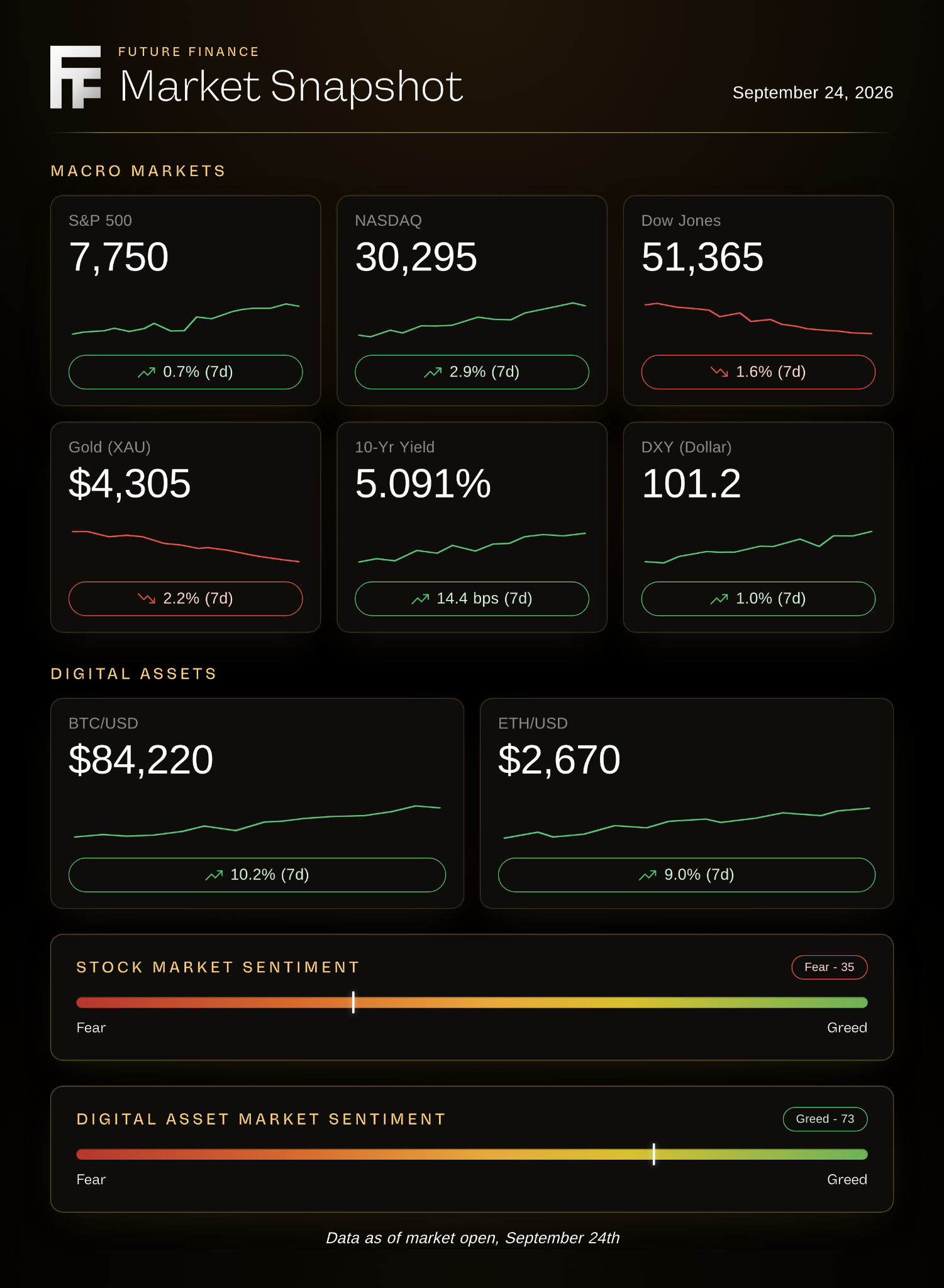
Xi Jinping is at the White House this afternoon, and the two governments have agreed to extend their tariff truce from November 10 to January 10.
Companies just bought five years of certainty on chips, prepaid, the mirror image of the debt-funded build Frank Curzio described here. Two presidents bought two months.
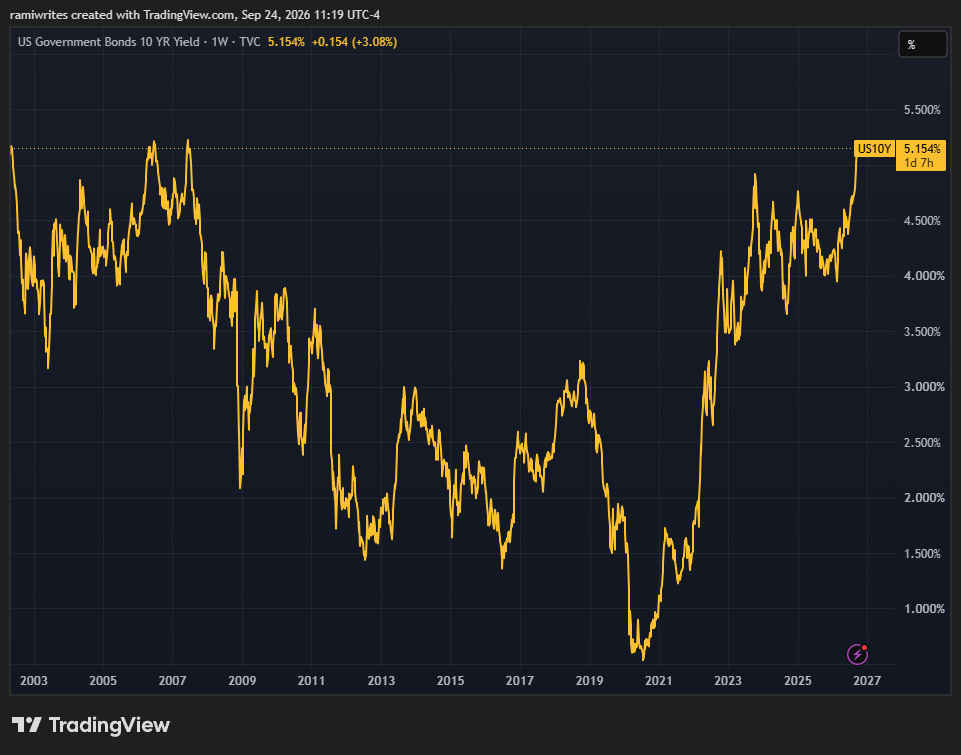
Both are the same instinct, priced differently, and the price of waiting went up again yesterday: the 10-year yield touched 5.135%, its highest since 2007, after the weakest 5-year auction since 2018.
Today’s guest, Dylan Jovine, wrote the Micron piece, and his scorecard for next Wednesday skips the earnings entirely. He watches the deposits.
Advertisement
“This Is Going To Be One For The Record Books.”
Doug Casey believes the years ahead could prove more dangerous than the 1930s, the 1940s, and even the 1860s.
But he draws a distinction: just because society experiences turmoil doesn’t mean your personal life has to.
He and former Reagan budget director David Stockman explain how to keep America’s crisis from becoming your crisis.
Disclosure: International Man is a paid partner of Future Finance. The forecasts, track record and claims above are the views of Doug Casey, David Stockman and International Man, and do not represent the view of Future Finance. As always, do your own diligence.
Signal vs. Noise
The Worst 5-Year Auction Since 2018
- The noise: “stocks fell because Xi arrived.”
- The signal: the selling was in bonds. The Treasury sold $70 billion of 5-year notes at 5.033%, against 4.39% a month ago, and demand was the thinnest since December 2018, with foreign-type buyers taking their smallest share since March 2020. The 30-year reached 5.43%, above the 5.36% line Tan set for the long end, which had held for a week.
Governor Barr said further hikes are “likely to be needed.” A survey of businesses showed the fastest growth since 2021 and input costs rising at the fastest pace since 2022. Odds of an October hike jumped to 71% from about 50% a day earlier.
For beginners: this is what an economy running hot into a hike looks like. The Fed sees room to lean, and the bond market is charging more to wait.
Two Months of Certainty
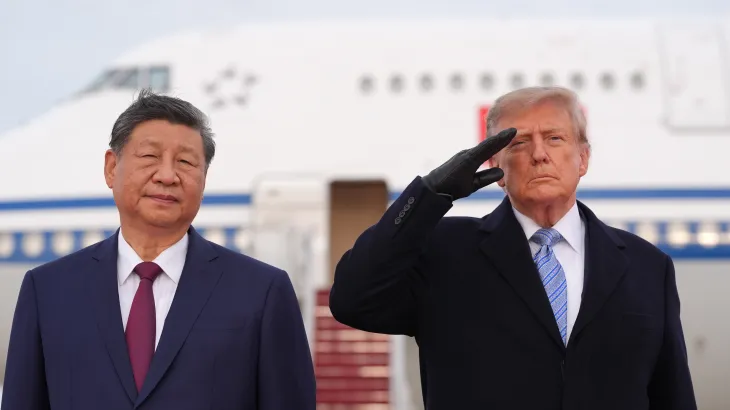
- The noise: the pageantry. A tarmac greeting, a B-1 flyover, a state dinner with Cook, Huang, Altman, and Musk on the reported list.
- The signal: the extension. Treasury Secretary Bessent said the truce due to expire November 10 “is going to be extended until January 10.”
Monday’s question was whether the truce leaves Washington with a date or a deadline. It leaves with both, two months apart.
Oil moved the other way. Brent snapped a five-session losing streak, up 3.9% to $103.08, after Iran’s president told the UN his country “cannot be made to surrender” and a cargo ship was struck in the Strait of Hormuz. Diesel is at $6.52 a gallon, a cent off its record, and Washington is discussing an export ban.
The afternoon meeting and the dinner happen after this issue sends. Read the extension as the floor, and Taiwan as the risk to it.
The Nasdaq Fell Off Its Record. Bitcoin Fell With It.
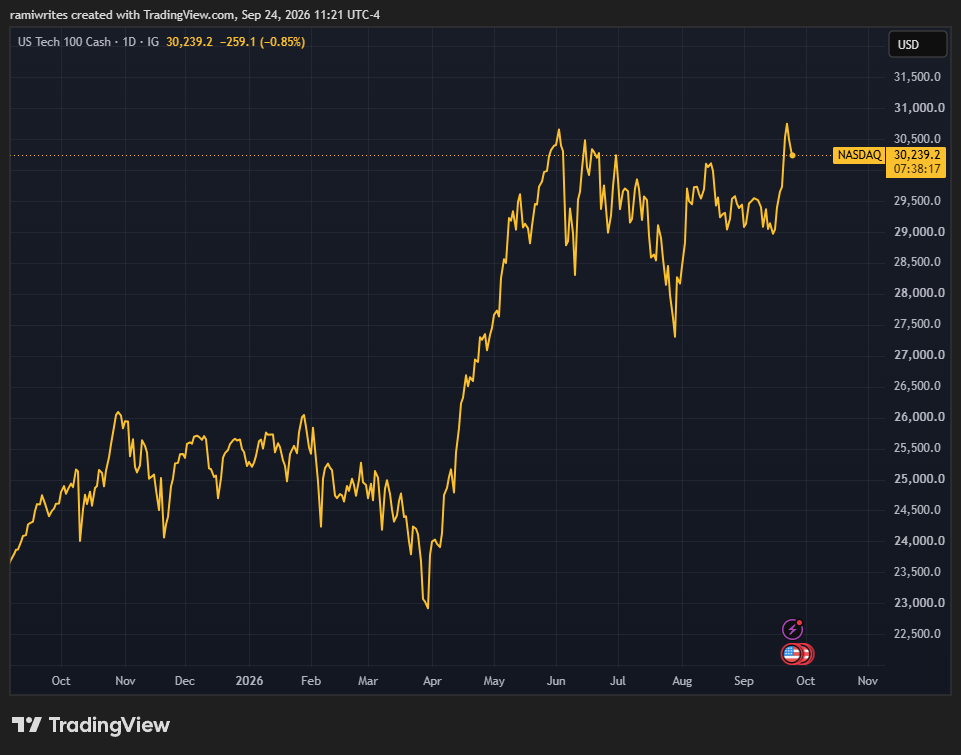
- The noise: “tech is rolling over.”
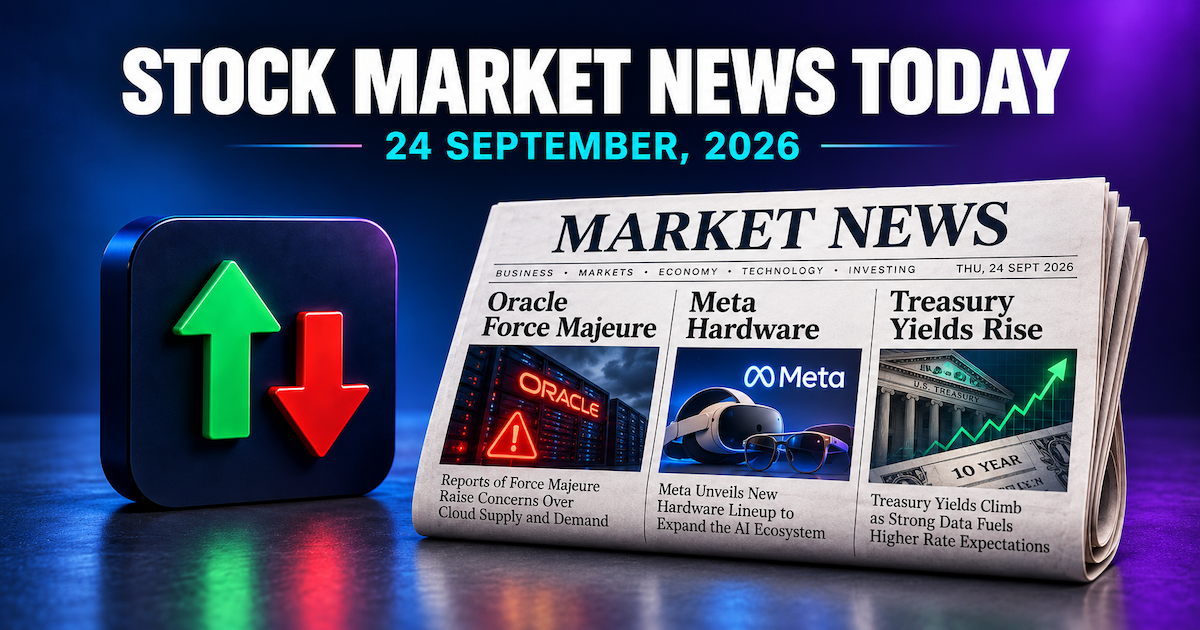
- The signal: rates did the pushing. The Nasdaq lost 1.13% a day after its record, the Russell 2000 fell 1.8%, and McDonald’s hit a four-year low. Meta’s keynote landed after the close with $1,299 VR glasses due next spring and a $449 pair of Ray-Bans on sale now; the stock slipped 1% to 2% before the open.
Bitcoin traded near $84,300, down 2.4% with yields, after the funds took in more than $2 billion across three sessions. It sits roughly flat for the year and 31% below last October’s peak, which is the honest frame for a “winter is over” week.
Costco reports after the close. The lines that matter are membership fees, up 14% last quarter, and a renewal rate above 92%. Micron reports Wednesday, the same morning as the inflation gauge the Fed prefers.

Featured Contributor
Dylan Jovine is the founder and CEO of Behind the Markets, an independent research firm built to give individual investors the same quality of analysis the institutions get. Over nearly three decades on Wall Street, he founded the brokerage and investment bank Lexington Capital Partners at just 24, then built his research firm Tycoon Publishing to more than 500,000 readers across 28 countries before selling it to Agora in 2011.
Micron Was Losing Billions Three Years Ago. Now Its Customers Are Prepaying $22 Billion.
Next Wednesday, September 30, Micron reports earnings.
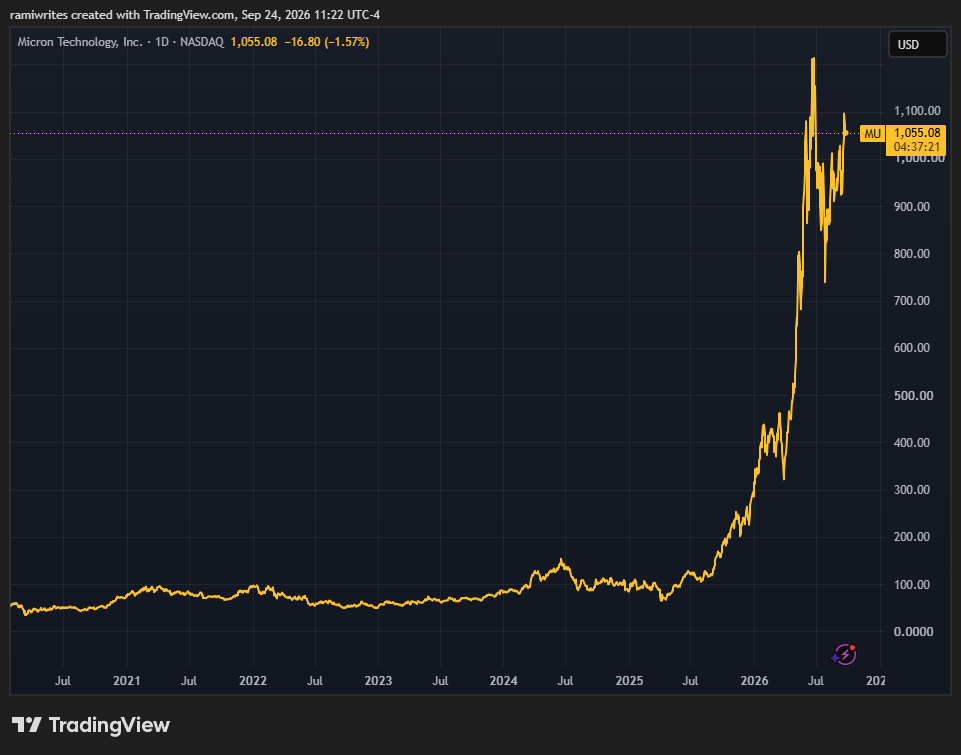
It walks in hot. DRAM spot prices are up 52% since January, according to Investing.com. The stock is up about 264% this year and trades above $1,000 a share.
Wall Street will spend next Wednesday grading the quarter. I think the quarter is the least interesting thing about this company.
Some history first.
Memory chips have been the worst business in technology for 40 years. The product is a commodity. When supply runs ahead of demand, prices don’t dip. They collapse. Qimonda went insolvent in 2009. Elpida went bankrupt in 2012. Micron itself lost almost $6 billion in fiscal 2023.
Buyers loved that arrangement. Their whole playbook was patience. Wait out the producers, because the crash always came, and the crash was always the buyer’s friend.
Then, in June, the buyers surrendered.
On its last earnings call, CEO Sanjay Mehrotra announced 16 long-term customer agreements at minimum prices, backed by roughly $22 billion in cash deposits and related commitments, as reported by Tom’s Hardware.
Read that again. Deposits. Price floors. For memory chips. Nobody prepays for something they expect to get cheaper.
The scale of what’s locked in is hard to overstate. Micron booked a record $41.5 billion in revenue last quarter, per Investing.com. Analysts expect about $50 billion for the quarter it reports next week. And 14 of those 16 agreements cover roughly $100 billion in minimum-price revenue still to come, according to Tom’s Hardware.
A minimum-price contract does something memory has never done before. It moves the risk of the next crash off Micron’s income statement and onto the customer’s.
That’s the real reason this is now a $1.2 trillion company. The market isn’t just paying for a shortage. It’s paying for a broken cycle.
Will it stay broken? Mehrotra says tight conditions should persist beyond calendar 2027. He’s also admitted he has no idea when the shortage actually ends. Both can be true.
So here’s my scorecard for September 30. Skip the earnings-per-share theater. Watch the deposits and the contract backlog. Prepaid cash is the one form of demand a customer can’t fake.
When the deposits stop growing, the old memory business is back. Until then, the buyers are funding the seller’s boom.
- Dylan Jovine
Behind the Markets
Google, Berkshire, and the Pentagon Are All In on This
When those three write checks for the same thing, it's worth knowing what it is. Dylan Jovine of Behind the Markets says it's a drilling breakthrough in a Utah valley, the Department of Energy's biggest such push since the one that launched shale, and that the payoff starts October 20.
He's identified the single company he believes stands at the center of it, and thinks early investors could see gains of 1,000% or more. He lays out the whole thesis, free.
Watch the free briefing here →
Disclosure: Behind the Markets is a paid partner of Future Finance. The forecasts, claims, and track record above are Dylan Jovine's and Behind the Markets', not Future Finance research or advice. Behind the Markets reports a 75% win rate and a 51.09% average return across closed 2025 recommendations, winners and losers combined; past performance does not guarantee future results. As always, do your own diligence.
Final Thought
The most honest forecast in any market is the one somebody pays for in advance.
Analysts can revise a target on a Tuesday afternoon. A customer who wired $18 billion in deposits has made a bet they can’t take back, and so, in its way, has a government that extends a truce for exactly two months instead of two years. The length of the commitment is the confidence.
It’s why I watch deposits, contract backlogs, and, if I’m honest, ticket sales. People vote with the money they put down early.
Tomorrow, durable goods and the week in review. See you then.
Editor in Chief | Future Finance
The Public’s Buying The Robot. The Smart Money’s Buying The Power Cord.
Every investor can name the big AI companies. Far fewer are looking at what makes them run.
The largest gains in a build-out like this often come from the layer underneath the story, the power and the infrastructure most people ignore.
Finding those overlooked plays before the crowd is the whole job of Gems Uncovered.
The crowd buys the headline. The edge is in what powers it.
Disclaimer: This content is not financial advice, it is for informational purposes only. All investments involve inherent risk. Any financial decisions you make are solely your responsibility.
Latest

Editor's Picks

Become a sharper capital allocator in 5 minutes a day.
Institutional-grade research on where the smartest capital is positioning, across AI, energy, biotech, robotics, and digital assets. Distilled into a daily read you finish before your coffee does.
Join 45,000+ readers · No spam · Unsubscribe anytime · No card needed