

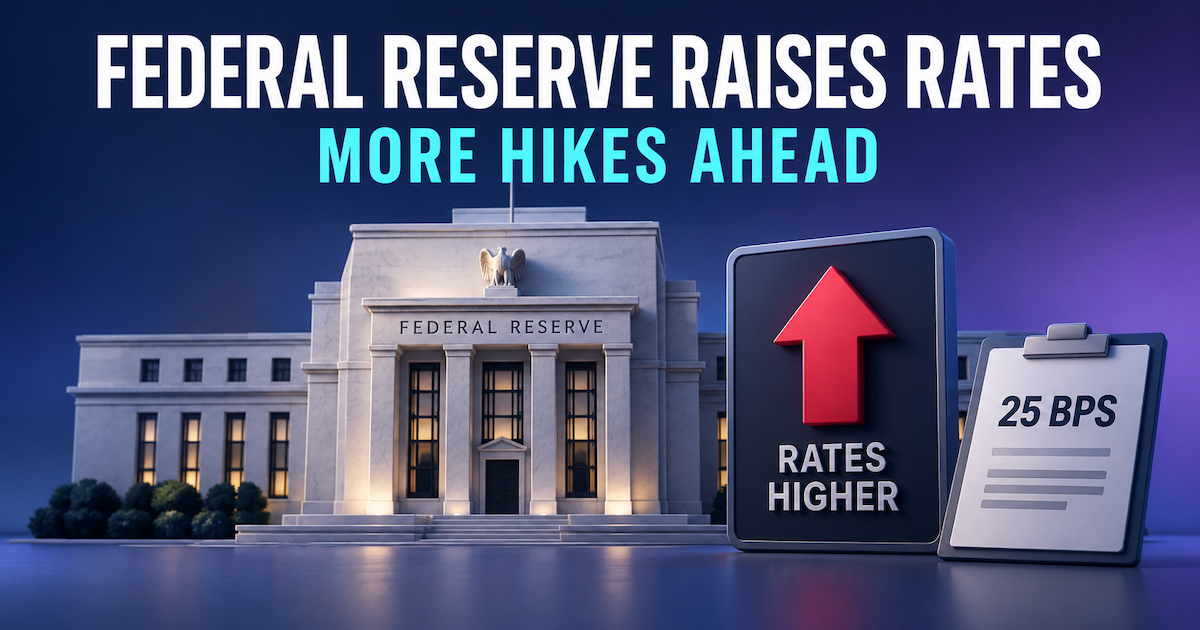
Federal Reserve Raises Rates 25 Basis Points, Signals More Hikes Ahead
The Fed just raised rates, and another hike may already be coming. Here's why mortgages, loans and stocks could feel it next.
September 16, 2026
·
5 Min Read



The briefing serious investors read first.
Free analysis before markets open. Start thinking in decades, not days.
Join 45,000+ readers · No spam · Unsubscribe anytime
Federal Reserve Raises Rates 25 Basis Points, Signals More Hikes Ahead
The Federal Reserve has made borrowing more expensive again, and it may not be finished.
Rates rose by 25 basis points today, taking the Fed's benchmark range to 3.75% to 4.00%.
For Americans, that could mean continued pressure on mortgages, loans and credit cards. For investors, the bigger concern is what comes next.
Most Fed officials now expect at least one more rate hike before the end of the year.
Why Did the Federal Reserve Raise Rates?
The Fed raised interest rates for the first time since 2023 because inflation is still proving harder to bring under control.
Chair Kevin Warsh said inflation remains elevated and argued that today's move should help return it to the Fed's 2% target more quickly.
The central bank also raised its inflation forecast for this year to 3.7%.
Oil and energy costs have added fresh pressure, but the Fed is increasingly concerned that inflation has spread beyond a few temporary shocks.
Are More Fed Rate Hikes Coming?
The clearest signal came from the Fed's new projections.
Sixteen of 18 policymakers expect rates to rise at least one more time before the end of 2026.
The median projection now points to a federal funds rate of 4.00% to 4.25% by year-end.
Markets are already looking towards the Fed's next meeting in October, with traders putting slightly better than even odds on another hike.
That means today's decision may be the beginning of a new tightening cycle rather than a one-off move.
What Does the Rate Hike Mean for Mortgages and Stocks?
Higher Fed rates can filter through almost every part of the economy.
Mortgage rates are already approaching 7%, while higher borrowing costs can make car loans, business financing and credit more expensive.
Stocks also face a tougher environment.
When government bonds offer attractive yields, investors have less reason to pay high prices for risky assets, particularly growth and technology companies whose profits may be years away.
The 10-year Treasury yield remains close to 5%, adding another layer of pressure.
Higher Rates Can Change Where the Next Winners Emerge
When the cost of money changes, capital rarely sits still.
It moves between sectors, technologies and businesses that are best positioned for the new environment, often before the shift becomes obvious in the headlines.
That's why we created The $5 Trillion Signal.
It breaks down five technologies we believe could attract enormous investment over the next decade, the themes forming around them, and the signals worth watching before the crowd arrives.
Get your free copy of The $5 Trillion Signal below.
The briefing serious investors read first.
Free analysis before markets open. Start thinking in decades, not days.
Join 45,000+ readers · No spam · Unsubscribe anytime
Disclaimer: This content is not financial advice, it is for informational purposes only. All investments involve inherent risk. Any financial decisions you make are solely your responsibility.
Latest


Editor's Picks


Become a sharper capital allocator in 5 minutes a day.
Institutional-grade research on where the smartest capital is positioning, across AI, energy, biotech, robotics, and digital assets. Distilled into a daily read you finish before your coffee does.
Join 45,000+ readers · No spam · Unsubscribe anytime