

Your diversified portfolio holds just one bet…
The trade you placed without knowing it…
September 29, 2026
·
5 Min Read




The briefing serious investors read first.
Free analysis before markets open. Start thinking in decades, not days.
Join 45,000+ readers · No spam · Unsubscribe anytime · No card needed
Today’s Big Picture
You can own 500 stocks, a bond fund, a money market account and a house, and still hold one position at 100% weight…
The U.S. dollar.
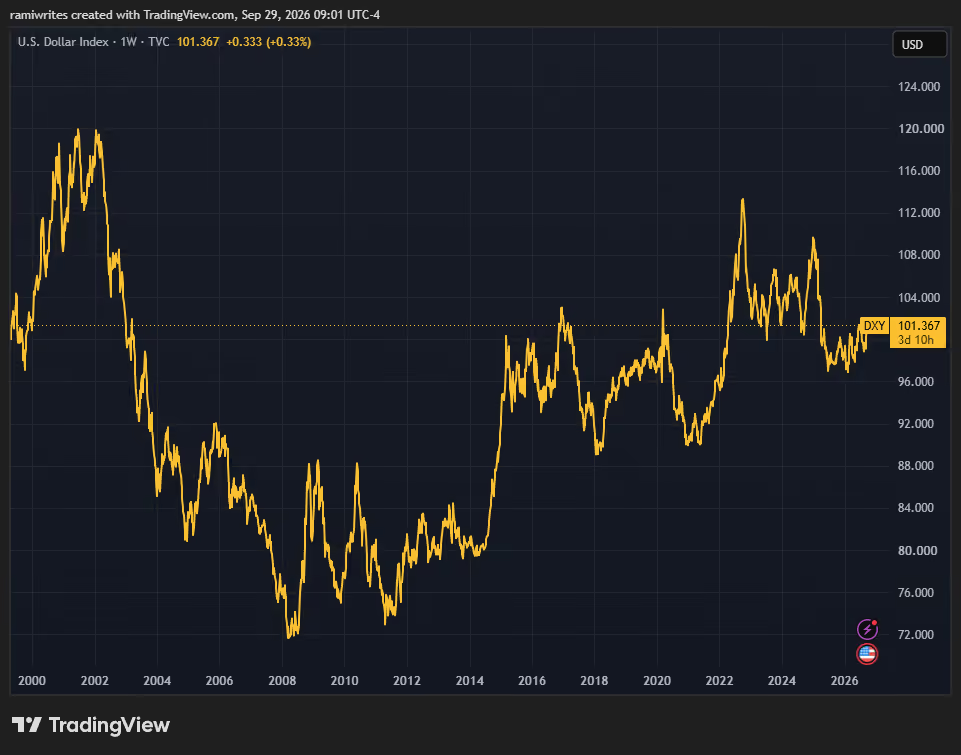
Most Americans never think of that as a bet. But last year, it behaved like one. The dollar index fell about 9.5%, its worst year since 2017, and every dollar-only saver lost global purchasing power without placing a trade.
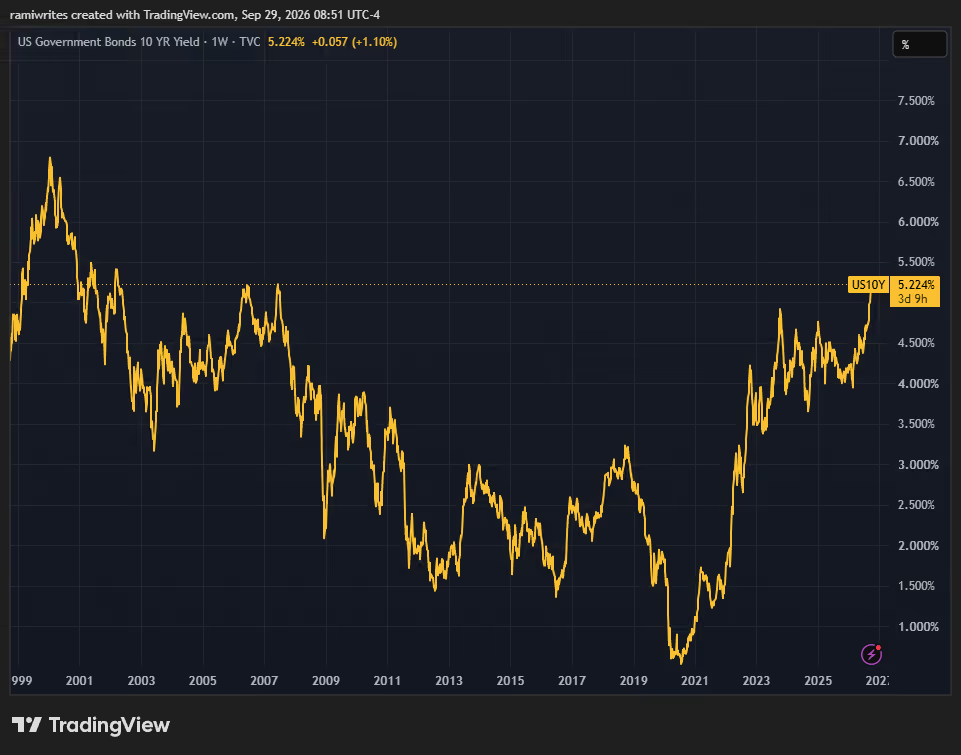
This year the same bet is paying. The dollar is up about 3%, much of it since late summer, because the Fed started hiking again and the 10-year Treasury yield reached 5.24% yesterday, its highest since 2007. Higher yields pull money toward dollars.
A position you never chose still moves your money, in both directions.
Yesterday Tan traced how the world’s savings came to sit in dollars, starting with a deal struck in 1974.
Today’s Featured Contributor asks the same question from your side of the table: what a currency does inside a portfolio, and what moves it over the span of years.
It comes from Frank Trotter, CEO of Battle Bank, which offers foreign-currency accounts and is a paid partner of this issue; its offer follows the piece.
.avif)
Signal vs. Noise
5.24% and a Down September
- The noise: stocks sold off on Iran.
- The signal: yields did the pushing. The 10-year closed near 5.24%, the highest since mid-2007, and the 30-year near 5.55%. The S&P 500 fell 0.77% to 7,683.69, which puts September on track for a loss with one session left, though the index is still up 12.2% for the year.
Governor Lisa Cook said she expects “continued pressure on inflation from the AI buildout” and from higher oil. Traders now price an October hike at 72.5%.
Gold took the other side of the same math. It fell about 3.5% to $4,168, because every tick higher in yields raises the cost of holding a metal that pays nothing.
Micron Reports Tomorrow. Watch the Deposits.

- The noise: whether Micron beats the roughly $31 a share Wall Street expects for the quarter it reports after tomorrow’s close.
- The signal: the money its customers have already put down. Micron guided to about $50 billion in quarterly sales. The number Dylan told you to watch is the roughly $22 billion in deposits and commitments behind its 16 long-term supply deals, about $18 billion of it cash.
Growing deposits mean buyers still expect memory to get more expensive. If they stall, the old boom-and-bust cycle is back in play.
Australia Hiked Overnight
- The noise: another central bank, another quarter point.
- The signal: the Reserve Bank of Australia raised its rate unanimously to 4.60%, its fourth hike this year and the highest since 2011, citing “further disruptions to global oil supply.” When other central banks hike too, the dollar’s yield advantage narrows. Today’s backgrounder calls that tug-of-war the weather, and explains the climate underneath it.
Elsewhere, Starship reached orbit for the first time Monday, deployed 26 Starlink satellites and splashed down in the Pacific, though it ended short of its six planned orbits. Bitcoin sits near $83,900 after an eighth straight day of fund inflows, with Monday’s $31 million a fraction of last week’s $2.39 billion.
Today brings job openings, expected near 7.23 million, and consumer confidence at 10 a.m. Tomorrow at 8:30, the Fed’s preferred inflation gauge and the final second-quarter GDP land together, and the quarter closes that afternoon.

Featured Contributor
Today's guest is Frank Trotter, CEO of Battle Bank. He has been building foreign-currency deposit accounts for American savers since 1986 and co-founded everbank.com. Battle Bank is also a paid partner of this issue. His piece first ran in Battle Bank's Battle Bulletin and is edited for length.
What’s on the Other Side of Every Trade? A Serious Look at Currency Investing
Every investor holds a currency position, whether they know it or not.
An American who keeps everything in U.S.-dollar-denominated stocks, bonds and bank deposits has made a concentrated bet on a single piece of paper issued by a single government.
For most of the past 15 years, that bet paid off handsomely and invisibly.
In the early 2000s and again in 2025, it stopped paying.
The U.S. Dollar Index fell roughly 9.5% in 2025, its worst annual performance since 2017, and it posted the weakest first half since 1973. The euro gained about 13.5% against the dollar, the Swiss franc over 14% and the Norwegian krone over 13%. Investors who assumed currency was background noise discovered it was a very loud instrument.
All investments carry risk of loss, and the value of currencies can decline. This bulletin is a backgrounder for your consideration, not a personalized recommendation.
Start with the investable universe
Of the roughly 180 circulating currencies in the world, the serious investor should confine attention to the 20 or so largest, and within that group, to currencies that float with relatively little management.
A currency’s price tells you something only if the price is allowed to move.
The renminbi trades inside a band set by China’s central bank, the Hong Kong dollar and Saudi riyal are pegged, and the Danish krone shadows the euro by design.
These are policy instruments, and holding them means trusting a bureaucracy to keep an arrangement that history says bureaucracies eventually abandon, usually at the worst moment for the holder.
The relatively clean floats include the dollar, euro, yen, pound, Swiss franc, Norwegian krone, Swedish krona, and the Canadian, Australian and New Zealand dollars.
Everything below the top 20 can be a liquidity trap, a capital control regime or a lottery ticket.
Currencies are not equities
A stock is a claim on a (hopefully) growing stream of earnings. A currency compounds nothing by itself. It is a relative price between two national monies, and for every currency that rises, another falls, plus whatever interest the deposit pays.
A U.S. investor holding Swiss francs in 2025 earned a gain close to the Dow’s, by an entirely different mechanism. The Dow rose because 30 large businesses earned money; the franc rose because global investors marked down the dollar.
The former is wealth creation. The latter is wealth measurement. Major pairs typically move with a fraction of the volatility of equity indexes, and the price of that calm is lower expected return.
Currencies in a portfolio are not there to make you rich. They are there to contribute to a diversified portfolio.
One currency is not diversification
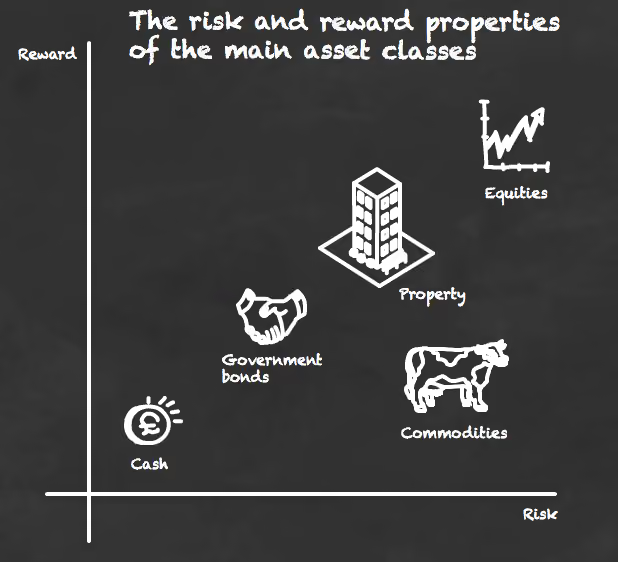
Own the S&P 500, a bond ladder, a money market fund and a house, and you may believe you’re diversified across hundreds of positions. Measured in currency terms, for the most part you own one position at 100% weight.
The argument to ignore currencies writes itself when the dollar is strong, as it was for most of 2011 through 2024. Then 2025 arrived, and the same concentration subtracted double digits of global purchasing power in 12 months.
An American with no foreign currency exposure did not avoid the currency market that year. They simply took the losing side of it, in size, without ever placing the trade consciously.
What drives relative currency values
Currency prediction is hard over short horizons. Over multiyear horizons, relative values respond to identifiable forces, and the investor’s job is to weigh them together.
- Relative inflation.
Purchasing power parity is a poor timing tool and a good anchor. A currency whose purchasing power erodes at 4% a year while another erodes at 1% fights a three-point headwind every year until the gap closes.
- Relative fiscal position.
A government borrowing 6% to 7% of GDP at full employment, as the United States has been doing and is forecast to do, is signaling that the gap will be closed by growth it cannot manufacture, austerity it will not choose, or monetary accommodation it will eventually demand. Markets price that third possibility into the currency.
- Relative debt.
Flow is the deficit; stock is the debt. Debt above 100% of GDP does not doom a currency immediately, as Japan long demonstrated, but it removes room for error and tempts governments to hold rates below inflation at the holder’s expense.
- Risk and credit standing.
Currencies carry reputations. In February, Deutsche Bank’s head of FX research, George Saravelos, went so far as to call the dollar’s safe-haven status a myth.
The 2022 freezing of roughly $300 billion in Russian central bank reserves taught every reserve manager that access to dollar assets is conditional on political alignment.
- Rate differentials.
In the short run, this is often the dominant driver, because capital flows toward yield. But rate differentials are the weather, while the fundamentals above are the climate.
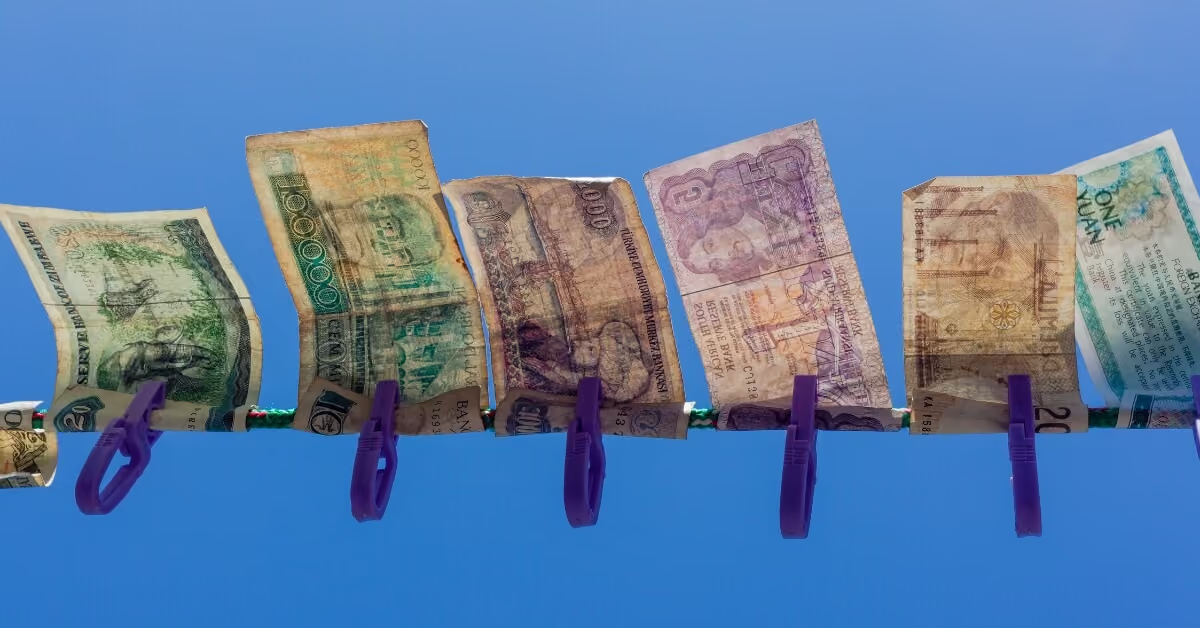
Chasing carry into a deteriorating currency is how investors get paid in pennies and charged in dollars.
Where we have felt confident
Applying those filters over the years has repeatedly led us to the same short list: the Norwegian krone, the Australian dollar and the Swiss franc, monies of countries that produce real things the world must buy or run their public finances like adults.
The euro, nobody’s idea of a perfect currency, serves as the liquid counterweight to the dollar.
The opportunity
Currency investing done properly is unexciting. Confine yourself to the major floating currencies. Expect currency-like returns, not equity-like returns, and judge currencies on inflation, deficits, debt, credit standing, float and rate differentials, weighed together.
And above all, stop mistaking a 100% dollar portfolio for a neutral position. There is no neutral position.
There is only the currency risk you chose and the currency risk you never noticed you were taking.
- Frank Trotter
CEO, Battle Bank
FDIC-insured deposits denominated in foreign currency are not insured against market loss due to a decline in the value of a particular foreign currency; if the price of a currency falls and you sell a loss of principal will occur.

Advertisement
Most Americans Are Making One Enormous Currency Bet
Most Americans earn, save, spend and invest almost entirely in U.S. dollars. They may not think of that as a currency strategy, but it is.
When so much of an investor’s financial life is tied to a single currency, the question becomes whether diversification should extend beyond the assets in a portfolio to the currencies behind them.
Battle Bank gives clients direct access to foreign currencies through Currency Deposit Accounts and Currency CDs, offering another way to diversify and build a more global financial strategy.
For investors accustomed to looking beyond a single stock, sector or asset class, looking beyond a single currency may be worth considering too.
Discover Foreign Currency Opportunities →
Disclosure: Battle Bank is a paid partner of Future Finance. We may receive compensation from Battle Bank if you click on our links and open an account or use certain banking products. This compensation comes at no additional cost to you.
FDIC insurance protects the deposit if the bank fails. It does not protect against changes in exchange rates or declines in the value of the currency held.
Final Thought
The line from today’s piece worth keeping is its bluntest: there is no neutral position.
It reaches well past currencies. A paycheck, a mortgage and a retirement account in one money; savings in one bank; a portfolio in one country’s stocks. Each is a position, whether you chose it or inherited it.
This year the dollar side of that position is paying, as the Fed hikes and yields sit at 2007 highs. Last year it cost double digits. Knowing which side you’re on comes before any decision about whether to stay there.
Tomorrow: inflation, GDP, quarter-end and Micron, all in one day. See you then.
Editor in Chief | Future Finance
Everyone Owns The Same Seven Stocks. The Edge Is Everywhere Else.
When a third of the market is crowded into seven names, the opportunities with real room to run are the ones the crowd hasn’t found yet.
That’s the whole job of Gems Uncovered, the weekly research report on early, asymmetric plays before they reach the mainstream.
The crowd piles into what’s already big. This is about what’s next.
Disclaimer: This content is not financial advice, it is for informational purposes only. All investments involve inherent risk. Any financial decisions you make are solely your responsibility.
Latest




Editor's Picks


Become a sharper capital allocator in 5 minutes a day.
Institutional-grade research on where the smartest capital is positioning, across AI, energy, biotech, robotics, and digital assets. Distilled into a daily read you finish before your coffee does.
Join 45,000+ readers · No spam · Unsubscribe anytime · No card needed