

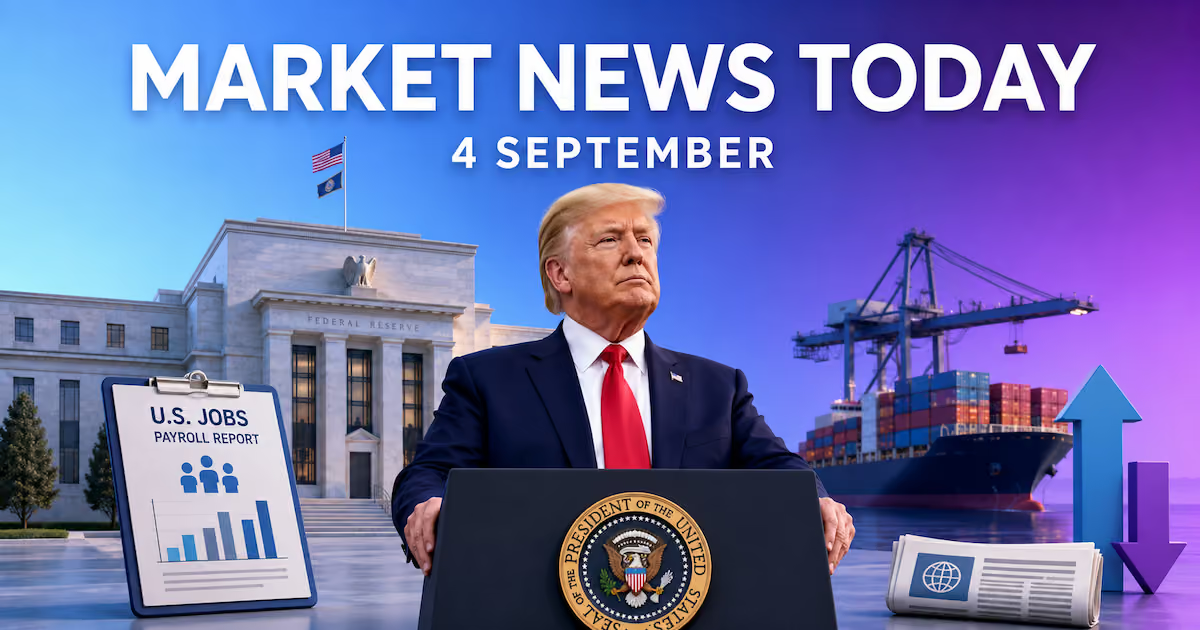
Market News Today 4 September – Trump Rate Cuts, Trade Deficit, Jobs Report
Trump threatened to halt trade unless rates fall after a shock jobs report. Here’s the market news that matters today.
September 4, 2026
·
5 Min Read



The briefing serious investors read first.
Free analysis before markets open. Start thinking in decades, not days.
Join 45,000+ readers · No spam · Unsubscribe anytime · No card needed
Wall Street just got the kind of economic news that would normally be worth celebrating.
America created far more jobs than expected in August.
But instead of strengthening the case for lower interest rates, the surprise has pushed markets toward an uncomfortable question: could the Federal Reserve actually raise rates this month?
Donald Trump wants the exact opposite.
Hours after the jobs numbers landed, the president demanded lower rates and threatened a dramatic response if the Fed refuses.
Here’s the market news you need to know today.
Jobs Report Today: Why Did 162,000 New Jobs Worry Markets?
The U.S. economy added 162,000 jobs in August, smashing expectations of roughly 53,000.
Unemployment held at 4.1%, while June and July were revised higher by a combined 55,000 jobs.
Restaurants and bars were among the biggest sources of new employment, while local government education also added tens of thousands of positions.
On the surface, that is good news.
The problem for markets is what it could mean for interest rates.
The Federal Reserve has been trying to control inflation, and a stronger labor market gives policymakers more room to keep borrowing costs high.
Traders responded by increasing bets on a September rate hike.
Treasury yields climbed and stocks came under pressure.
It is one of the strangest features of the current market: stronger economic news can hurt stocks if investors think it means higher rates for longer.
Trump Rate Cuts: Why Is He Threatening to Stop Trade?
Trump’s response was immediate.
The president celebrated the jobs report but argued that America’s stronger economy should mean lower, not higher, borrowing costs.
He said the U.S. should have the lowest interest rate in the world and threatened to stop trading with countries where America runs a deficit if the Fed refuses to cut rates.
Trump argued that high rates put U.S. businesses at an unfair disadvantage and described cutting off trade as an alternative to tariffs.

The timing makes the clash particularly important.
Today’s jobs report strengthened the case for the Fed to remain cautious or potentially raise rates.
Trump is demanding it move in the opposite direction.
If his trade threat ever became policy, the consequences could reach far beyond interest rates.
Cutting trade with major partners could disrupt supply chains, increase costs for businesses and consumers and potentially add another source of inflation.
That would leave the Fed facing an even harder decision.
U.S. Trade Deficit: Why Is Trump Focusing on It Now?
Trump’s warning also comes immediately after new data showed America’s trade deficit jumped to $88.6 billion in July, up from $71.2 billion in June.
Imports rose while exports fell.
The goods deficit alone reached $119.6 billion.
Trump has long argued that countries selling much more to America than they buy are benefiting unfairly from the relationship.
The latest numbers give that argument fresh ammunition.
But there is an important detail.
Part of the increase in imports came from capital goods such as computers and semiconductors as companies pour money into new technology and AI infrastructure.
So the widening deficit does not necessarily mean the U.S. economy is weakening.
Some of it reflects enormous investment taking place inside America.
Why Markets Are Suddenly Watching Rates Again
Today has brought the market’s biggest tension into focus.
The economy is stronger than expected, but that strength could make cheaper money less likely.
At the same time, the White House is now openly connecting interest rates with trade policy.
When economic data, politics and global trade can shift expectations this quickly, chasing a move after it happens is rarely enough.
The bigger opportunity is understanding where capital could move next.
That’s why we created The $5 Trillion Signal.
It is a completely free, beginner-friendly report covering five technologies we believe could reshape the global economy: AI, robotics, energy, biotech and blockchain.
It takes just a few minutes to read and shows you the major themes we’re watching before they become impossible to ignore.
Enter your email below and we’ll send it straight to your inbox.
The briefing serious investors read first.
Free analysis before markets open. Start thinking in decades, not days.
Join 45,000+ readers · No spam · Unsubscribe anytime · No card needed
Disclaimer: This content is not financial advice, it is for informational purposes only. All investments involve inherent risk. Any financial decisions you make are solely your responsibility.
Latest



Editor's Picks



Become a sharper capital allocator in 5 minutes a day.
Institutional-grade research on where the smartest capital is positioning, across AI, energy, biotech, robotics, and digital assets. Distilled into a daily read you finish before your coffee does.
Join 45,000+ readers · No spam · Unsubscribe anytime · No card needed