

Be ready to lose twice what you plan to make…
A family-office CIO on the AI trade, the worst asset class, and a risk rule beginners never hear. Tan’s first podcast. →
September 3, 2026
·
8 Min Read



The briefing serious investors read first.
Free analysis before markets open. Start thinking in decades, not days.
Join 45,000+ readers · No spam · Unsubscribe anytime · No card needed
Today’s Big Picture
Before you put money into anything, be prepared to lose twice what you plan to make.
That rule comes from a man whose job is keeping a family fortune intact across generations, in a Dubai office that manages the wealth behind one of India’s largest consumer companies. Tan sat down with him this week for the first Future Finance podcast.
Ask him where the AI trade is and he doesn’t say chips. He says energy. Gas turbines, nuclear, the supply chain behind small reactors.
That’s the third time this week the same answer has arrived from a different direction.
Monday it was Musk’s satellites. Yesterday it was the grid and the crews who widen it. Today it’s a professional allocator with no connection to either story.
When three unrelated roads reach the same place, the place is the signal. And last night, Broadcom showed you the other half of his thesis: what happens when a market starts demanding returns on all that spending.
The interview is below, along with a rule about concentration you’ll want to argue with.

One Stock. Three Potential Trillion-Dollar Spinoffs.
In 2014, Marc Chaikin told his readers to put a big chunk of their retirement money into Nvidia. He says anyone who followed that recommendation is up more than 45,000% at this point.
He now believes he has found an even better retirement stock for the years ahead. The company is sitting on three fast-growing businesses, and each one could be spun off into a separate publicly traded company.
One ticker today could become three tickers tomorrow:
See Chaikin’s new #1 retirement pick here →
Disclosure: MarketWise is a paid partner of Future Finance. The forecasts, track record and claims above are the views of Marc Chaikin Chaikin Analysis and MarketWise, and do not represent the view of Future Finance.. As always, do your own diligence.
Featured Contributor

Today’s guest is Tan Gera, co-founder of Decentralized Masters, introducing the first Future Finance podcast. The views of his guest are his guest’s own; nothing here is a recommendation.
Seven Letters In, and You've Never Heard My Voice
Last week I spent seven days in your inbox. The ledger, the hardest call, the two doors, the whole structure of my portfolio.
By Friday it felt like we’d built something. Then it occurred to me that practically none of you have ever heard my voice.
So I fixed that.
For the first-ever Future Finance podcast, I sat down with Aditya Parmar, Head of Investments at the Burman Family Office in Dubai. That’s the office that manages the fortune behind India’s Dabur Group, one of the country’s largest consumer companies.
Click Here To Watch The Episode →

I wanted someone whose job is keeping generational wealth intact, because that’s a different sport from getting rich, and he plays it at the highest level.
Here’s what we covered.
- Why Real estate is “the worst asset class.” It’s an opportunity-cost argument: what the money could have done elsewhere.
- Private equity’s real barrier is access. His office puts roughly a quarter of its capital there and often does the buyouts directly. For smaller investors, he warns, venture outcomes are binary and demoralizing.
- The AI bubble, when it comes. We’re in the early, infrastructure-heavy phase. At some point investors demand returns on the spending, and that’s the moment to be positioned for.
- His own AI engine. He’s building a model that maps how investors like Stanley Druckenmiller think, trained on 30 years of their filings, to sharpen his own decisions.
- And so much more…
Watch the first Future Finance podcast →
- Tan Gera
Co-Founder, Decentralized Masters
Signal vs. Noise
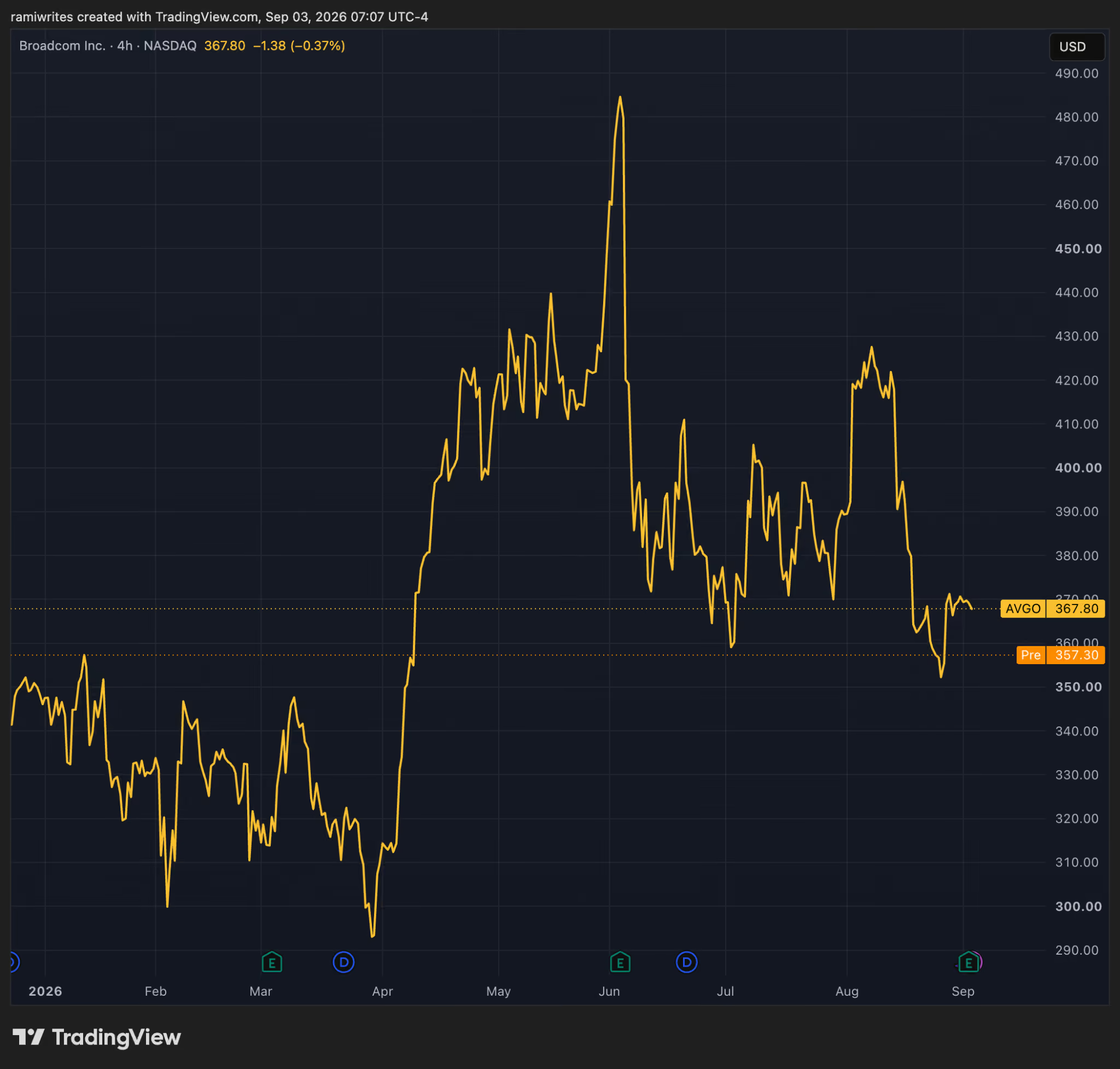
Broadcom Beat Everything and Fell 6%
- The noise: the reflex after last night’s drop was “the AI trade is cracking.”
- The signal: Broadcom (NASDAQ: AVGO) reported revenue of $29.6 billion, up 86% in a year. Its AI chip sales hit $16.7 billion, up 221%. It raised next year’s AI target to about $115 billion and named Google, Anthropic, OpenAI, and Meta as committed customers.
Then it guided next quarter to $34.8 billion, a few hundred million short of the $35 billion the market had already decided on. The stock fell as much as 6% after hours.
This is the exact moment Tan’s guest describes in the podcast. The demand is real: Dell booked $60.9 billion of AI orders this week, and the turbine makers are sold out to 2031. The problem is the price now assumes perfection, so a beat that isn’t a bigger beat reads as a miss.
He expects a proper reckoning at some point, when investors demand returns on all that capital. Last night was the reckoning arriving one guidance line at a time.
The Fed Might Hike, and Most Beginners Don’t Know It
- The noise: the assumption, built over two years, that the Fed only moves in one direction.
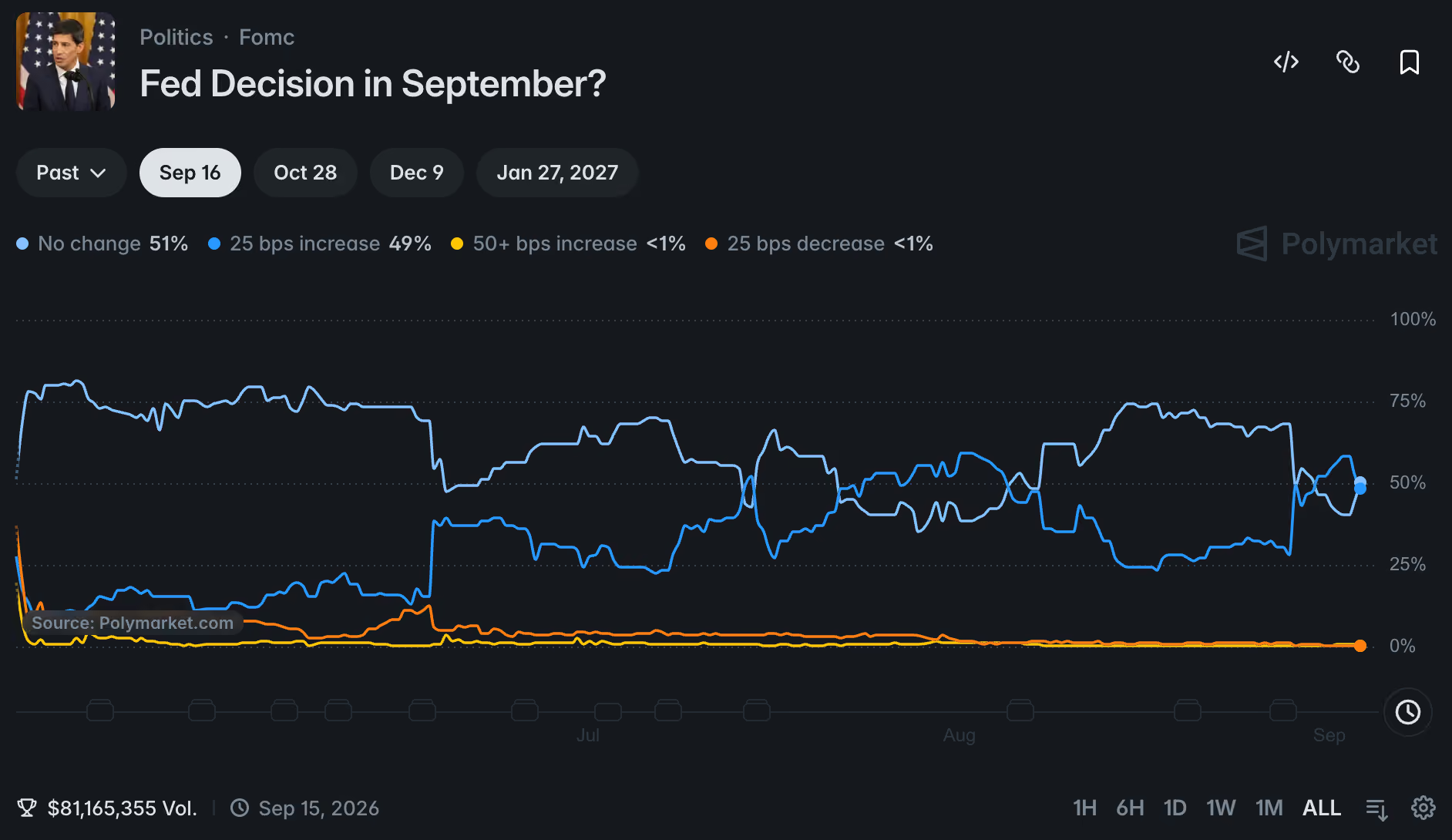
- The signal: traders now put the odds of a rate hike on September 16 at about 66%. The 10-year Treasury yield touched 4.82% yesterday, its highest since November 2023, and Brent crude settled above $95 after two tankers hit mines near Hormuz.
The labor side is the complication. Private payroll processor ADP counted just 38,000 new jobs in August, the weakest since January, and July’s official count was a decline of 23,000.
That’s the tension Friday’s jobs report has to resolve. Consensus sits near +55,000, with unemployment at 4.1% or 4.2%.
A strong number locks in the hike. A weak one, or another negative, revives the case for holding still.
Wall Street Started Tokenizing Itself in July
- The noise: “tokenization” still sounds like a crypto pitch to most people.
- The signal: the DTCC, the plumbing company that holds custody of roughly $114 trillion in securities, processed its first tokenized trades on July 15 and launches the full service in October. Citadel Securities, BlackRock, JPMorgan, and Goldman Sachs are in the working group.
BlackRock’s tokenized Treasury fund now holds about $2.75 billion. Tokenized Treasuries overall sit near $27 billion.
Tan’s guest makes the honest point on this: the technology works, and the hurdle is institutional inertia. When the largest clearinghouse on Earth moves anyway, the inertia is losing.
The yield side of that world, the part where those assets earn something on-chain, is what Doc tracks twice a week in Beat Banks. One caveat he’d give you himself: only a sliver of tokenized assets flows into DeFi today. It’s a trend to understand before it’s a yield to chase.
Every Time an Elon Idea Sounds Stupid, It's Worth a Fortune
Electric cars. Reusable rockets. Internet beamed from space.
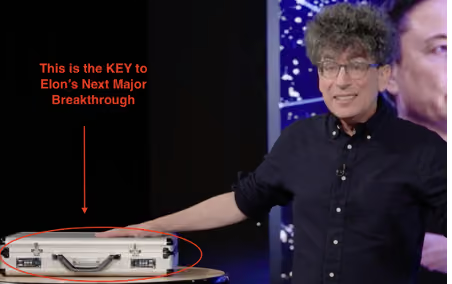
Each one sounded ridiculous, then made the early believers rich.
James Altucher says the next one is already sitting at the FCC, and it solves the single biggest problem in the $25 trillion AI race.
His free masterclass walks through the filing, the plan, and the exact tickers he's watching.
What to Watch For

- Today: jobless claims at 8:30 a.m. (consensus near 205,000) and the ISM services report at 10 a.m., where the prices index has been running above 70. Lululemon reports after the close, five days before its new CEO starts.
- Friday: the August jobs report. Consensus +55,000, unemployment 4.1% to 4.2%, wages up 0.3%. After July’s decline, this is the number the Fed reads last before it decides.
- Tuesday, September 8: Canada’s retaliatory tariffs take effect on about $20 billion of U.S. goods.
- Wednesday, September 9: Apple’s iPhone event, the first under new CEO John Ternus.
- Circle: September 15, the Senate’s procedural vote on the crypto bill. September 16, the Fed, with a hike priced at two-in-three. September 24, Xi Jinping in Washington.
Final Thought
Three days on one question, and the answers arrived in the order they usually do.
The exciting one is a filing. The practical one is a backlog. The wise one is a rule about how much you can afford to be wrong.
I’d keep the rule. Every level Tan showed you last week, every trim and every waiting order, was that rule wearing a price tag.
Friday’s jobs report decides the Fed’s hand. See you then.
Editor in Chief | Future Finance
One Subscription. The Entire Gems Uncovered Research Library.
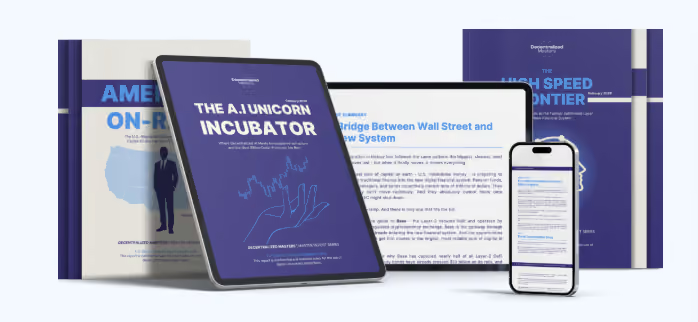
You just read why the surface of the news rarely tells the whole story.
Gems Uncovered is built on that same principle. It’s our weekly research briefing on early-stage assets and native market access, the opportunities that build real wealth before they ever reach a mainstream exchange.
One level beneath the headlines is where the edge lives.
Disclaimer: This content is not financial advice, it is for informational purposes only. All investments involve inherent risk. Any financial decisions you make are solely your responsibility.
Latest


Editor's Picks
Become a sharper capital allocator in 5 minutes a day.
Institutional-grade research on where the smartest capital is positioning, across AI, energy, biotech, robotics, and digital assets. Distilled into a daily read you finish before your coffee does.
Join 45,000+ readers · No spam · Unsubscribe anytime · No card needed