

Gold Just Had Its Best Year Since 1979. The Real Story Isn't the Price.
What the world's oldest safe haven is quietly telling us about everything else
5 min read



The briefing serious investors read first.
Free analysis before markets open. Start thinking in decades, not days.
Join 45,000+ readers · No spam · Unsubscribe anytime · No card needed
A 5,000-year-old asset just went on a round trip
Gold is not supposed to be exciting. It earns no interest, pays no dividend, and reports no earnings.
It is just a dense yellow metal that has sat in vaults and jewelry boxes for thousands of years.
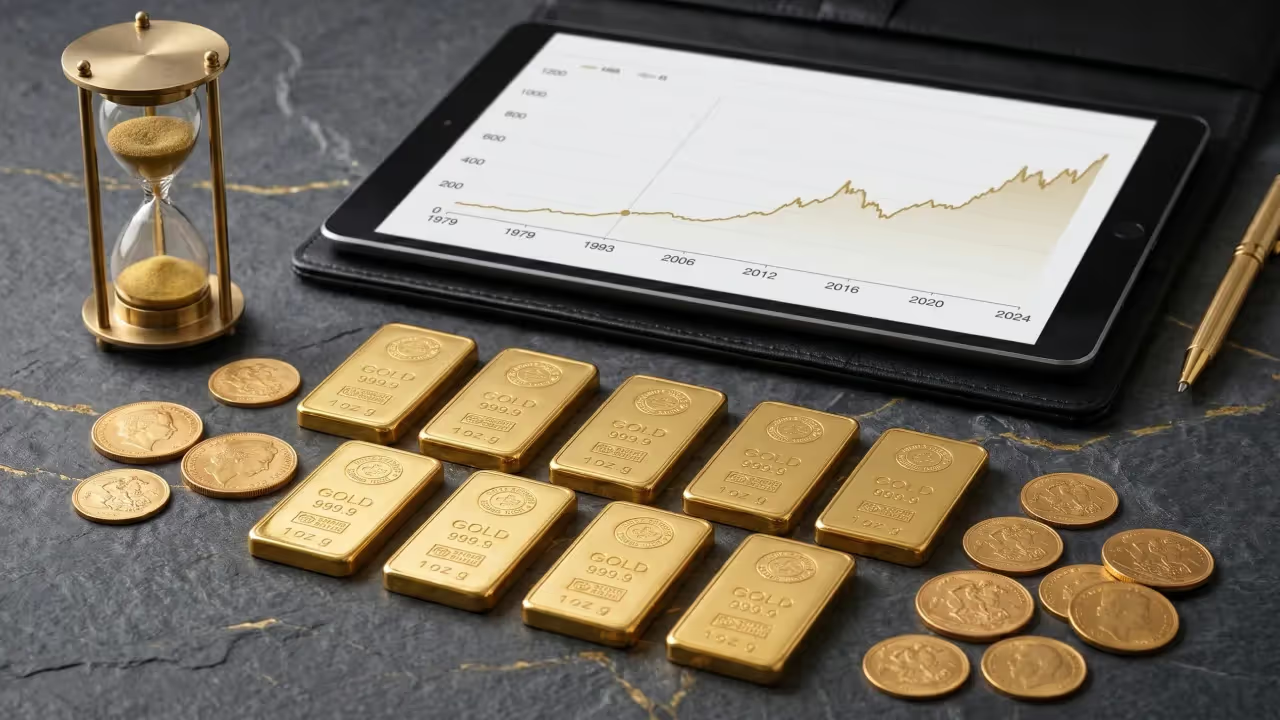
And yet in 2025 this boring relic posted its best year in roughly half a century, rising around 65% and setting more than fifty fresh all-time highs along the way.
An asset that does nothing outran most of the assets that do everything.
Then, in early 2026, it did the other thing safe havens do. It fell.
After spiking above $5,500 an ounce in late January, gold dropped sharply, and as this report goes out it trades closer to $4,500, down roughly a fifth from that peak.
Still up strongly over the past year, but a long way off its high and swinging hard. That whole round trip, the surge and the steep pullback, is the real subject here.
Gold does not move for no reason. It moves when something deeper shifts underneath the financial system, and lately a great deal has been shifting.

But here's what everyone is missing in the headlines...
The interesting part is not the price. It is the message. A roaring gold market is the financial world's way of telling you that a lot of serious money is nervous about something, and is quietly buying protection. Learn to read that message, and gold becomes less of a curiosity and more of a signal you can use. This report explains what a safe haven actually is, why gold has played that role for millennia, what its recent run is signaling, and the single most useful lesson hidden in how it behaved next to Bitcoin. None of it is a recommendation. It is the idea, and what the evidence shows.
What safe haven actually means
You hear the phrase constantly. Almost nobody stops to define it.
A safe haven is simply an asset that investors run toward when they are frightened. When stocks are tumbling, when a war breaks out, when confidence in governments or currencies wobbles, people want somewhere to park their wealth that will not fall apart in the panic. The thing they choose is, by definition, the safe haven.
What makes something qualify? A few stubborn properties. It has to hold its value when other things are collapsing, which usually means it is not tightly tied to the fortunes of any single company or economy. It has to be widely trusted, by people across borders and generations, so that it is still worth something to someone else when you need to sell. And it helps enormously if its supply cannot be quickly inflated away, so that a panic does not get met with a flood of new units.
Gold ticks every one of these boxes, and it has ticked them for longer than any other asset in human history. That track record is precisely why, in a frightening year, money still runs to a metal our ancestors prized before writing was invented.

Why gold, of all things?
It is worth pausing on the strangeness of this. In a world of artificial intelligence and instant global payments, why does a shiny metal remain the ultimate refuge?
The answer is a combination of physics, history, and trust.
The physics: gold is genuinely scarce, and getting more of it is slow, expensive, and difficult. No government can conjure more gold the way it can create more currency. That hard limit on supply is the bedrock of its appeal.
The history: gold has been treated as money or as a store of wealth across virtually every civilization for thousands of years. That is not an accident of marketing. It is an unbroken record of humans, in wildly different circumstances, independently concluding the same thing.
The trust: because of that history, gold does not depend on any single government, bank, or company keeping its promises. It is nobody's liability. When you hold it, you are not trusting an institution to stay solvent. You are simply holding a thing that the whole world has agreed is valuable for longer than any nation on the map has existed.
That combination is why, when trust in the modern financial system frays, gold is the asset people fall back on. It was here before the system, and people suspect it will be here after.
What the recent run was actually signaling
So when gold has its best year since 1979, what is the world telling us?
Several anxieties were pushing in the same direction at once, and gold was the pressure gauge. There was worry about currencies losing value as money supplies expanded, the slow erosion we covered in our debasement report. There was geopolitical tension, including conflict in the Middle East, the kind of uncertainty that sends money looking for shelter. There was a softening US dollar, which tends to lift gold, since the two often move in opposite directions. And there was unease about whether the institutions that manage money, including central banks, would keep their footing.
When those fears blew in the same direction, gold rose. The metal itself did not change. The world around it got more uncertain, and gold is where uncertainty goes to hide. The scale of the move showed how much fear was in the system: more than fifty separate record highs in a single year, and total demand for the metal at record levels.
Then the lesson arrived in reverse. In early 2026, some of that fear eased and some of it simply got priced in. A firmer dollar and higher bond yields, driven partly by the same geopolitical mess, made a metal that pays no interest less attractive for a while. Gold fell roughly a fifth from its January peak, settling near a level that long-term chart-watchers treat as an important floor.
It remained up strongly over the prior year, but the drop was real and fast. That round trip is the most useful thing in this whole report. A safe haven is not a one-way escalator. It rises when fear builds and gives ground back when fear fades, and the swings can be violent in both directions. Watching gold surge and then correct inside a few months is a live demonstration that even the oldest refuge on Earth is a volatile asset, not a guarantee.
The tell that says the most: who was buying
Prices can be pushed around by speculators in the short term. To understand what is really happening, you watch who is buying with conviction.
And in gold's case, the buyers tell a profound story. Central banks, the very institutions that issue the world's currencies, have been buying gold hand over fist. They have been net buyers for many years running, and in recent years their purchases jumped to levels not seen in decades. In 2025 alone they added hundreds of tonnes to their reserves, with countries like Poland leading the way.
Consider what that means. The people who run the money printers are choosing to hold a growing share of their national savings in something that cannot be printed. They are, in effect, hedging against their own currencies.
Gold's standing rose in other ways too. It was elevated to the highest tier of safety in the international banking system, and by some measures it overtook major currencies to become one of the most widely held reserve assets on the planet.
This is the world's most conservative money quietly voting with its reserves. When the most cautious, best-informed players in the entire system are accumulating an asset, that is a signal worth understanding, whatever you choose to do about it.

The most important lesson: gold versus Bitcoin
The sharpest lesson in this whole episode comes from comparing gold to a much younger asset that is often called digital gold.
For years, many people argued that Bitcoin was simply a modern version of gold: a scarce, un-printable store of value for the internet age. The theory was appealing. Both are scarce. Both are nobody's liability.
So in a frightening year, shouldn't they behave alike? Not quite.
During gold's record run, with all those safe-haven fears swirling, gold climbed steadily as the refuge of choice. Bitcoin, facing the very same macro backdrop, often behaved differently. Through that stretch it tended to trade more like a high-growth technology asset than like a safe haven, leaning on the tide of liquidity and sometimes selling off when fear spiked rather than catching a bid.
The lesson here is genuinely clarifying. Two assets can both be scarce and still play completely different roles in a portfolio. In times of fear, gold has behaved like the mature safe haven it has always been, while Bitcoin has behaved more like a high-growth risk asset, tied to the tide of liquidity rather than to fear itself.
Neither role is better. They are simply different jobs, and an investor might reasonably want both for different reasons. Gold is the thing you may hold because you are worried. Bitcoin is often held for its long-run growth potential, a different goal entirely.
The useful takeaway is simply not to assume they are interchangeable: expecting Bitcoin to cushion a panic the way gold has may disappoint, because so far the two have tended to answer to different forces. Understanding that difference is worth more than any price forecast, because it tells you what each asset is likely to actually do when it matters most.

An honest word on the risks
The early-2026 pullback makes this the right moment to be clear-eyed rather than swept up.
A safe haven is not a guaranteed winner. Gold can fall, and it can fall sharply and stay down for years. The drop from its January high is a mild, recent reminder; history holds far harsher ones. It went through long, painful stretches in the past where it lost value and tested the patience of everyone holding it.
Safe haven describes how it tends to behave in a crisis, not a promise that its price only goes up.
It also pays you nothing while you hold it. No interest, no dividend. In calm times, when safe bonds offer a decent guaranteed return, that lack of yield is a real cost, an idea that connects directly to our risk-free-rate report.
And buying anything after a huge run carries its own danger. The fact that gold has soared tells you nothing about whether today is a good moment to buy; often the opposite. Chasing a record-setting asset because it has already gone up is one of the oldest mistakes there is.
None of this is a reason to dismiss gold. It is a reason to hold both ideas at once: gold has a genuine, time-tested role as a safe haven, and it is a volatile asset that can hurt you if you treat its history as a guarantee.
How to read the safe-haven signal yourself, for free
This is the part you can act on the moment you finish reading. All of this data is public and free.
1. Watch the gold price as a fear gauge.
You do not have to own any gold to learn from it. Treat its price as a thermometer for how nervous serious money is. You can follow the gold price and demand research at the World Gold Council, the industry's main data source. What to look for: sustained, broad rises often signal rising anxiety about currencies, geopolitics, or the financial system. A calm, drifting gold price suggests the opposite.
2. Watch what central banks are doing.
The most conservative money in the world publishes its gold buying. When the institutions closest to the printing press accumulate gold, pay attention. The World Gold Council publishes central bank gold demand data regularly. What to look for: persistent net buying is a long-run vote of low confidence in paper currencies.
3. Compare gold and Bitcoin during the next scare.
This is the live experiment you can run yourself. The next time markets get frightened, watch the two side by side. What to look for: if gold holds up while Bitcoin falls, you are watching the safe-haven-versus-risk-asset divergence in real time, and learning what each one actually does under stress.
4. Notice gold against a falling dollar.
Gold and the US dollar often move in opposite directions. A weakening dollar is frequently a tailwind for gold, and a clue about confidence in the currency. What to look for: gold rising while the dollar falls is a classic signal of debasement and safe-haven demand working together.
A note on expectations, so you use this well. Reading gold tells you about the mood of the financial system, not about next month's price. Gold can rise on fear and then give a chunk of it back when calm returns. Use it as a signal about sentiment and trust, not as a timer for any trade.

The one idea to take with you
If you forget everything else, keep this.
Gold's job is not to make you rich quickly. Its job, the one it has held for thousands of years, is to be the thing people trust when they stop trusting everything else. So when gold has its best year in half a century, the headline is not really about gold. It is about how much fear and distrust is moving through the system, and about the world's most conservative money quietly buying protection.
And the deepest lesson is the one the gold-versus-Bitcoin split made impossible to ignore: scarcity alone does not make a safe haven. The role an asset plays under stress is what defines it, and that role is learned by watching, not assumed.
And the early-2026 fall is the other half of the same lesson. The refuge can correct hard the moment fear eases, which is exactly why safe haven describes a behavior under stress, never a promise of a rising price.
You can read this signal for free, in a browser, the same way the largest institutions do. That alone puts you ahead of most people, who see only the price and miss the message.
- Rami Al-Sabeq (Editor in Chief | Future Finance)
Latest



Editor's Picks

Become a sharper capital allocator in 5 minutes a day.
Institutional-grade research on where the smartest capital is positioning, across AI, energy, biotech, robotics, and digital assets. Distilled into a daily read you finish before your coffee does.
Join 45,000+ readers · No spam · Unsubscribe anytime · No card needed