
Buffett made a mistake. Munger caught it.
The mistake took one sentence to fix, and that fix is the rule for a market that's stopped rewarding everything. →
August 14, 2026
·
7 Min Read



.avif)
The briefing serious investors read first.
Free analysis before markets open. Start thinking in decades, not days.
Join 45,000+ readers · No spam · Unsubscribe anytime
📊 Today’s Big Picture
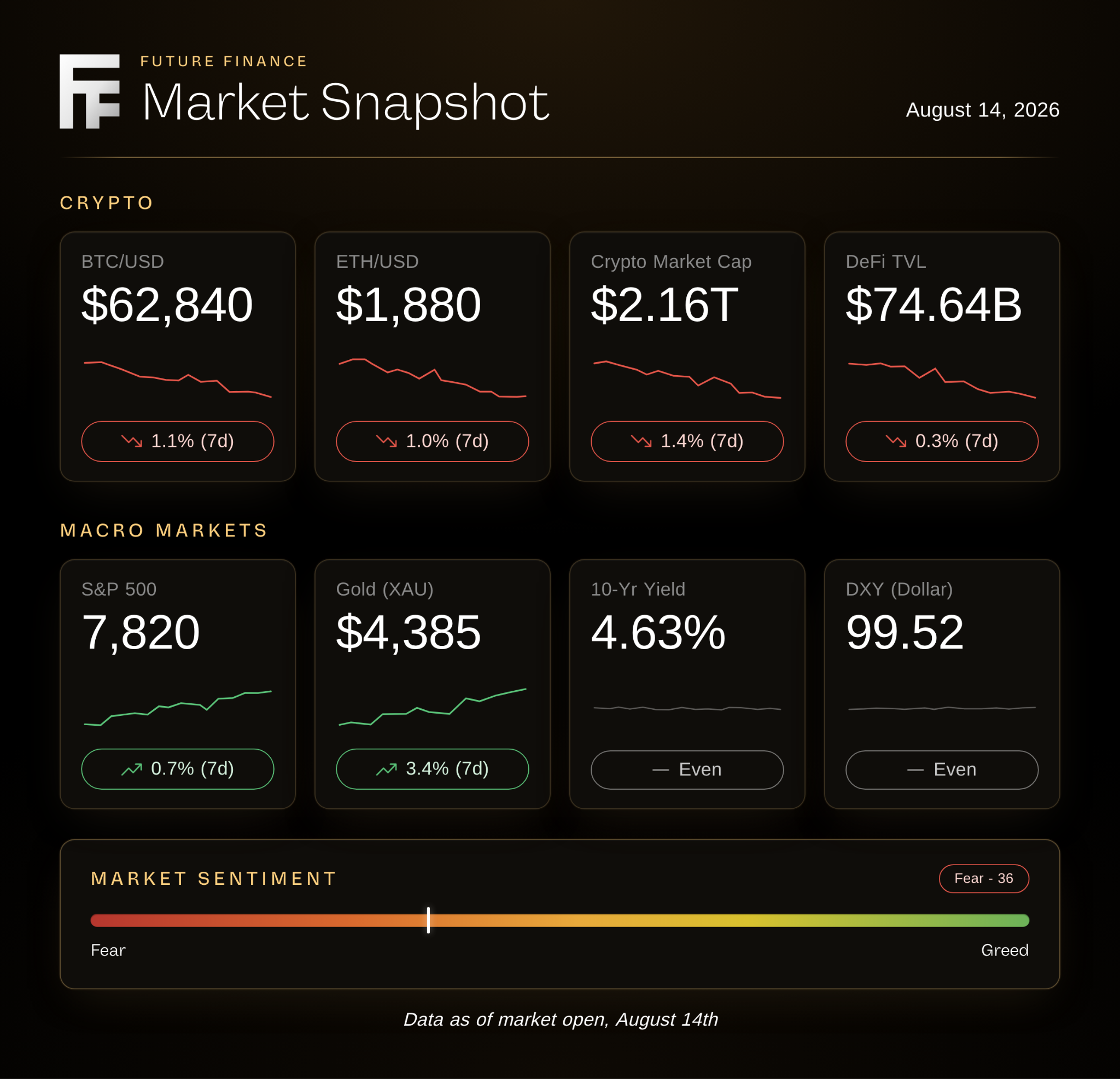
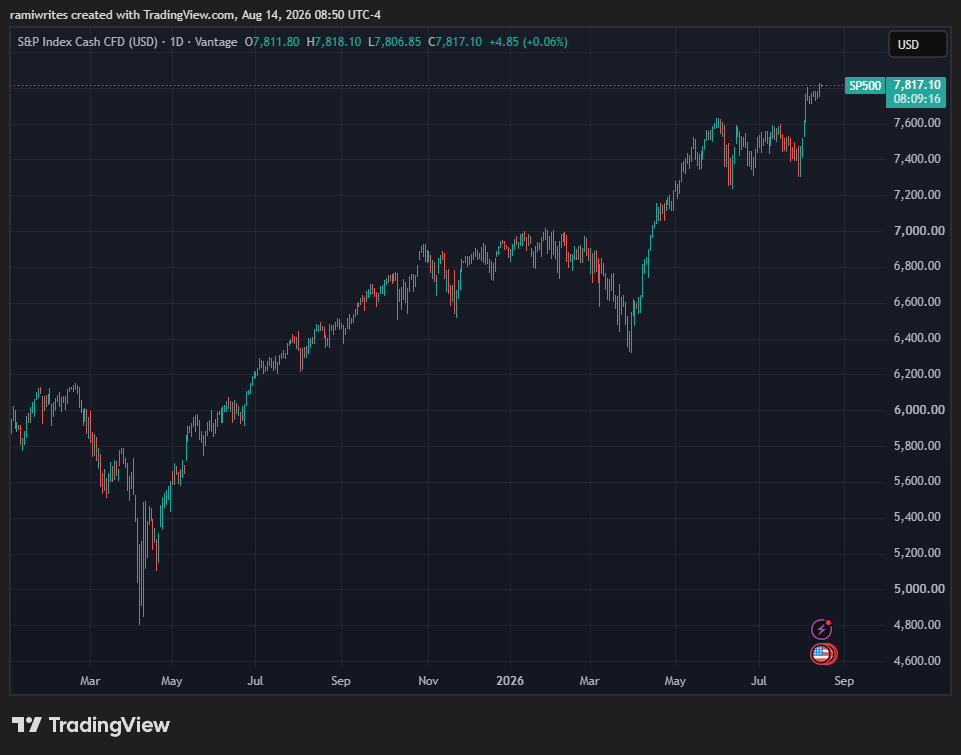
The S&P 500 closed at a record 7,798.99 on Thursday, capping the friendliest data week of the year.
This morning, the last test of that week came back, and it broke the pattern.
July retail sales fell 0.6%. Wall Street expected growth near 0.3%. It’s the first monthly decline of the summer, and it landed one week after the first negative jobs month of the cycle.
The details soften it somewhat: the pullback came mostly from cars, gas stations, and online shopping, while back-to-school clothing rose 1.9% and restaurants kept growing.
But the big question of the week just changed shape.
Through Thursday, the question was whether cooling data would stop a September rate hike. After this morning, the hike is likely finished, and the question is why the consumer stopped spending.
Add Thursday’s other warning, the government paying 5.216% to borrow for 30 years, the most since 2001, and the record sits on more tension than it looks.
It’s the right morning for today’s guest.
Frank Curzio, the analyst who spent five years finding stocks for Jim Cramer, is here with the single piece of advice that built Berkshire Hathaway, made for markets that have stopped rewarding everything equally.
By the end of this issue, you will know what pulled back, what held, and what it changes for September.
🔍 Signal vs. Noise
Three Headlines, Three Realities
- The first headline is that a record-high stock market means the economy is in the clear.
- What reality says: the bond market sent a different message the same afternoon.
While stocks were closing at a record, the Treasury sold $25 billion of 30-year bonds. The rate investors required: 5.216%, the highest for that bond since 2001.
Demand came in slightly weaker than last month, and buyers required a rate slightly above where the bond traded before the sale. Small details, and they point the same direction: borrowing for 30 years keeps getting more expensive.
Why would that happen during the friendliest data week of the year? Because the two markets respond to different things.
Stock prices move on the Fed’s next decision, and this week’s data made that friendly. The 30-year rate moves on decades of government borrowing, and that picture didn’t improve: the debt is past $39 trillion, and interest already costs more than defense.
Stocks rallied on next month’s Fed odds. The 30-year rate is set by decades of deficits. Watch both, because they’re moving apart.
- The second headline is that a record quarter means a rising stock.
- What reality says: Applied Materials just delivered the week’s fourth reminder.
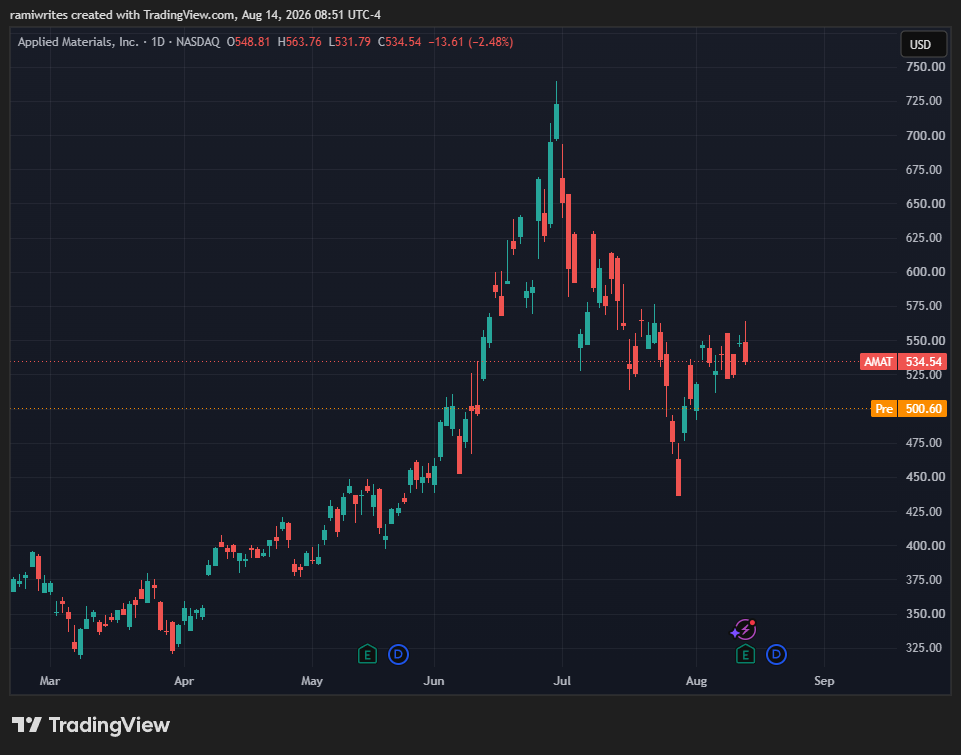
Last night, Applied Materials (NASDAQ: AMAT), the company whose machines make chipmaking possible, reported record revenue of $9.12 billion, beat on profit, and forecast next quarter’s revenue up 51%.
The stock fell about 3%.
It’s the third time this week the pattern played out. Cisco (NASDAQ: CSCO) reported record AI orders Wednesday and fell on margin concerns. Now Applied Materials.
The common thread: both stocks had already priced perfection. Applied Materials rose roughly 108% this year before last night. When perfection is the baseline, a record is merely meeting expectations, and its shrinking China business gave sellers their reason.
Nvidia (NASDAQ: NVDA) reports August 26 carrying the highest expectations of all.
After a 108% run, a record quarter counts as meeting expectations. That’s the bar Nvidia faces on August 26.

- The third headline is that the consumer was holding up fine.
- What reality says: this morning’s official number says the pullback has started.
Retail sales fell 0.6% in July against expectations of roughly +0.3%. Sales excluding autos fell 0.3%.
Where it came from matters. Car dealers fell 1.8%, online sellers dropped 2.2%, and gas stations slipped 0.9%. Those are the big-ticket and discretionary corners of the budget, exactly where households cut first when they feel squeezed.
What held: clothing rose 1.9% on back-to-school shopping, restaurants grew 0.5%, and groceries were flat. This was a pullback, and it was a selective one.
One more lesson inside this report. A widely followed card-data tracker showed July as a 10th straight month of gains. The official survey says sales fell. Private trackers measure different slices with different adjustments, which is why the Census number is the one that moves markets.
One month is not a trend. But a spending decline in the same month the economy lost 23,000 jobs is the first time this cycle both engines sputtered together.
The September hike is likely finished. The consumer question is just beginning.
When the Market Stops Buying Everything, Research Picks the Winners.
This week made the shift plain. A record quarter from Applied Materials got sold. A record market flinched at one weak consumer number.
From here, returns come from picking right. And picking right comes from research.
That's what Gems Uncovered is: our weekly research briefing on early-stage assets and native market opportunities, the ones that build real wealth before they ever reach a mainstream exchange.
Every issue hands you the thesis, the evidence, and the risks, in plain English.
Everybody Wants Moats. Few Buy Them at a Fair Price.
As Frank’s about to explain, the great businesses win over time, but they’re almost never cheap. The real work is telling the ones worth their price from the ones that only look expensive.
That’s the job Frank Curzio does for members every week inside Curzio Alpha: the trends he’s tracking, the companies he’s excited about, and the exact positions he’s taking.
Featured Contributor

Today, a special guest: Frank X. Curzio is the founder and CEO of Curzio Research and a no-nonsense stock analyst with more than 30 years in the markets. He spent five years helping CNBC’s Jim Cramer find ideas for Mad Money and the Action Alerts Plus portfolio, launched two newsletters at Stansberry Research, and hosts Wall Street Unplugged, ranked the No. 1 “most listened-to” financial podcast on iTunes. He’s also a digital-asset pioneer, having launched the financial publishing industry’s first security token offering in 2019.
Warren Buffett, former CEO of Berkshire Hathaway (NYSE: BRK.B), is widely regarded as one of the greatest investors, if not the greatest investor, in market history.
But according to Buffett himself, the credit for Berkshire’s decades-long success goes to his longtime business partner, Charlie Munger, who passed away in November 2023, a month shy of his 100th birthday.
In his annual letter to shareholders shortly after Munger’s death, Buffett wrote, “In reality, Charlie was the ‘architect’ of the present Berkshire, and I acted as the ‘general contractor’ to carry out the day-by-day construction of his vision.”
The tribute also included some of Munger’s greatest investment advice, guidance that shaped Buffett’s decisions for decades.
Based on Berkshire’s incredible track record, it’s clear this lesson stands the test of time.
And the best part: it’s easy for any investor to implement.
How to Invest Like the Architect of Berkshire Hathaway

Not long after Buffett took control of Berkshire Hathaway in 1965, Charlie Munger told him he’d made a dumb mistake.
Fortunately, it was a mistake that could be corrected with a simple adjustment.
According to Buffett, Munger told him:
“Warren, forget about ever buying another company like Berkshire. But now that you control Berkshire, add to it wonderful businesses purchased at fair prices and give up buying fair businesses at wonderful prices. In other words, abandon everything you learned from your hero, Ben Graham. It works but only when practiced at small scale.”
And Berkshire’s long-term success proves just how effective this advice is.
This century alone, the company has delivered more than twice the return of the market.
So let’s break down the two main components of this advice.
1. Find Wonderful Businesses

What makes a business “wonderful” by Berkshire Hathaway’s standards?
It’s pretty simple.
According to Buffett’s 2007 letter to shareholders, the No. 1 criterion of great companies is an enduring “moat” that creates a long-term competitive advantage and protects the company against economic changes. This moat can take the form of being the lowest-cost producer (like Geico and Costco), or having a powerful global brand (like Coca-Cola and Gillette). Such businesses will continue to deliver steady profits over time.
Ideally, a good business will also have strong management, but a business should not rely on a stellar manager.
“If a business requires a superstar to produce great results, the business itself cannot be deemed great,” wrote Buffett.
2. Pay a Fair Price
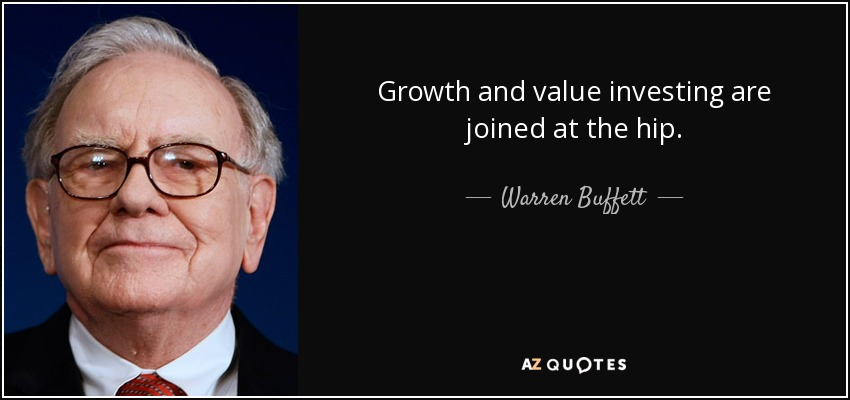
Of course, the market doesn’t give away great companies for free, or even cheap.
Investors are constantly on the hunt for such companies, driving up share prices, and making it nearly impossible to find them at a bargain price.
Put simply, a great company is rarely cheap.
That’s why Munger advised looking for “fair prices” vs. “wonderful prices.”
But what makes a price “fair”?
There are many ways to value a stock. But as a shortcut, look for a company that trades at an average valuation vs. its peers, while growing faster than the market. All else equal, these businesses are well-positioned for future profits, and for share-price gains.
Of course, not everyone has the time, or the desire, to comb through a business’s financials to find fair prices.
Fortunately, there are a couple of simple shortcuts you can take.
2 One-Click Ways to Buy the Market’s Biggest Moats
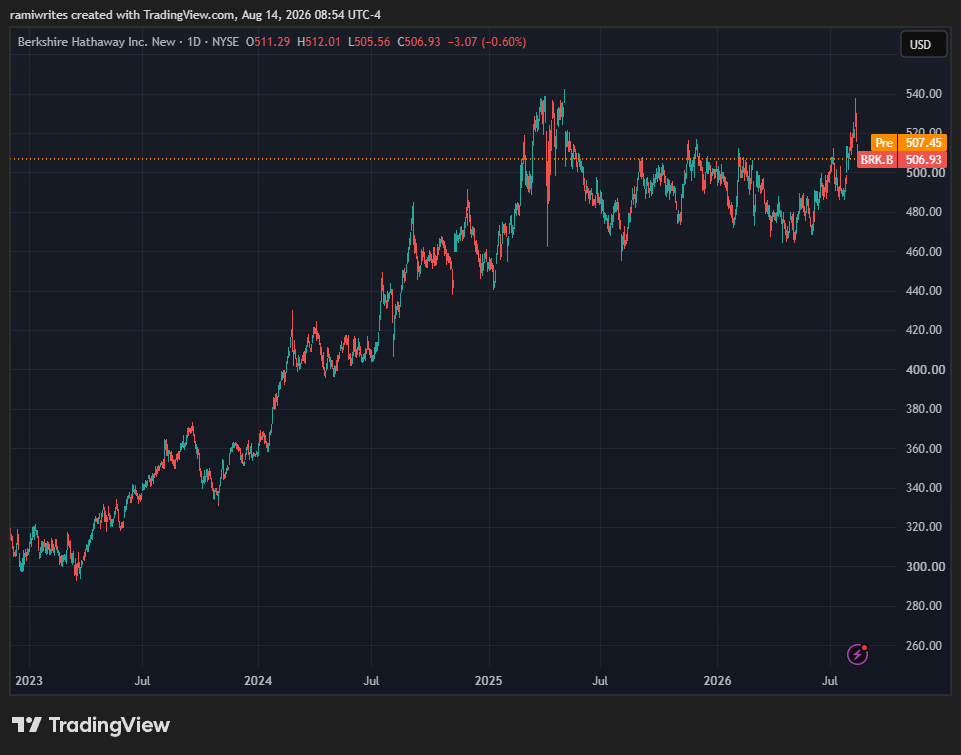
The obvious way to piggyback off Berkshire Hathaway’s success is by owning BRK.B shares in your portfolio. And that’s certainly a valid option. But it’s not the only one.
The VanEck Morningstar Wide Moat ETF (MOAT) aims to invest in attractively priced companies with sustainable competitive advantages (moats), as determined by Morningstar’s equity research team.
Both investments offer great ways to tap in to Charlie Munger’s wisdom: the surest way to build steady wealth over time is by buying businesses with strong moats at fair prices.
That was Frank Curzio.
Munger’s rule is simple. Applying it every week is the work.
“Wonderful businesses at fair prices” is the whole game. The hard part is doing it consistently: spotting the real moats, judging the price, and knowing when to move.
And this week showed why it matters. A record quarter from Applied Materials got sold, and a record market flinched at one weak consumer number. The rally has stopped paying any price for any story.
That’s what Frank does. With more than 30 years in the markets, he does the digging for you inside Curzio Alpha and hands you:
Every trend he’s researching.
Every opportunity he’s excited about.
Every position he’s taking.
No upsells. No maze of memberships. One hub, built to help you buy great businesses at fair prices with more clarity and conviction.
Get instant access to Curzio Alpha →
Paid partner placement from Curzio Research. The views and claims above are Frank Curzio’s and Curzio Research’s, not Future Finance research or advice. As always, do your own diligence.
💭 Today’s Final Thought
Five issues this week, five mornings of data, and the story changed one last time on the way out.
Monday the market feared a rate hike. Thursday it had a record. This morning, the consumer pulled back for the first time all summer.
Two numbers now define where things stand.
5.216%: what America pays to borrow for 30 years, the most since 2001.
Minus 0.6%: what shoppers did in July, in the same month the job market shrank.
Cheap money and a spending consumer built this rally. The first held this week. The second just wobbled.
Watch how stocks trade this number today. A market that rallies on it is still playing the Fed game. A market that sells it has started playing the recession game. That reaction is the most useful information you’ll get all day.
The hike argument ended this week. The growth argument opened this morning. Position for the second one now.
Editor in Chief | Future Finance
One Subscription. The Entire Gems Uncovered Research Library.

You just read why the surface of the news rarely tells the whole story.
Gems Uncovered is built on that same principle. It’s our weekly research briefing on early-stage assets and native market access, the opportunities that build real wealth before they ever reach a mainstream exchange.
One level beneath the headlines is where the edge lives.
Disclaimer: This content is not financial advice, it is for informational purposes only. All investments involve inherent risk. Any financial decisions you make are solely your responsibility.
Latest
.avif)
.avif)
.avif)
.avif)
Editor's Picks


Become a sharper capital allocator in 5 minutes a day.
Institutional-grade research on where the smartest capital is positioning, across AI, energy, biotech, robotics, and digital assets. Distilled into a daily read you finish before your coffee does.
Join 45,000+ readers · No spam · Unsubscribe anytime