
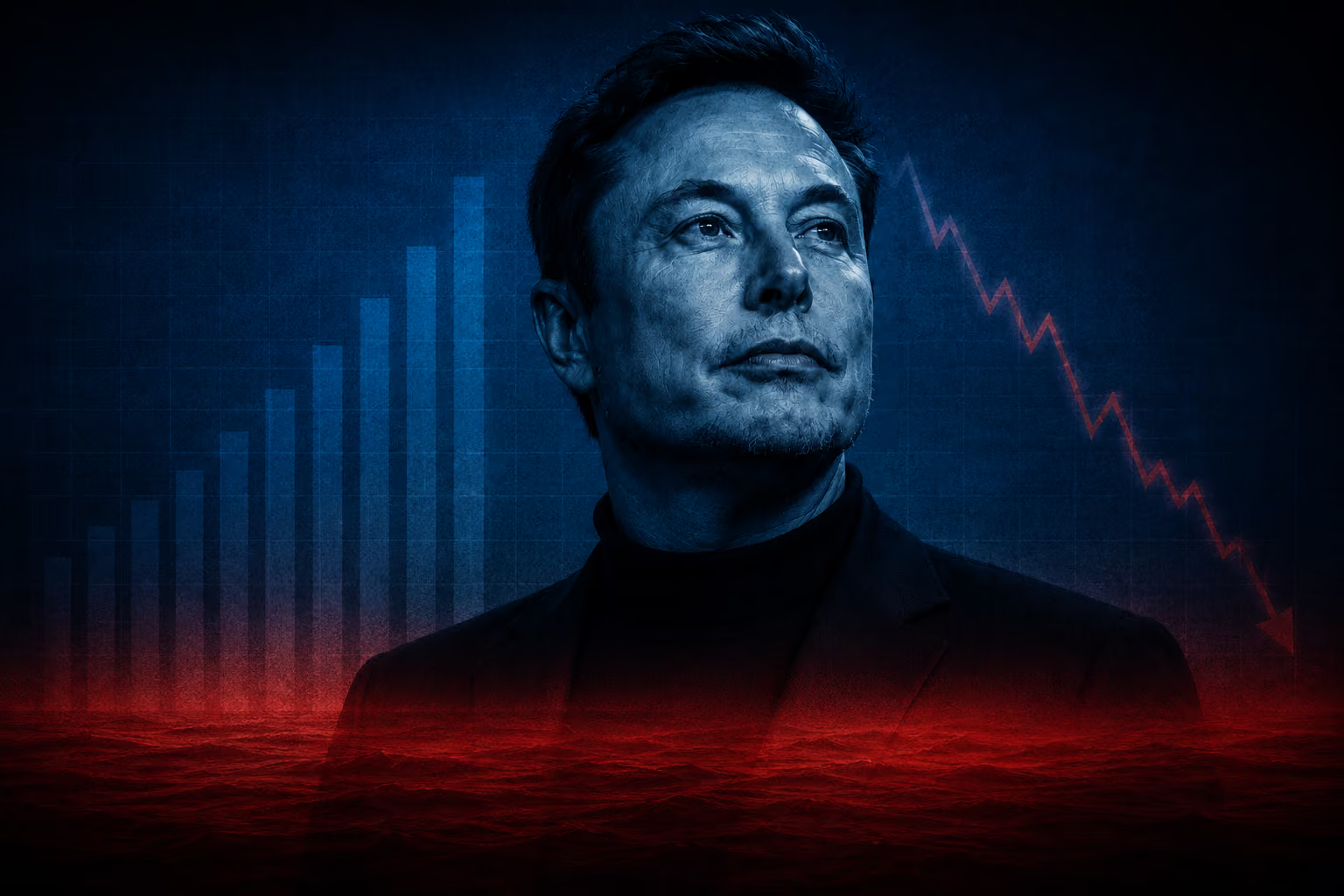
A good quarter just killed Tesla's stock.
Tesla's best quarter in a year. Stock dropped 3.6%.
April 24, 2026
·
10 min read



The briefing serious investors read first.
Free analysis before markets open. Start thinking in decades, not days.
Join 45,000+ readers · No spam · Unsubscribe anytime
Before we begin: this report is for education, not financial advice. Nothing here is a recommendation to buy or sell any stock, company, or asset, and we make no price predictions. Investing carries risk, including loss. Please read the full disclaimer at the end.
📊 Today’s Big Picture
Wednesday at 4:05pm Eastern, Tesla dropped its quarterly earnings.
- Revenue: beat.
- Profit per share: beat.
- Auto margins: beat.
By 4:15pm, the stock was up 4% in after-hours trading.
Then the earnings call started.
By the next morning, the stock was down 3.59% - a full 7-point swing from 90 minutes earlier.
Nothing in the numbers changed. The quarter that was good at 4:05 was still good Thursday.
What changed was what Elon Musk told investors the company is becoming.
But here’s what everyone is missing in the headlines…
This wasn’t a bad earnings report. It was a good earnings report from a company telling you it’s not going to be the same company anymore.
Today: the number that moved the stock wasn’t on the income statement - and what it tells you about how to read any earnings report…
🔍 Signal vs. Noise
Tesla’s Quarter That “Beat” Three Times Over

Here’s what the press releases led with Wednesday evening:
- Revenue: $22.4 billion, up 16% year-over-year
- Adjusted earnings per share: $0.41 vs. $0.37 expected
- Automotive gross margin excluding credits: 19.2%, up from 12.9% a year ago
- Free cash flow: +$1.44 billion vs. an expected loss
On the face of it, this is a blowout quarter. Three beats, a margin expansion of 630 basis points, and a return to positive cash generation.
And to be fair: the core car business is running better than it was last year. Auto margins are improving.
But here’s the thing a beginner reader needs to know about earnings reports.
The headline number is not the story.
The conference call is the story.
The headline number is what the financial quarter that just ended looked like.
The call is what the quarter that hasn’t started yet is going to look like - and in Tesla’s case, what the next several years are going to look like.
The noise:
Revenue beat. EPS beat. Margin beat. Free cash flow beat. The stock popped 4% in after-hours.
All of that was public by 4:15pm Wednesday.

The signal:
Now here’s what came out on the call.
- Capital expenditure for 2026: raised from $20 billion to over $25 billion. For reference, Tesla spent $8.6 billion on capex in all of 2025. Tesla is about to triple its annual spending.
- Free cash flow will be negative for the rest of 2026. The CFO said this directly. The $1.44 billion of FCF you just saw in Q1? Gone, and then some, for the next nine months.
- Hardware 3 vehicles cannot achieve Unsupervised Full Self-Driving. This is the first time Tesla has admitted this. Millions of existing Teslas will need retrofits. Tesla is building facilities for that. It’s a cost, not a revenue.
- A new project called Terafab - a $3 billion AI chip research facility at Giga Texas, built in partnership with Intel.
- Musk described Optimus - Tesla’s humanoid robot - as “probably the biggest product in the world in general.”

This is not a car company posting good quarterly numbers.
This is a car company telling you it’s done being a car company.
It’s becoming an AI and robotics platform that happens to also sell cars. And to get there, it’s going to spend triple its historical capex budget and generate negative cash flow for most of a year.
That’s a different investment thesis.
That’s a different company.
A good quarter can reveal the beginning of a worse period - and markets figure that out faster than headlines do.
The stock lost the whole beat by Thursday afternoon. Wall Street got the signal. The press release was the noise.
Free Strategy Call
Built for Every Market
As we just showed you, m ost portfolios work until the cycle turns. But inside our Mastermind, members stress-test before the weather changes. They don't predict. They prepare.
Book a Strategy Call Right Here📰 From Around the Market
Every issue, we bring you the most important stories from around the world and show you why they matter. Think of this as your shortcut through the noise - one click per story, and you’re caught up.

Intel just hit an all-time high.
Thursday after the close, a company most people had written off as a relic posted earnings that beat revenue expectations by over a billion dollars - and sent the stock to a price it hasn’t seen since the dot-com era. There’s a specific reason it happened this week, and it ties directly back to Wednesday’s biggest story in a way almost nobody is covering.
The airline that just cut its full-year profit forecast in half.
One US airline reported earnings Thursday and quietly slashed its 2026 earnings guidance from a range that started at $1.70 down to a range that now starts with a negative number. The reason is a line item showing up in every earnings report this week - and it’s the clearest sign yet that the war has moved from the oil chart to the corporate income statement.
A quiet diplomatic win nobody’s talking about.
Three different ambassadors walked into the Oval Office Thursday afternoon. 90 minutes later, Trump posted that a ceasefire set to expire Sunday would be extended for three weeks. This isn’t the Iran deal - it’s the other Middle East ceasefire - and it might be the single most underrated market-moving story of the week.
The nuclear IPO that priced 21% above its range.
An Amazon-backed reactor company was supposed to price at $16 to $19 a share. Thursday night, investors asked for so many shares that underwriters upsized the deal and priced it above the top. The company’s name is a single letter, and its listing today will tell you more about the market’s appetite for AI-linked nuclear than any analyst note could.
👀 What to Watch For
The Fed meeting - next Tuesday and Wednesday, April 28-29
This is the first FOMC meeting since the Iran war started, and markets are now pricing a 99% probability that the Fed holds rates steady. The reason is Thursday’s Flash PMI data, which showed US services and manufacturing both expanding but with output prices hitting a 44-month high - the highest since July 2022. The S&P Global chief economist called it “the most worrying inflation picture for almost four years.” Watch for Powell’s press conference Wednesday afternoon for any signal on whether the Fed sees the oil-driven price spike as a one-off or as a regime change.
Mag-7 earnings start Tuesday
Alphabet reports Tuesday AMC. Meta, Microsoft, and Amazon all report next week. After Tesla’s capex pivot and Intel’s blowout, the question every report will have to answer is the same one: how much are you spending on AI, and when does it turn into revenue? Given that these four alone account for roughly 35% of the Nasdaq by weight, their collective answer will set the tone for the market through May.
Oil at $105 Brent
Every day the Strait of Hormuz stays partially shut and Iran keeps collecting transit tolls on friendly shipping, the oil price stays elevated. Brent broke through $105 Friday morning - up roughly 5.5% from Tuesday’s close, and the highest level since the war started. If this holds through the weekend, expect it in every earnings call and every CPI print for the next month.
💭 Today’s Final Thought
The biggest moments in a company's history almost never show up on the income statement.
They show up on the conference call.
The income statement is always describing a period that just ended. By the time it's printed, the company has already moved on. The management team is already building the next thing, making the next bet, spending the next dollar toward a business that doesn't exist yet.
That's why a good quarter can crash a stock. And why a bad quarter can launch one.
What Tesla reported Wednesday afternoon was a good quarter.
What Tesla told investors on the call was that the next several quarters are going to look different. Harder. Cash-flow negative. Priced on a narrative about robots and AI chips rather than a spreadsheet about cars.
- The market heard both.
- The market priced both.
By Thursday afternoon, the 4% pop was gone and the stock was down 3.59% on the day. Nothing on the income statement had changed.
You don't need to know whether Tesla's pivot works. You don't even need an opinion on it.
You need to notice when a story you're holding has just quietly become a different story.
That's the skill.
Everything else is noise.
See you Monday.
- Rami Al-Sabeq (Editor in Chief | Future Finance)
Gems Uncovered
Go Deeper With Gems Uncovered
Most investors see one layer of the market. The opportunities that build real wealth live beneath it. Gems Uncovered is our monthly research briefing on early-stage assets, native market access, and high-conviction plays before they surface on mainst
Subscribe to Gems Uncovered →Disclaimer: This content is not financial advice, it is for informational purposes only. All investments involve inherent risk. Any financial decisions you make are solely your responsibility.




Editor's Pick

Become a sharper capital allocator in 5 minutes a day.
Institutional-grade research on where the smartest capital is positioning, across AI, energy, biotech, robotics, and digital assets. Distilled into a daily read you finish before your coffee does.
Join 45,000+ readers · No spam · Unsubscribe anytime