.svg)
The 72-Hour Reversal
.avif)
TODAY'S BIG PICTURE
Saturday night, the Islamabad peace talks collapsed and Trump announced a naval blockade of the Strait of Hormuz.
Oil spiked past $104. Equity futures cratered. Bitcoin (BTC) dropped to $71,000.
Every headline screamed escalation.
Less than 72 hours later, here's where we are:
- The S&P (INDEX: SP500) closed yesterday at 6,967 - erasing every point lost since the war began February 28
- Oil crashed from $104 to $92 in 36 hours
- Bitcoin surged to $74,800 - a four-week high
- March PPI (a key measure of wholesale inflation) came in at +0.5% - half the expected +1.1%
What happened?
Three things. Trump said “we’ve been called by the other side” - signaling Iran reached out to resume negotiations.
PPI printed dramatically cooler than expected, easing fears that the Fed would need to keep interest rates high indefinitely.
And bank earnings came in strong across the board, with JPMorgan posting record trading revenue of $11.6 billion.
But here’s what everyone is missing in the headlines…
The story this week isn’t the blockade. It isn’t the recovery.
It’s the whiplash itself.
Today, we’re discussing how we’re positioning ourselves for a market that can reverse completely in a single headline…

SIGNAL VS. NOISE
“Digital Gold Is Dead”
During this week’s chaos, people had a moment dunking on Bitcoin.
You probably saw the headlines…
- Gold above $4,700
- Bitcoin down 44% from its October peak of $126,200
- BTC-to-gold ratio collapsed from 40 ounces in 2025 to roughly 15
.avif)
Half of financial Twitter spent the weekend writing Bitcoin’s obituary.
Then BTC rallied 6% in two days while gold barely moved.
But I’m not dunking on gold either. I’m here to level with you.
Both sides of this debate are being dishonest about timeframe.
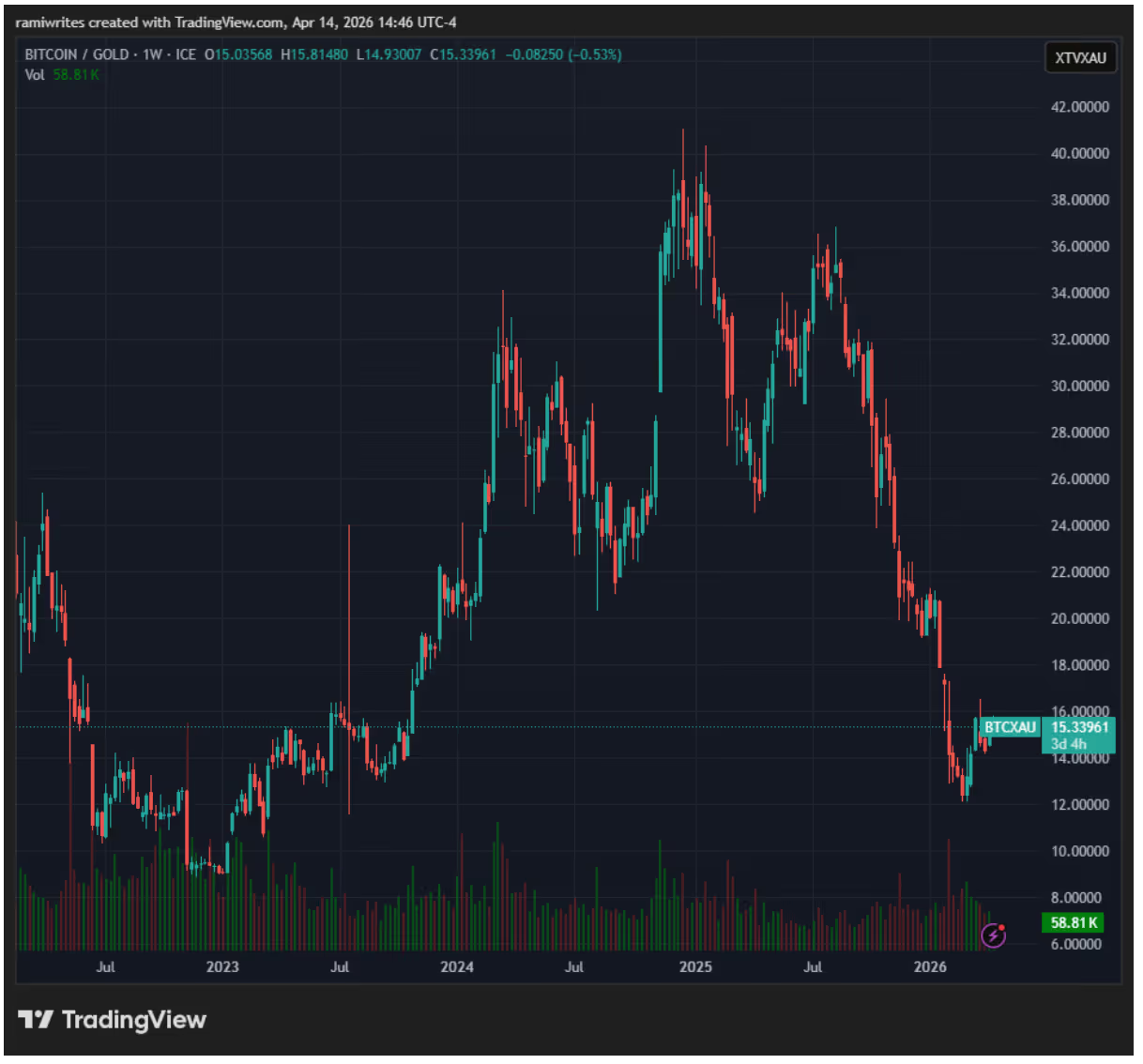
The Noise:
A 2020 Bitcoin buyer at $10,000 is up roughly 600% versus gold’s 165% over the same period. But a January 2025 buyer is underwater on both.
Whether Bitcoin “failed” as a store of value depends entirely on when you bought it . Neither side is being upfront about that.
The same timeframe problem shows up in ETF data.
Headlines show $4.5 billion in Bitcoin ETF outflows this year. But that lacks context.
When you look at the reports institutions are required to file every quarter - showing exactly what they owned - the picture looks completely different:
- BlackRock grew its Bitcoin ETF (NASDAQ: IBIT) holdings by 328%
- Morgan Stanley (NYSE: MS) nearly tripled its share count
- The outflows are mostly hedge funds closing out a specific short-term trading strategy that stopped being profitable - not long-term investors leaving
- Weekly crypto ETF inflows just hit a 4-month high at $1.1 billion
- Year-to-date Bitcoin ETF flows have now turned positive
That’s repositioning. Not abandoning.
.avif)
The Signal:
Bitcoin is trading like a risk asset right now. That’s a fact, not a failure.
The dominant holders in 2026 are institutions grouping it alongside stocks in their portfolios.
So when fear spikes, they sell it with stocks. When fear subsides, it bounces with stocks too. That’s exactly what happened this week.
Meanwhile, the stuff that actually compounds keeps compounding:
- Strategy (NASDAQ: MSTR) (formerly MicroStrategy - a publicly traded company that has made Bitcoin its core treasury asset) bought another $1 billion in Bitcoin this week - 780,897 BTC total
- Oil futures on Hyperliquid - a decentralized trading platform that runs on blockchain - crossed $1 billion in activity this weekend.
The noise gets louder. The infrastructure keeps building.
I know which side I’m paying attention to.

ABN PRINCIPLE IN PRACTICE
The Real-Time Argument for All-Weather Thinking
This week is the most clear illustration of All-Weather thinking we’ve seen in months.
- Early last week: the S&P rallied 3.6% on ceasefire optimism. Oil dropped below $100. It felt like the worst was over.
- Saturday night: peace talks collapsed. Blockade announced. Oil spiked to $104. Bitcoin dropped to $71K.
- By Monday close: Trump signaled Iran called. The S&P swung 96 points in a single day and erased all war losses.
- By Tuesday close: PPI came in cool. Bank earnings crushed. S&P closed at 6,972 - less than 1% from its 52-week high.
Seven days. Three completely different realities.
.avif)
If you were positioned for one scenario - “the ceasefire holds,” “the war escalates,” or “the recovery is real” - you were right at some point this week and wrong at another.
That’s fragile positioning.
The All-Weather approach - the A in our ABN framework - asks a different question: what structure holds up regardless of the scenario?
Look at investors who spread their capital across different types of assets that don’t all move in the same direction…
- Some benefiting from inflation (gold, commodities)
- Some from deflation (high-quality bonds)
- Some from growth (equities, crypto)
- Some generating yield regardless of direction
They didn’t need to predict the Islamabad outcome or the Monday reversal or the PPI surprise.
They didn’t need to be right about anything.
Their structure absorbed all three pivots.
That’s not a magic trick. It’s a design decision you make before the volatility shows up.
This is exactly the kind of thinking our team built the ABN System around. If you’re curious about how our members apply All-Weather portfolio construction in practice, that’s what we cover inside Decentralized Masters.
AROUND THE MARKET
Every issue, we bring you the most important stories from around the world and show you why they matter. Think of this as your shortcut through the noise - one click per story, and you’re caught up.
.avif)
Strategy only needs 2% annual Bitcoin appreciation to cover all preferred stock dividends. The financial model behind the biggest accumulation machine in crypto - and why it matters even if you never buy their stock.
Japan proposed putting crypto on equal footing with stocks.
105 cryptocurrencies. A proposed flat 20% tax. An insider trading ban. The FSA submitted a bill to the Diet on April 10 that would reclassify crypto as a financial instrument - equivalent to stocks and bonds. It still needs to pass, but the direction is unmistakable.
HSBC issuing stablecoins? Read that again.
Hong Kong granted its first stablecoin licenses - to HSBC (NYSE: HSBC) and a joint venture backed by Standard Chartered (LON: STAN). HSBC plans to launch a stablecoin in H2 2026 and integrate it into apps with millions of users. When legacy banks start building the thing they spent years dismissing, pay attention.
The Fed’s permission slip to do nothing.
March wholesale prices rose just 0.5% - versus the 1.1% Wall Street expected. When you strip out energy (which spiked because of the war), producer prices barely budged. The Fed just got a data point that makes doing nothing a lot easier to defend.
JPMorgan’s traders are on fire.
$11.6 billion in total trading revenue. Fixed income up 21%. Investment banking fees up 28%. The flip side: NII guidance was cut, and Jamie Dimon warned of “an increasingly complex set of risks.” The war is good for trading desks and bad for everything else.
WHAT TO WATCH FOR
• Big Bank Earnings Today (April 15)
JPMorgan (NYSE: JPM) and Citi (NYSE: C) crushed it. Goldman’s (NYSE: GS) equities desk hit a record. Wells Fargo (NYSE: WFC) was the weak link (revenue missed). BofA (NYSE: BAC) and Morgan Stanley complete the picture - watch for guidance on how much banks expect to earn from lending and any commentary on crypto.
.avif)
- China Q1 GDP - Thursday, April 16
Consensus is 4.8% YoY. A miss below 4.5% reignites global growth fears. A beat provides rare good news for risk assets at a moment when markets are desperate for it.
- Hormuz diplomatic signals
Both sides have indicated willingness for a second round of talks. France and the UK are planning a Friday summit on restoring Strait navigation. Oil’s $12 crash priced in progress - any breakdown sends it right back to $104.
- US tax filing deadline
Expect some selling pressure as investors cover 2024–2025 gains. Historically a short-term drag that reverses within days.
Today’s Final Thought
Here’s what this week proved. Not suggested. Proved.
The people who panicked Saturday night and sold into Sunday’s fear missed a 6% Bitcoin rally and the S&P’s full recovery by Tuesday. The people who went all-in on the recovery Monday morning are now exposed if the next headline is “talks collapse again.”
The people who did nothing - because their structure was built for exactly this kind of week - are exactly where they were seven days ago.
That’s the best outcome in a week like this one.
Chaos and construction, happening simultaneously. The trick is knowing which one to react to - and which one to simply watch.
See you soon.
— Rami Al-Sabeq
Editor in Chief | Future Finance
Get Ahead Of The Crowd
Most investors see one layer of the market. The opportunities that build real wealth live beneath it. Gems Uncovered is our monthly research briefing on early-stage assets, native market access, and high-conviction plays before they surface on mainstream exchanges.
Subscribe to Future Finance Free.
Built for investors who value clarity.