.svg)
When Prices Know More Than Headlines
.avif)
TODAY'S BIG PICTURE
Tuesday night at 7:15pm Eastern (45 minutes before the ceasefire deadline) Trump posted that he was extending it indefinitely.
Stock futures ripped higher overnight.
Risk-on, again.
But between that post and Wednesday morning, two ships were shot at in the Strait of Hormuz. The US naval blockade is still in place. Iran’s negotiating team has refused to attend talks in Islamabad. The IRGC has threatened “crushing and unimaginable blows.”
And Brent crude, the global oil benchmark, is still above $100 - up about 4.5% since Monday.
Those are the headlines. Here’s what everyone is missing…
This is the third Iran relief rally in two weeks.
Each one has been priced, unwound, then priced again.
Today, we’ll show you why prices keep telling a different story than the announcements…
And why that gap is the most valuable thing you can watch right now…
.avif)
SIGNAL VS. NOISE
The “Peace” Deal
Last night’s headlines:
- Ceasefire extended indefinitely
- Trump cites Pakistan PM’s request
- Stock futures pop overnight
- Oil “retreats” from the $100 line
- “De-escalation,” says every cable chyron
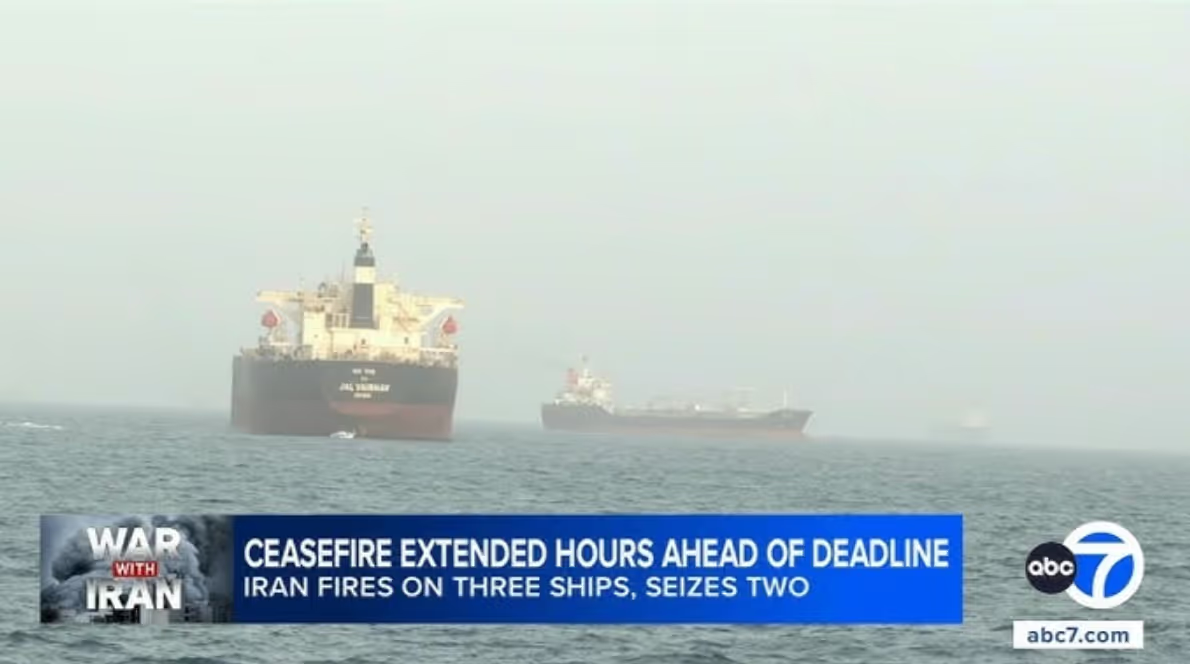
On the surface - and this is how most retail investors will read it - the war is getting managed. The worst-case scenario is off the table. Time to be risk-on again.
To be fair: the immediate risk of US bombers flying into Iranian airspace on Tuesday night did evaporate. That’s real.
But the ceasefire extension is a pause on shooting between the US and Iran.
- It’s not a ceasefire between Iran and shipping in the Strait of Hormuz.
- It’s not a lifting of the US naval blockade.
- It’s not a diplomatic deal, a sanctions release, or an agreement on anything Iran has demanded - the return of lifted sanctions, the end of the blockade, the inclusion of Lebanon in the truce.
Iran’s own foreign minister is calling the blockade “an act of war.”
The adviser to Iran’s Speaker of Parliament - a hardliner - called the extension “time to deliver a surprise strike.”
This is what a ceasefire extension looks like when both sides use it to regroup instead of resolving.
The Noise:
Stock futures +0.5% overnight. CNBC headlines saying “oil retreats.”
The Nasdaq (INDEX: NASDAQ) trying to bounce back after breaking its 13-day winning streak on Monday. Short-sellers closing positions on the relief trade.
All of it based on one Truth Social post from Tuesday night.
The Signal:
Now look at what the markets that trade on actual supply and demand are doing.
- Brent crude: $101.93. Up roughly 4.5% since Monday. Touched $114 intraday Tuesday - the first time above that line since the war started.
- WTI crude: $95.12. Still up on the week despite the “extension rally.”
- Gold: $4,734 an ounce. Holding near all-time highs, barely moved on the extension news.
- US 10-year Treasury yield: 4.29%. Up about 5 basis points since Monday. Bonds selling off, which is what happens when big money thinks inflation is coming back, or that the Fed’s hands are tied.
- Only 12 ships crossed the Strait of Hormuz in the 24 hours into Tuesday. The normal count is about 70.
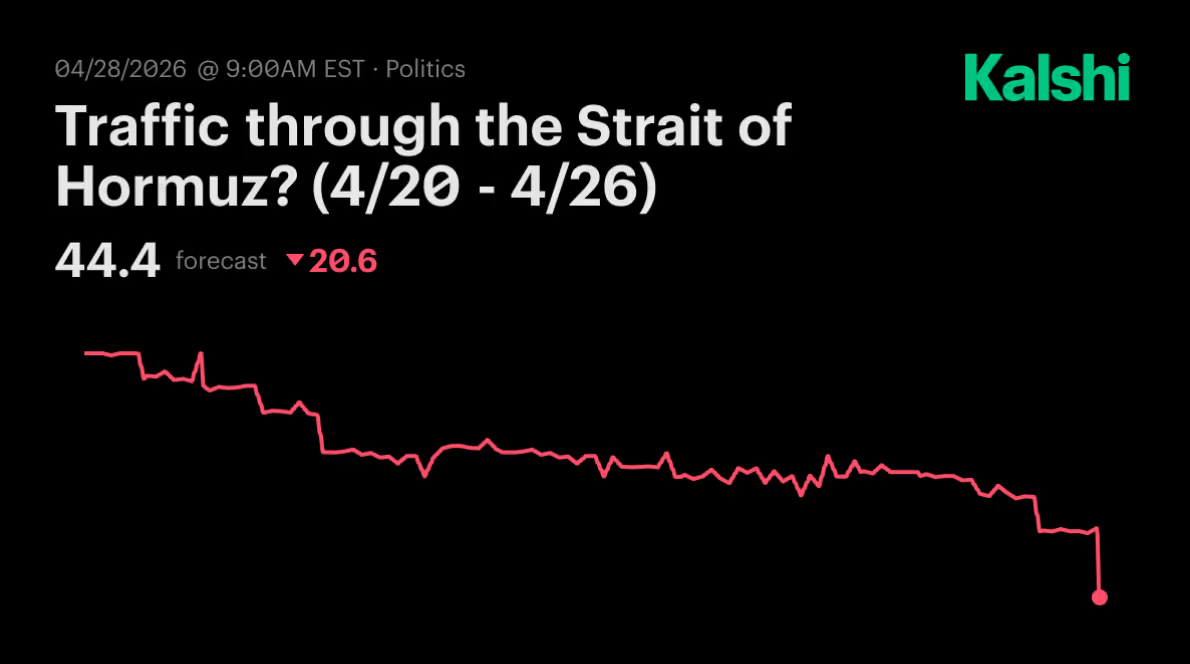
These prices don’t care about press conferences.
They care about what’s actually moving through the water.
And what’s moving through the water is: almost nothing.
What’s not moving: a blockade. What’s still happening: ships getting fired on. What’s still in effect: a war where Iran has been losing chokepoint control to the US Navy for eight straight days.
The prices are telling you the truth. The announcements are telling you the plan.
When those two things disagree, the prices win. Every time.

ABN PRINCIPLE IN PRACTICE
You Don’t Need to Be Right. Just Ready.
This is now the third time in two weeks that markets have priced an Iran relief rally:
- Friday April 17: Iran’s foreign minister tweeted Hormuz was “completely open.” Oil crashed 11%, the S&P hit a record 7,126, Nasdaq extended its 13-day streak.
- Monday April 20: The weekend reversal erased about half of it. The Nasdaq streak broke.
- Tuesday April 21 evening: Trump extended the ceasefire. Futures popped again overnight.
-
Three relief rallies. Three reversals or pauses.
Same story each time - headline, pop, reality, pare.
If you’re positioning your portfolio to catch each one, you’re paying transaction costs three times and you’re getting chopped up.
If you’re positioning your portfolio to catch the resolution of the crisis, you’re making one of three bets - escalation, stalemate, or breakdown - and hoping you got it right.
Neither of those is what the ABN framework asks you to do.
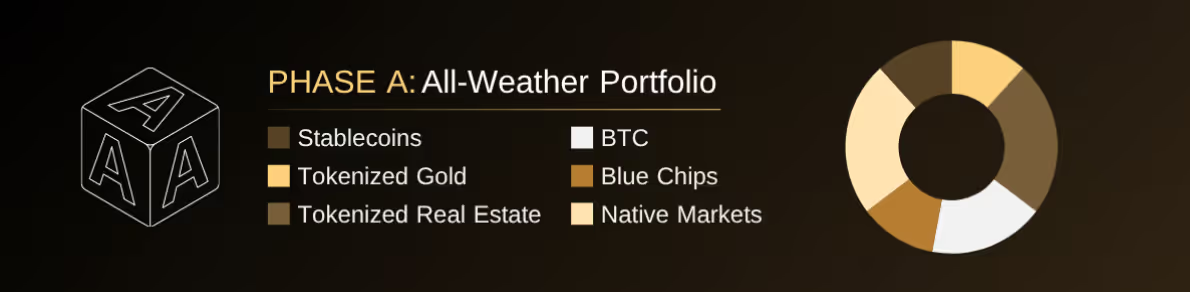
The “A” in ABN - All-Weather - doesn’t try to predict the headline. It tries to build a structure that doesn’t care about the headline.
- Some assets that rise when the war escalates.
- Some that rise when the war resolves.
- Some that rise regardless of either, because they’re tied to longer, deeper trends that don’t depend on which way Tuesday night breaks.
What does that actually look like in practice?
It means owning gold - which is holding $4,800 right now whether the ceasefire extends, breaks, or does anything in between.
It means owning energy exposure - which has been the single best-performing sector of the past three weeks, regardless of which relief rally you traded or missed.
It means owning Bitcoin (BTC) - which institutions bought $238 million worth of on Monday alone through ETFs, the fifth straight day of inflows, while retail was busy panicking about the weekend.
It means owning quality equities and duration-appropriate bonds - the boring stuff that pays you to be patient.
And most of all, it means accepting something uncomfortable: you will not catch every rally, and you will not dodge every selloff.
That’s the price of a structure that survives regardless of which headline lands.
BUILT FOR EVERY MARKET
As we just showed you, most portfolios work until the cycle turns. But inside our Mastermind, members stress-test before the weather changes. They don’t predict. They prepare.
Book a Strategy Call Right Here
FROM AROUND THE MARKET
Every issue, we bring you the most important stories from around the world and show you why they matter. Think of this as your shortcut through the noise - one click per story, and you’re caught up
The company that just bought $2.54 billion of Bitcoin at the lows.
Strategy (NASDAQ: MSTR) - the Michael Saylor-run corporation that has essentially converted itself into a Bitcoin holding company - bought 34,164 Bitcoin last week for $2.54 billion at an average price of $74,395. That’s the third-largest weekly purchase in the company’s history, and they did it on the exact week retail investors were panicking. Total holdings now: 815,061 Bitcoin. Worth paying attention to who’s buying when prices are falling.
TThe wealthiest Fed chair nominee ever - and he may never get the job.
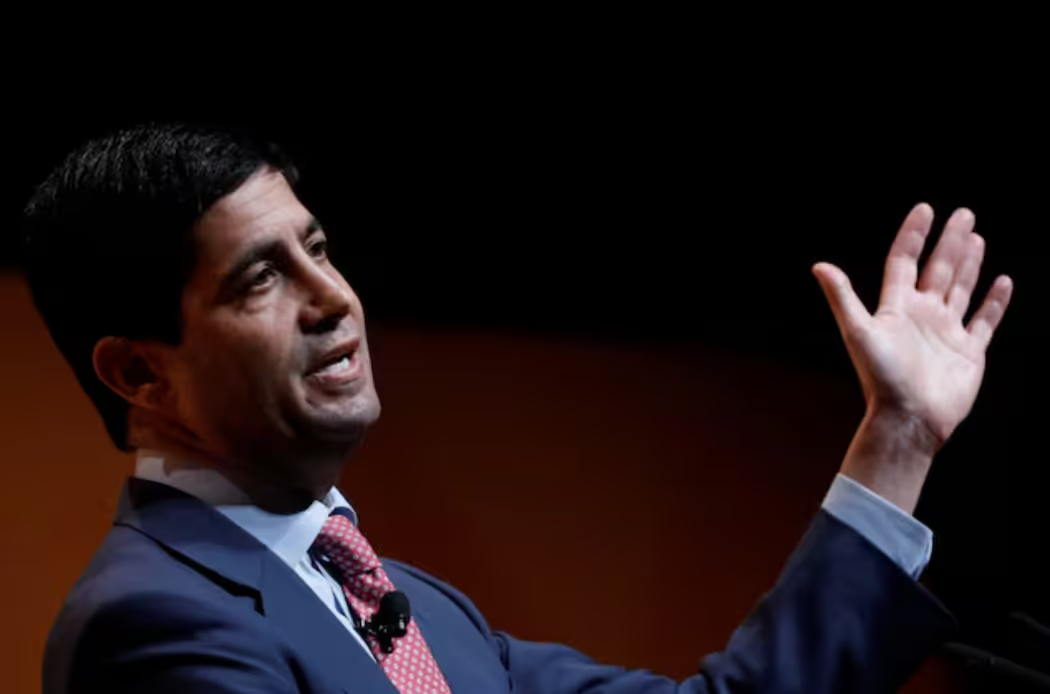
Kevin Warsh testified before the Senate on Tuesday. Highlights: he called for “regime change” in Fed policy, didn’t rule out cutting rates to 1%, and when asked if digital assets should be part of the financial system, he said “yes.” But Senator Thom Tillis (R-NC) refused to ask him a single policy question - he used his five minutes to demand the DOJ drop its investigation of Jerome Powell before he’d support the nomination. Math: without Tillis, Warsh can’t clear committee. Practical meaning: Warsh almost certainly won’t be confirmed before May 15, when Powell’s term as chair officially ends.
The Apple CEO era is ending. Calendar it.
Tim Cook - who has run Apple (NASDAQ: AAPL) since 2011 and turned it into the world’s most valuable company - will step down on September 1, 2026. His successor: John Ternus, current COO, who runs hardware engineering. Apple stock dropped 2.5% on the news. Worth watching how the market re-prices a $4 trillion company whose identity has been Cook’s for 15 years.
The Amazon-backed reactor IPO that prices Thursday.
X-Energy - the small-modular-reactor company Amazon (NASDAQ: AMZN) backed with a $500 million investment and a 5-gigawatt power purchase commitment through 2039 - prices its IPO Thursday evening at $16–$19 a share, targeting a $7.5 billion valuation under the ticker XE. Trading debut Friday. Why this matters for anyone holding AI-adjacent stocks: a successful print sets the valuation multiple for every other nuclear company supplying Meta (NASDAQ: META), Microsoft (NASDAQ: MSFT), Google (NASDAQ: GOOG), and the broader AI buildout.
WHAT TO WATCH FOR
Tesla (NASDAQ: TSLA) earnings - today, after market close
Consensus is split wider than almost any company of its size - Wall Street’s highest target is $600, the lowest is $145. The earnings report drops at 4pm Eastern; the call is at 5:30pm. Three things to watch: automotive gross margin excluding regulatory credits (the honest read on whether the core car business is profitable), any mention of “Terafab” (Elon’s new AI compute project), and any concrete update on Cybercab production, which is supposed to begin this month in Texas. The options market is pricing a ~5% move in either direction.
The oil reality check - Thursday morning
At 9:45am Eastern Thursday, the S&P Global Flash PMIs print. The one that matters: Services. Expected at 50.1. Any reading below 50 means the US services economy is actively contracting - combined with oil at $100 and March inflation running 3.3%, that’s the first statistical confirmation of stagflation since the word went out of fashion in 1982.
Consumer sentiment, final - Friday
The preliminary April reading hit 47.6 - an all-time low going back to 1952. Friday’s final reading includes responses from after the ceasefire extension. If it bounces, the collapse was war-driven. If it stays near 47, something structural is breaking underneath.
X-Energy debut - Friday
The nuclear IPO that sets the sector multiple.
Today’s Final Thought
Markets are a voting machine in the short term and a weighing machine in the long term.
That’s a famous line - almost 100 years old now - and it shows up every single time we have a week like this.
The voting part is the tweets. The relief rallies. The “extension indefinitely.” The Nasdaq streaks. The headlines.
The weighing part is slower.
It’s what Brent crude is doing. What gold is doing. What the 10-year yield is doing. How many ships actually crossed the Strait of Hormuz in the last 24 hours. Whether a blockade is lifted or just repackaged as a ceasefire extension.
One of those is easy to watch.
The other actually tells you what’s happening.
Three relief rallies in two weeks is the voting machine going through its cycles.
Oil at $100, a blockade still in place, and two ships shot at overnight is the weighing machine - reminding you that none of the votes have actually changed the underlying reality.
You don’t need to predict how the ceasefire extension ends.
You need to notice which side is telling you the truth.
See you Friday.
Editor in Chief | Future Finance
Go Deeper
Most investors see one layer of the market. The opportunities that build real wealth live beneath it. Gems Uncovered is our monthly research briefing on early-stage assets, native market access, and high-conviction plays before they surface on mainstream exchanges.
Subscribe to Future Finance Free.
Built for investors who value clarity.